 |
Shinese |
|
He is not recognized by the F.C.I. |
Origin |
Tibet <> China -> U.S.A. | |
Translation |
Francis Vandersteen | |
This breed is also known as |
Peke-A-Tzu
|
A brief presentation of the Shinese |
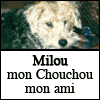
| The Shinese is a hybrid of the Shih Tzu and the Pekingese. Small dogs, the Shinese generally weighs less than 7 kilos and measures up to 33 centimeters. The Shinese is a playful dog with lots of energy and a desire to protect its humans; it will bark at the approach of strangers or if they cross its path, alerting you to their presence. Hybrids tend to be stubborn, and training will be needed to establish who's boss. You can expect the Shinese to behave well with children and other pets, although supervision is necessary to ensure its safety with larger animals and young children. |
History of the Shinese |
| The Shinese is a relatively recent hybrid, although the two breeds that make up the hybrid have a long history. |
A little of the Shih Tzu |
||
| Genetic tests have proven that the Shih Tzu is one of the oldest breeds in existence. The breed is thought to have originated in Tibet, where it was raised by Tibetan llamas as a miniature lion. The breed served as a companion and guard dog for monks in lamaseries. Many myths surrounded these little dogs; one belief was that they were incarnations of the household gods. Another belief was that they sheltered the souls of lamas who had not reached nirvana. The dogs were given by the lamas to the Chinese rulers as tribute, and the Chinese imperial court gave them the name Shih Tzu, meaning "little lion" or "lion-dog". As some of these dogs had been given to people outside China, the breed was able to perpetuate itself after the end of the imperial reign. Some of the dogs were brought to England; all modern Shih Tzus are descended from just 14 dogs. The breed was recognized by the American Kennel Club in 1969. | ||
 |
||
| Standard of the Shih Tzu |
A little of the Pekingese |
| Legend has it that the Pekingese is the result of a love affair between a lion and a marmoset. Dogs were believed to have mystical powers that offered protection to palaces and temples. Initially, dogs belonged only to royalty and even had their own servants. When a human died, the dog was euthanized and buried with him to join him in the afterlife. Dogs were not allowed to leave the palace until they were discovered during the Opium Wars of 1860, when five Pekingese were found during an invasion of the imperial summer palace. These dogs were brought to Britain, and one was presented to Queen Victoria. These dogs quickly became popular in Britain, but were very expensive due to their rarity. The breed was accepted into the American Kennel Club in 1906. |
 |
| Standard of the Pekingese |
Appearance of the Shinese |
| The Shinese inherits traits from both its parent breeds; as with all mixed breeds, you can expect it to inherit more physical characteristics from either parent breed, or a relatively equal combination of traits from each. The hybrid will be small, weighing less than 7 kilos, with large dark eyes. It will usually have a long mane, a face described as "squashed" or "flat" and a short muzzle. The Shinese's head is generally a little round, and its ears are long and floppy. Most Shinese have small legs and a short, hair-covered tail. |
Temperament of the Shinese |
| The Shinese inherits behavioral traits from its parent breeds, the Shih Tzu and Pekingese. Typically, the Shinese will be very energetic and playful. A hybrid dog will be very loyal to its human family and prefer to be with them; in fact, if it is separated from them for too long, it can become anxious and depressed. It will be protective of its humans and bark to alert them to strangers. This hybrid tends to be wary of new people; early socialization will help him to feel at ease with others. The Shinese appreciates its independence and would rather walk alone than be carried around all the time. Shinese owners say they are lively and easy to train, especially with positive reinforcement. |
Needs and activities of the Shinese |
| The Shinese's activity needs vary according to the dog and the characteristics it has inherited from its parents. The Shinese generally likes to play outside and should be encouraged to do so. Ideally, it should have a fenced-in yard, where it can run and play off-leash. The hybrid will also enjoy walks or jogging on a leash; in fact, the Shinese loves to run. This hybrid can have difficulty with extremely hot temperatures, so care must be taken to ensure that it doesn't overexert itself in very hot weather. When indoors, the Shinese is generally relatively inactive, so it's perfectly suited to an apartment. |
Maintenance of the Shinese |
| The Shinese will have a long, thick coat of fur that requires daily brushing to remove tangles and prevent matting. Professional grooming every two months is recommended to maintain its long, thick coat and make it more manageable. The Shinese's face and eyes should be checked daily to avoid anything that could cause skin irritation. Hybrids shed on average, but frequent brushing will reduce the amount of hair you find in your home. As with all dogs, you'll need to brush your Shinese's teeth two or three times a week to ensure his long-term dental health, and his nails should be trimmed if necessary. |



 English (United Kingdom)

Comments