 |
Silkinese |
|
He is not recognized by the F.C.I. |
Origin |
Australia <> China -> U.S.A. | |
Translation |
Francis Vandersteen |
A brief presentation of the Silkinese |
| The Silkinese is a hybrid of the Australian Silky Terrier and the Pekingese. This toy-sized canine will quickly become the darling of your heart and your life. It's the result of blending two pure breeds of similar size, bred for very similar purposes. The Pekingese is known to have been the favorite companion of the imperial family in China, and non-imperial family members who owned one were liable to the death penalty, while the Australian Silky Terrier was bred strictly as a companion. Unlike many terriers bred in the 1700s and 1800s, the Australian Silky Terrier is the only true toy breed native to Australia. |
History of the Silkinese |
| The Silkinese is a hybrid of the Australian Silky Terrier and the Pekingese. Although there is some information on the hybrid's temperament and appearance, there is no real information on where and when it was developed. We can most likely assume that the hybrid was developed in the USA between the late 1900s and the early 2000s, when interest in mixing purebred dogs for a number of reasons became more popular. That said, let's take a very brief look at the background of parent breeds to find out who and what your Silkinese hybrid can be. The Silkinese hybrid is recognized by the American Canine Hybrid Club, the Dog Breed Registry, the Designer Dog Kennel Club, the Dog Registry of America and the International Designer Canine Registry. |
A little of the Australian Silky Terrier |
||
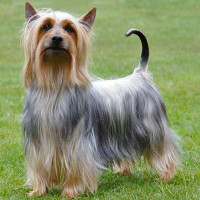
| The Australian Silky Terrier, aka Sidney Silky, is obviously native to Australia and is the only toy breed known to have originated there in the 1800s. Its ancestors are thought to be native Yorkshire Terriers and Australian Terriers. This breed, like the parent breed Pekingese, was developed for companionship and was not commonly used for vermin hunting as most Terriers are, but rest assured and don't let its delicate appearance fool you, it's a real Terrier and quite capable of it. After being introduced to the United States by servicemen returning from World War II, the Australian Silky Terrier was officially recognized by the American Kennel Club in 1959 and is the 100th most popular breed in its registry. | ||
 |
||
| Standard of the Australian Silky Terrier |
A little of the Pekingese |
| The Pekingese parent breed, named after the capital of the time, originated in China (Peking or Beijing) and dates back at least 2,000 years, making it one of the oldest dog breeds on the planet. It was prized and cherished by China's imperial families, and it was illegal for a commoner to own one, as being found in its possession was punishable by death. The breed seems to have been bred purely as a companion, and in those days was so small that royal ladies were said to carry them hidden in the sleeves of their clothes. The breed continues to be appreciated for its companionship and loyalty. It was recognized by the American Kennel Club in 1906 and is the 93rd most popular breed on its register. |
 |
| Standard of the Pekingese |
Appearance of the Silkinese |
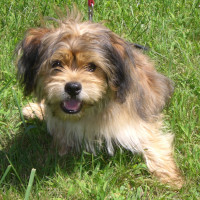
| Your Silkinese hybrid is a mix of Pekingese and Australian Silky Terrier and, as such, may inherit appearance characteristics from either or both of its parent breeds. Breeders and owners of the Silkinese hybrid describe it as measuring between 6 and 25 cm at the shoulders and weighing between 7 and 9 kilos at full maturity. It is described as having a soft, downy, silky coat, which can be long or short, in the most common colors of tan, black and brown. Its tail is downy, of variable length and probably curls over the back. It is longer than it is tall and is quite energetic, its small size enabling it to live well in an apartment or condo. Its dark eyes resemble those of the Pekinese parent, its nose is black and it is likely to have an underbite. His ears may be small, V-shaped, set high and carried erect, or they may be heart-shaped, set more towards the front of the head and falling close to the head. |
Temperament of the Silkinese |
| Your Silkinese hybrid is a mix of Pekingese and Australian Silky Terrier and may inherit personality and temperament traits from one or both parent breeds. Breeders and owners of the Silkinese hybrid describe it as friendly, playful, cheerful, affectionate, intelligent and sometimes independent. They are also described as energetic, courageous and loyal, and are relied on to alert you to the approach of anyone, friend or foe. It's important to start socializing him at an early age to ensure he gets on well with children, the family cat, other dogs and strangers. He's eager to please and intelligent, which makes him fairly easy to train. Its high energy level will require daily management. |
Needs and activities of the Silkinese |
| Your Silkinese hybrid is an active toy dog. He'll need at least an hour or two a day of exercise, whether in the form of the aforementioned walks, playtime in the dog park or fenced yard, interactive games like fetch, Frisbee and agility, and obedience training. It's imperative to keep him on a leash when he's outside, to avoid the danger of having to chase him down the street, through the neighborhood or into the woods as he follows his nose after an interesting scent or small animal that has caught his eye. His small size means he's perfectly suited to life in an apartment or condominium, provided he gets daily exercise. He can also live well in a family home, with or without a fenced yard, in an urban or rural environment. They are best suited to temperate climates, with extra protection and precautions required in extreme temperatures. |
Maintenance of the Silkinese |
| Your Silkinese falls into the moderate category for maintenance and shedding, making it necessary to brush it several times a week, depending on the length of its coat. His coat can be hypoallergenic or not, depending on which parent breed has the most influence in the biological mix, with only the Silky parent providing the hypoallergenic coat trait. His ears will need to be checked weekly and cleaned as required with absorbent cotton and a dog-approved ear cleaning product. While you have him on your lap, where he'll be most of the time, check his ears and nails. Trim them as needed, probably once a month, unless he's able to keep them worn down by his normal exercise activities. He's an active little family companion who will enjoy his daily walks, but not necessarily long ones because he's so small. He is considered to be in the low category for drool and dog odor. It is recommended to brush his teeth at least two to three times a week to avoid the development of periodontal disease and tooth loss. |



 English (United Kingdom)

Comments