
 |
Silky Cairn |
|
He is not recognized by the F.C.I. |
Origin |
Australia <> Scotland -> U.S.A. | |
Translation |
Francis Vandersteen |
A brief presentation of the Silky Cairn |
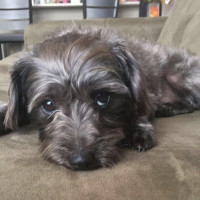
| The Silky Cairn is a designer dog, an intentional cross between two small but spirited Terriers, the Cairn Terrier, developed on the rugged, rocky coasts of Scotland, and the Australian Silky Terrier, developed by crossing Yorkshire Terriers with the larger Australian Terrier. These little canines move and think quickly, but their stubbornness and obstinate behavior can make them harder to train than other dogs. While they make excellent companions for older children, they are both too fragile and too nippy for toddlers and very young children, and can be bossy or quarrelsome around other dogs. |
History of the Silky Cairn |
| The Silky Cairn is a combination of two Terrier varieties, the Cairn Terrier, a hardy Terrier from the rocky shores of Scotland, and the Australian Silky Terrier, a small companion Terrier developed in Australia. |
A little of the Australian Silky Terrier |
||
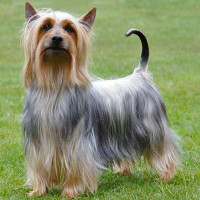
| The Australian Silky Terrier was developed in the early 1900s in Australia, by importing Yorkshire Terriers and mixing them with native Australian Terriers to improve the overall quality of their coats. Initially called both Silky Terrier and Sydney Terrier, sometimes even Sydney Silky Terrier, the breed was recognized as a breed in its own right in 1906 in New South Wales. At the time, there were many variations between different Australian Silky Terriers, not least because the mixing of Australian Terriers, Yorkshire and Silky Terriers continued even after the breed standard was drawn up in 1926. Legislation introduced by the Kennel Control Council of Victoria prohibited further crossbreeding between the three Terrier breeds, and conformation of size and ears became more stable. The breed standard was updated in 1959 to reduce the size range from 3 to 5.5 kilos to 3.5 to 4.5 kilos. | ||
 |
||
| Standard of the Australian Silky Terrier |
A little of the Cairn Terrier |
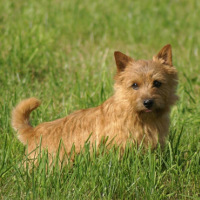
| Until Terriers were separated into Dandie Dinmont and Skye Terriers in 1873, all Terrier-type dogs in Scotland were grouped together under the name Scotch Terrier. The Cairn Terrier is classified as a sub-category of the Skye Terriers, a category that also includes the West Highland White Terrier and the Scottish Terrier. They were first imported into the USA the same year they were recognized by the American Kennel Club, in 1913. |
 |
| Standard of the Cairn Terrier |
Appearance of the Silky Cairn |
| The Australian Silky Terrier and the Cairn Terrier are quite similar in appearance. Both are small dogs, longer than they are tall, with light bodies, but strong enough to find and eliminate pests such as rats, mice and even snakes, which is also true of the Silky Cairn. This crossbreed typically has a flat, somewhat wedge-shaped head, with almond-shaped or round eyes, either dark brown like the Australian Silky Terrier or hazel like the Cairn Terrier, and small triangular ears that stand vertically from the head. The Cairn Terrier's muzzle is just a tiny bit shorter and wider than that of the Australian Silky Terrier, and their coats can vary somewhat, from the long, single-layered silky coat of the Australian Silky Terrier to the shorter, two-layered coat of the Cairn Terrier, with a soft, short undercoat covered by an abundant, hard, weather-resistant outer coat. |
Temperament of the Silky Cairn |
| The Silky Cairn, like most Terrier breeds, is a courageous, spirited canine that doesn't hesitate to bark. They are hardy and active, making them good companions for older children, but young children and toddlers can be a problem due to the dog's small size and the Terrier's tendency to display jealous or possessive behavior towards toys and food. The Australian Silky Terrier is generally unfriendly to other dogs and can be bossy or quarrelsome, whereas the Cairn Terrier tends to be a little more tolerant of other dogs. They have a strong propensity for hunting, and are likely to attack anything that moves or runs. Although these dogs are quick learners, many are stubborn, obstinate or opinionated, which makes training them a little more difficult, especially when it comes to toilet training. |
Needs and activities of the Silky Cairn |
| Although this hybrid is quite small, it's also quite energetic, and tends to need more daily activity than most other dogs of this size, usually around an hour of vigorous activity a day. Exercise for these small dogs is most effective if it's broken down into several short sessions throughout the day, and in addition to brisk walks in the park or neighborhood, they may enjoy activities such as advanced obedience training, earth dog competitions and rally sports. Silky Cairns can be great companions for apartment dwellers if they get plenty of exercise and are socialized and trained early on. |
Maintenance of the Silky Cairn |
| The Silky Cairn's coat should be fairly easy to care for, whatever coat it inherits, but there will be some differences in the way it is maintained. The single-layer coat of the Australian Silky Terrier should generally be washed about once a month, while the shorter, rougher coat of the Cairn Terrier should only be washed every few months to avoid damaging the texture of the coat. Both will need brushing two or three days a week, although in the case of the Cairn Terrier this is more to remove dead hairs and in the case of the Australian Silky Terrier, to remove tangles. Nails should be trimmed twice a month or as required, and this small dog will be prone to tooth decay, so teeth should be brushed daily. |



 English (United Kingdom)

Comments