 |
Sprollie |
|
He is not recognized by the F.C.I. |
Origin |
Great Britain <> Scotland -> Great Britain | |
Translation |
Francis Vandersteen | |
In his country of origin, his name is |
English Springer Collie |
A brief presentation of the Sprollie |
| The Sprollie is a cute, energetic hybrid breed created from an English Springer Spaniel and a Collie Rough. Although affectionate and gentle, this breed of dog isn't for everyone. These dogs have a very high activity level and are not suited to apartment living. A minimum of one hour's exercise a day is mandatory for these dogs, as if they are not kept busy, they will become destructive. If well bred, this breed gets on very well with other pets and people of all ages. Today, this breed is used as a working dog and also makes a wonderful pet. |
History of the Sprollie |
| The idea of a hybrid or designer dog breed is not new, although many dog breeds that fall into this category are. Over the past few decades, people have crossed two distinct pedigree dogs to obtain a dog with a certain appearance, temperament or ability. The Sprollie is a cross between an English Springer Spaniel and a Collie Rough. These two breeds are wonderful in their own right, and when brought together they create a beautiful, unique dog with the characteristics of both parents. The full history of these dogs is not documented, which means it can be difficult to determine. Collie Roughs were crossed with English Springer Spaniels to create the Sprollie. They are thought to have originated in the UK and are quite popular there, where they are used on farms. Although this hybrid breed is an excellent working dog, it has recently been bred with the aim of becoming a pet. The ultimate goal is to establish the Sprollie as a pure breed in its own right. This can be achieved by breeding the first generation of Sprollie. These dogs will then be crossed to create pure-bred Sprollies. For the time being, as Sprollies are created by crossing a Collie Rough with an English Springer Spaniel, there are no breed-specific characteristics. This means that temperament and appearance can vary considerably from dog to dog, as they can develop different traits from each parent. |
A little of the English Springer Spaniel |
||
| Spaniel-type dogs are thought to have originated in Spain, and were carried to other parts of the world by the Romans or by trading ships. Before the invention of guns, Spaniels were used to flush out game for hunters. In the 1880s, Springer Spaniels and Cocker Spaniels were often born in the same litter, the larger puppies being used to scout game and called Springers. The Kennel Club (England) granted them separate status in 1902. The English Springer Spaniel is thought to be the ancestor of most of today's Spaniels. The breed went on to become popular in Canada and the United States, and was officially recognized by the American Kennel Club in 1910. | ||
 |
||
| Standard of the English Springer Spaniel |
A little of the Collie Rough |
| Collies were bred as working and herding dogs that drove, managed and herded livestock. It's not known exactly where this breed originated, but it's assumed that centuries ago, these dogs were found in northern England and Scotland. There is documentary evidence that they were brought to the British Isles by the Romans around 2,000 years ago. Old Cockie was born in 1867 and is believed to be the dog that specified the characteristics of the rough Collie. He was also thought to have introduced the sable-colored coat to the breed. In 1873, a smooth Collie named Trefoil was born. The smooth variety is descended from this dog. Queen Victoria discovered the breed on a trip to Scotland. She adored and sponsored both varieties of the breed, making them very popular in the 1860s and 1870s. Some thought the Borzoi was part of the Collie mix, contributing to its long legs, slender muzzle and elegant silhouette. The breed became well known in the U.S.A. and was popular with celebrities and the wealthy. They were imported from England at high prices, in a kennel created and owned by J.P. Morgan. Half a century later, the breed was in demand in Japan, which led to the import of these dogs by American breeders. The breed's popularity was revived in the 20th century when Queen Alexandra began breeding them. They are well known for appearing in the popular Lassie series. |
 |
| Standard of the Collie Rough |
Appearance of the Sprollie |
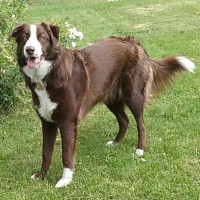
| Being a hybrid breed, the Sprollie's appearance can vary from dog to dog. Indeed, some puppies may develop the characteristics of one parent, while other dogs may take on those characteristics from the other parent. Most Sprollies have the medium-sized floppy ears of the English Springer Spaniel. Coat colors and tails, which are of moderate length with feathering, resemble the Collie more than the Springer. These dogs have broad heads with alert expressions that are well proportioned, with equally broad but tapering muzzles and distinct stops. The eyes are set wide apart, oval in shape, and the teeth generally meet in an almost perfect scissor bite. The neck is strong, muscular and slightly arched, with one shoulder wider than the nape. The Sprollie's forelegs are strong, the shoulders set back and the limbs straight. Ribs are well sprung and chests are deep. The hind legs are equally muscular and well developed, with angular paws. These dogs have oval-shaped feet with deep pads and arched toes. |
Temperament of the Sprollie |
| The Sprollie is a lively, affectionate pet that can have a personality that varies from individual to individual. These dogs can be obedient and gentle, or crazy and destructive. When a Sprollie is well socialized with children at a young age and as it matures, it can be an excellent pet. These energetic dogs need to be supervised in the presence of very young children. Some Sprollie are very affectionate towards all family members, while others choose to be more devoted to a single person. If this breed is raised in the company of other dogs and cats, it will get on well with them. These dogs can learn quickly, especially if you use positive reinforcement to encourage good behavior. A dog's personality depends mainly on his parents' temperament and what he learns as he grows up. It's never too early to start obedience training your Sprollie puppy. |
Needs and activities of the Sprollie |
| Because of their high energy levels, these dogs can be very difficult to manage as puppies. As a young dog, the Sprollie needs plenty of opportunities to test his brain and impress you with his intelligence. Once these dogs are old enough, they need to be taken for runs or hikes, and would love to be enrolled in agility, flyball or other challenging dog sports. Keep them busy, or they could become destructive. This breed needs to be matched with an owner who shares their love of exercise and is very active. The Sprollie will need to exercise for at least an hour a day. If you don't keep your Sprollie busy, it can become bored and destructive. Take him for a walk, play ball, go swimming, hiking, running or just let him run free in a large garden. Don't over-exercise your Sprollie puppy, as this could damage its still-developing joints. |
Maintenance of the Sprollie |
| The Sprollie hybrid breed can have a short or medium coat, and can also be sparse or bushy. These dogs look and feel best when brushed at least two or three times a week, focusing on the areas behind the ears and at the top of the legs, where the limbs meet the body. Give them a bath if necessary. You should also brush your dog's teeth, to help prevent tooth and gum decay, as well as bad breath. This should be done at least once or twice a week, but the more often, the better. Sprollie's ears should be cleaned once a week to prevent ear infections, and nails should be trimmed regularly. The exact frequency of nail trimming will depend on the dog and its lifestyle. As the Sprollie is a very active breed, it's not necessary to trim its nails as often as for other breeds, as they wear naturally as the dog runs and plays. On average, nails should be checked once or twice a month. |



 English (United Kingdom)

Comments