 |
Swiss Newfie |
|
He is not recognized by the F.C.I. |
Origin |
Switzerland <> Canada -> U.S.A. | |
Translation |
Francis Vandersteen |
A brief presentation of the Swiss Newfie |
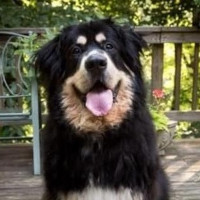
| The Swiss Newfie is a very large hybrid dog, an intentional combination of the Great Swiss Mountain Dog, the oldest and largest of the Sennenhund dogs that developed in the Swiss mountains, and the Newfoundland Dog, a gentle giant with an imposing appearance that seems more at home in the water than on land. The Swiss Newfie needs only a moderate amount of exercise for its size, and is usually content to stretch its legs for an hour or so each day. However, some Swiss Newfies may require a great deal of time devoted to daily grooming, especially those who have inherited the abundant, fluffy coat of the Newfoundland Hound mother breed. While these dogs can be a little rambunctious during their long adolescence, they are generally reliable and affectionate companions, very sensitive to their family's emotions. |
History of the Swiss Newfie |
| The Swiss Newfie is a deliberate crossbreed known as a designer dog, in this case a cross between two extremely large but good-natured dogs, the Great Swiss Mountain Dog, a sheep herder who also specialized in pulling and carting, and the Newfoundland Dog, a massive water dog with a mysterious past. |
A little of the Great Swiss Mountain Dog |
||
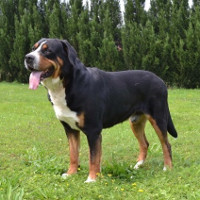
| The Great Swiss Mountain Dog is the oldest and largest of the breeds founded in the mountains of Switzerland. These dogs, known as Sennenhund dogs, are the descendants of dogs that crossed Switzerland with ancient conquerors such as the Romans and Phoenicians. These dogs developed into four distinct guard, shepherd and cart dog breeds, namely the Appenzeller, Entlebucher, Bernese and, of course, the Great Swiss, although all four have similar black and tan coloration, usually with a white face and chest, and white feet. The Great Swiss Mountain Dog, in particular, became a favorite with local butchers, and was particularly appreciated for its ability to safely transport carts of fresh produce and fresh milk to their destination. | ||
 |
||
| Standard of the Great Swiss Mountain Dog |
A little of the Newfoundland |
| Newfoundland Dogs were developed in the coastal towns of northern Canada, most notably in the fishing village of St. John's, where they were known as Greater St. John's Dogs. Although most theories indicate that Newfoundland Dogs are descendants of the Tibetan Mastiff, there is no evidence of Tibetan Mastiffs in the region, and no known indigenous dogs in the area. Whatever the breed's origins, it developed into a very large dog, perfectly suited to helping fishermen in the cold, harsh environment of the Newfoundland region, and by the late 1700s, the Newfoundland Dog breed had become common along these shores. |
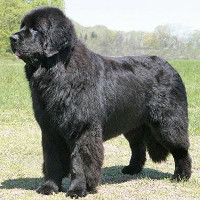 |
| Standard of the Newfoundland |
Appearance of the Swiss Newfie |
| The Swiss Newfie is a well-muscled, heavily boned dog that is slightly longer than it is tall, and while some females can weigh just under 45 kilos as adults, very few males will. Both parent breeds have broad, flat skulls and broad, blunt muzzles that are well balanced in relation to the head, and this is passed on to the Great Swiss Mountain Dog, although the Newfoundland Dog tends to have a slightly broader head and more pendulous lips than the Great Swiss Mountain Dog. Its brown eyes are generally very dark and almond-shaped, with a soft, delicate expression, and its triangular ears are set close to the edge of the skull, almost flat against the sides of the head. Dogs that most closely resemble the body style of the Great Swiss Mountain Dog may be a little leaner than those inspired by the Newfoundland Hound, but the difference is usually minimal. |
Temperament of the Swiss Newfie |
| The Swiss Newfie is a combination of two dog breeds that are generally very sociable and easy to get along with, and they tend to need a lot of company for a big dog. They are generally very tolerant with children, but are powerful dogs that can be a little too boisterous in their interactions with toddlers and young children and need to be closely supervised. Although these dogs are affectionate and confident with their families, socialization may be necessary to ensure they remain confident and polite with strangers too. Properly socialized and trained, however, these dogs should make excellent therapy or emotional support animals, as they are particularly sensitive to the emotions of those around them. Socialization with other dogs is also wise for this crossbreed, as both parent breeds are known to be sometimes wary of other dogs, and some males are also aggressive towards other males, especially if not properly trained. While the Newfoundland can bring a bit of stubbornness and the Great Swiss Mountain Dog contributes to a long adolescence, this combination should otherwise be fairly easy to train, and training should start early to ensure a well-behaved, well-controlled adult dog. |
Needs and activities of the Swiss Newfie |
| Although this dog doesn't need a lot of vigorous exercise, it does need to stretch its long legs at least several times a day, and the addition of strength training in the form of specially weighted backpacks or draft carts designed for dogs will help it maintain its strength and muscle tone. The Swiss Newfie is also likely to be particularly attracted to swimming and water sports due to its Newfoundland Dog heritage, activities that can prove particularly beneficial for large dogs prone to hip and elbow dysplasia, as they provide non-weight-bearing exercise for joints and muscles. A home with secure, enclosed grounds is essential to provide the most suitable environment for the Swiss Newfie. |
Maintenance of the Swiss Newfie |
| The time and effort required to groom this hybrid depends largely on the coat each Swiss Newfie inherits. Both coats require fairly frequent bathing, usually every month or two, but those with the long, fluffy coat of the Newfoundland Dog will need to be brushed much more often than those who have inherited the short, smooth coat of the Great Swiss Mountain Dog. The Newfoundland's coat requires intensive daily brushing to prevent knots and tangles and to remove dirt and debris that have become embedded in its abundant fur, while the moderate shedding created by the Great Swiss's short coat can usually be controlled with just two or three brief brushing sessions a week. |



 English (United Kingdom)

Comments