
 |
Tibetan Chin |
|
He is not recognized by the F.C.I. |
Origin |
Tibet <> China -> U.S.A. | |
Translation |
Francis Vandersteen |
A brief presentation of the Tibetan Chin |
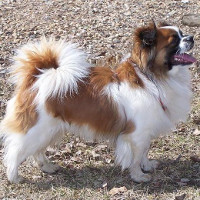
| The Tibetan Chin is a small hybrid breed that combines the DNA of the Tibetan Spaniel and the Japanese Spaniel. With its broad face, short muzzle and big eyes, this little lion dog is a breed with a ton of personality in a rather tiny body. Its long, soft coat comes in many colors, and its tail curls elegantly over its back. In terms of personality, Tibetan Chins are active, friendly dogs who love spending time with their owners. But when it comes to strangers, it draws on its Japanese-Chinese heritage and can become rather reserved, at least at first. Once the Tibetan Chin gets used to newcomers, it copes very well and gets on wonderfully with everyone, especially children. Just bear in mind that, because of its small size, it's best to make sure that children interacting with it know to play gently. Although the Tibetan Chin is a typical lapdog who likes to be in the center of everything, he's quite calm and rarely barks. This is a highly appreciated characteristic for those who live in small spaces or very close to their neighbors. All in all, thanks to its easy-going nature and affectionate attitude, the Tibetan Chin is an excellent choice for dog owners of all levels and ages. |
History of the Tibetan Chin |
| The Tibetan Spaniel and Japanese Chin have been around for some time. For this reason, they have rich origin stories that can help understand why the Tibetan Chin was created, and what other dog breeds may have been involved in its heritage. |
A little of the Tibetan Spaniel |
||
| The Tibetan Spaniel was originally created as a companion and guard dog for Tibetan monks. Eventually, its unique lion-like appearance and lively personality attracted the attention of other dog lovers, and the Tibetan Spaniel was often given as a gift to rulers and other dignitaries. In the late 19th and early 20th centuries, British missionaries got their hands on a few Tibetan Spaniels and brought them back to the West. Surprisingly, this popular dog didn't generate much interest in the United States at first. But over time, a litter born in the 1960s finally caught the attention of a small group of people in New Haven, Connecticut. As the breed was imported from Tibet, people fell more and more in love with it. Eventually, the Tibetan Spaniel was accepted by the American Kennel Club in 1984, and although not one of the most popular breeds, it is much loved by its supporters and used as a loyal companion and show dog. | ||
 |
||
| Standard of the Tibetan Spaniel |
A little of the Japanese Spaniel |
| The Japanese Spaniel originated in Asia almost 1,500 years ago. At one time, it was called the Imperial Chin due to its popularity in the imperial courts of China. The breed was highly prized and commonly used as a gift between the country's nobles and other dignitaries. This is how the Japanese Spaniel came to the attention of Western countries around the 19th century, when the dog was presented as a gift to President Franklin Pierce, following the end of Japan's isolation from the rest of the world. From then on, the Japanese Spaniel slowly gained in popularity, and was even the pet of Queen Alexandra of England at one point. The American Kennel Club accepted the Japanese Spaniel in 1888, putting it on a par with some of the oldest accepted breeds, and it has been used as a show and companion animal ever since. |
 |
| Standard of the Japanese Spaniel |
Appearance of the Tibetan Chin |
| A small hybrid, the Tibetan Chin reaches an adult weight of around 7 kilos and 28 centimeters. The Tibetan Chin has soft, triangular ears, a small muzzle, incredibly large eyes and a broad head. Its fur is long and soft, with an almost Pomeranian-like coat, and comes in a wide range of different colors. The tail is always curled over the back and is not particularly long, with light feathering from base to tip. With a hint of the classic lion mane of the Japanese Spaniel and the warm, affectionate eyes of the Tibetan Spaniel, there's no doubt that the Tibetan Chin is a beautiful and unique breed. |
Temperament of the Tibetan Chin |
| The Tibetan Chin is a very calm, self-assured breed. It tends to be quite charismatic and affectionate with the people it loves, but when it comes to strangers, the Tibetan Chin can be a little reserved at first. This breed adores children and gets on relatively well with other dogs, although it does better under supervision. When the Tibetan Chin interacts with children of any age, it's important that the children know to play gently, as the breed's small size can lead to accidents in the event of rough play. Overall, the Tibetan Chin is a very gentle, affectionate companion that gets on well with everyone and doesn't require much maintenance to be happy. It will adapt well to any size of home and its longer fur keeps it warm, but it tends to prefer milder temperatures. |
Needs and activities of the Tibetan Chin |
| While the Tibetan Chin is a fairly active breed, the Japanese Chin is definitely not, and generally prefers to limit his activities to jumping on your lap and perhaps playing in the yard for an hour a day. Because of this combination, the Tibetan Chin is a well-balanced breed that likes to play and take a moderately long walk from time to time, but when it's time to relax and unwind, it's more than happy to do so. This makes them the perfect breed for older or laid-back people who want a companion that doesn't need a lot of exercise to entertain. |
Maintenance of the Tibetan Chin |
| Although the Tibetan Chin's long, soft coat may seem high-maintenance, it's not. The fur stays fairly clean, requiring only a few brushing sessions a week to keep it knot-free and silky. Tools such as a wire comb and a pin brush are excellent for grooming the Tibétan Chin. This breed sheds seasonally, making the use of a good vacuum cleaner essential, but brushing and an occasional bath keep the coat at a manageable level. In addition to brushing and bathing, be sure to clean the ears frequently to remove any foreign bodies that may be trapped in them, and always dry the ears thoroughly after bathing. This will help reduce the risk of ear infections and irritations. Finally, don't forget to trim your Tibetan Chin's nails every two weeks to keep his paws healthy and prevent excessive scratching. |



 English (United Kingdom)

Comments