Tibetan Spaltese

He is not recognized by the F.C.I.

Origin
Tibet <> Central Mediterranean Basin -> U.S.A.
Translation
Francis Vandersteen

A brief presentation of the Tibetan Spaltese

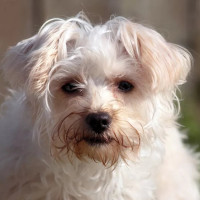
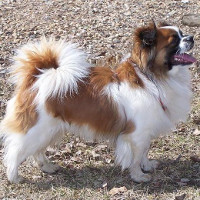
A fun mix of Tibetan Spaniel and Maltese, the Tibetan Spaltese is a small dog of hybrid design, full of spirit and personality. Bred to remain small while balancing some of the characteristics of both breeds, the Tibetan Spaltese is generally a well-mannered, easy-going dog. Despite its small size, it is surprisingly gentle with children and other dogs, especially if it receives some level of training or socialization. They are fundamentally social dogs, who like to be surrounded by their family and generally try to be the center of attention, whatever it takes. They are extremely affectionate and quite playful, and relish any opportunity given to them to interact with their family, whether it's playing or jumping on their owners' laps to lick them. They're also surprisingly bold and exploratory thanks to their Tibetan Spaniel heritage, and will often be found climbing on furniture to be close to their family or to see what's going on outside or around the house, where they're not tall enough to see. As the two related breeds have often been used historically as guard dogs, this breed has also taken this job in its stride, emitting alarm barks if they sense something is wrong or a stranger is nearby. Although they are extremely intelligent, which can sometimes make other breeds stubborn and overly independent, they are relatively easy to train and handle, making them a good breed for a novice dog owner. What's more, their small size and minimal exercise requirements make them ideal for small spaces and less active families.

History of the Tibetan Spaltese

Since the Tibetan Spaltese is a newly conceived breed, its history is fairly short, but the two parent breeds go back much further in time.


A little of the Tibetan Spaniel

        
The Tibetan Spaniel is without doubt one of the oldest breeds of its type, having been bred 2000 years ago by Buddhist monks in the Himalayas as a companion and guard dog. Because of their frequent interaction with people of varying mental and emotional states, they became very attentive to the condition of their masters, a trait that endures to this day. They took their job as watchdogs very seriously, which no doubt explains why they developed such powerful barks for their size and still take every opportunity to play the role of vigilant watchdogs. Although the breed was created so long ago, it didn't arrive in England until 1898, and didn't reach US shores in significant numbers until the mid-20th century. It is currently recognized by the EKC and the American Kennel Club and exists in many countries around the world, but is still considered rare, not even appearing in the top 100 breeds registered with the AKC.
Standard of the Tibetan Spaniel


A little of the Maltese

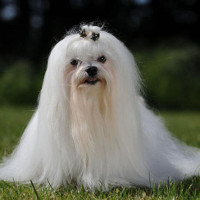
The Maltese, a Bichon-type breed with Spaniel roots, is also steeped in history, being a popular choice for European aristocrats for centuries due to their temperament and desirable aesthetic qualities. Originating on the island of Malta and partially named by the Romans in ancient times, this lively, intelligent breed arrived in the United States in the 19th century and even made its way into the famous Westminster Dog Show as early as the 1870s, before continuing to gain popularity both as a companion and as a frequent choice for crossbreeding thanks to its excellent overall characteristics.
Standard of the Maltese

Appearance of the Tibetan Spaltese

The Tibetan Spaltese is a small dog, measuring less than 30.5 centimeters at its tallest and generally weighing around 13 kilos. Due to their lineage, they can have a wide range of coat colors, from black or white to cream or even red, all of which are generally long and fluffy. They have a small, rounded head and a comparatively short muzzle, with extra hair around the eyes, whiskers and ears. They have small, round, almost protruding eyes, and furry, folded ears. Their chest is deep in proportion to their size, their posture is square and their back is straight, ending in a medium to long, excessively hairy tail.

Temperament of the Tibetan Spaltese

Compared with a number of other dogs of the same size, the Tibetan Spaltese has an excellent temperament overall. They are extremely sociable, love attention, enjoy spending lots of time with their family and are surprisingly attuned to their owners' needs and feelings. They are known to be lively companion dogs, frequently jumping into their owners' laps to shower them with affection and licks, and often climbing to considerable heights to be close to their family or to get a better vantage point. Because of this social nature, they are often quite good with children and other dogs, even without training, but they accept them particularly well when they receive them at the same time as their socialization. They tend to be wary of strangers, but this usually only makes them good watchdogs, as they'll bark happily in the presence of strangers or if they sense something is wrong. This type of behavior can also be eliminated by training, which is not particularly difficult, as they are relatively easy to train and handle. If there's a downside, it's that they can sometimes be a bit too whiny or develop small dog syndrome. But given the right attention and guidance, they usually have very few problems.

Needs and activities of the Tibetan Spaltese

The Tibetan Spaltese is considered a low-energy dog, partly because it lacks the stamina of hunting dogs, and partly because it doesn't take much for humans, who have much longer legs, to tire it out. That's not to say they don't like exercise or attention. Because of their high intelligence, they need to be stimulated both mentally and physically, so games of fetch or puzzles and treat toys are a good way to round off a walk around the neighborhood or let them roam free in a fenced yard or dog park. Their low energy levels can be a problem, however, as many non-active owners take the easy way out and forget or ignore their need for exercise, increasing the risk of obesity, which can occur quickly in these little pets. If they don't need to go for miles of walks a week, they still need about a kilometer of walking or jogging a day, at least 30 minutes of total exercise and extra stimulation when they're at home. If given the right amount, this will go a long way to maintaining good behavior, health, happiness and longevity.

Maintenance of the Tibetan Spaltese

There's no doubt that this is a high-maintenance breed. The combination of their long, dense coat and small size means that they often get dirty, even if they are kept at home most of the time. Their coats require considerable care, as whether it's the hypoallergenic Maltese or the regular-haired Tibetan Spaniel, they'll need daily brushing, combing and possibly detangling, as well as frequent bathing when they get dirty, and any trimming or cutting they may need. As if that weren't enough, they're also prone to tear stains that need cleaning, not to mention the extra cleaning due to the combination of inaccurate toileting and excess hair. Their coats can be kept short, but if they live in a cold climate, they'll need extra warmth when they go outside to relieve themselves. And of course, as with all other breeds, they need their nails trimmed to prevent breaking or cracking, their teeth brushed at least once a week, and their ears checked and cleaned to prevent moisture build-up and ear infections.

Comments

Latest page updates

  • Telomian

    Telomian He is not recognized by the F.C.I. Origin Malaysia Translation Francis Vandersteen A brief presentation of the Telomian The Telomian is a very rare breed of dog, and the only one native to Malaysia to have been bred outside the country. They were originally bred by the indigenous people of Malaysia to combat parasites such as snakes, rats,...
  • King Wheaten -- Cavalier King Charles Spaniel X Irish Soft Coated Wheaten Terrier

    King Wheaten He is not recognized by the F.C.I. Origin Great Britain <> Ireland -> U.S.A. Translation Francis Vandersteen A brief presentation of the King Wheaten The King Wheaten is a small dog with a heart this big and a playful disposition. Borrowing the energy and soft-coated waves of the Irish Soft Coated Wheaten Terrier and the size and...
  • Spanierd -- English Springer Spaniel X German Shepherd

    Spanierd He is not recognized by the F.C.I. Origin Great Britain <> Germany -> U.S.A. Translation Francis Vandersteen A brief presentation of the Spanierd The Spanierd is a hybrid dog. Its parent breeds are the English Springer Spaniel and the German Shepherd. They have an affable personality. He's known for entertaining family and friends with his...
  • Alaskan Goldenmute -- Alaskan Malamute X Golden Retriever

    Alaskan Goldenmute He is not recognized by the F.C.I. Origin U.S.A. <> Great Britain -> U.S.A. Translation Francis Vandersteen This breed is also known as Alaskan GoldenGoldenmuteAlaskan Gold Retriever     A brief presentation of the Alaskan Goldenmute The Alaskan Goldenmute is a descendant of two great dog breeds: the Alaskan Malamute and the Golden...
  • French pointing dog Pyrenean type

    French pointing dog Pyrenean type FCI standard Nº 134 Origin France Translation Mrs. Peggy Davis Group Group 7 Pointing Dogs Section Section 1.1 Continental Pointing Dogs « Braque » Type Working With working trial Acceptance on a definitive basis by the FCI Tuesday 18 January 1955 Publication of the official valid standard Tuesday 01 August 2023 Last...
  • French pointing dog Gascogne type

    French pointing dog Gascogne type FCI standard Nº 133 Origin France Translation Mrs. Peggy Davis Group Group 7 Pointing Dogs Section Section 1.1 Continental Pointing Dogs « Braque » Type Working With working trial Acceptance on a definitive basis by the FCI Monday 17 January 1955 Publication of the official valid standard Tuesday 01 August 2023 Last...
  • Vucciriscu

    Vucciriscu He is not recognized by the F.C.I. Origin Sicily Translation Francis Vandersteen En français, cette race se dit Vucciriscu Diese Norm ist in deutscher Sprache sichtbar Vucciriscu En español, esta raza se dice Vucciriscu In het Nederlands, wordt dit ras gezegd Vucciriscu This breed is also known as Sicilian Vucciriscu Sicilian Butcher...

© 2026 Groupe Milouchouchou ASBL. Tous droits réservés. En savoir plus

Protected by Copyright01
We use cookies

We use cookies on our website. Some of them are essential for the operation of the site, while others help us to improve this site and the user experience (tracking cookies). You can decide for yourself whether you want to allow cookies or not. Please note that if you reject them, you may not be able to use all the functionalities of the site.

Ok