
 |
Whippig |
|
He is not recognized by the F.C.I. |
Origin |
Great Britain <> Italy -> U.S.A. | |
Translation |
Francis Vandersteen |
A brief presentation of the Whippig |
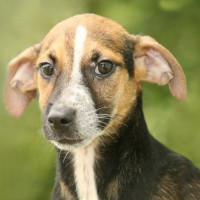
| The Whippig is a recent hybrid of a Whippet and an Italian Sighthound. Whippigs are energetic and playful, but they also like to snuggle up when they've had a chance to expend their energy, which means they're happy to live anywhere. Because his parents are both Greyhounds, the Whippig has inherited a hunting instinct. They are therefore not best suited to homes with other small pets. Whippigs require minimal grooming due to their short coats, and would make excellent pets for anyone with the time to give them plenty of attention. |
History of the Whippig |
| Not much is known about the history of the Whippig, as it is a new breed. However, its parent breeds, the Whippet and the Italian Sighthound, have a long history. |
A little of the Whippet |
||
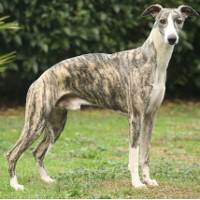
| The Whippet was developed in the 1800s by English workmen who crossed Greyhounds with Terriers to create a smaller, but still very fast Greyhound. Competitions were held to see which dog could catch prey the fastest. Sometimes, Whippet handlers simply raced the dogs and bet on the winner. When they weren't racing their Whippets, the working class used them to hunt rabbits. Not surprisingly, these dogs still have a strong propensity for hunting. The Whippet was recognized by the American Kennel Club in 1888. Despite its origins as a working dog, the Whippet's friendly personality and playful energy have made it a popular choice for companionship in recent years. | ||
 |
||
| Standard of the Whippet |
A little of the Italian Sighthound |
| The Italian Sighthound is thought to have originated in Greece and Turkey, but it conquered the hearts of Italian noblemen, hence its name. There are numerous paintings dating back to the Middle Ages of dogs resembling the Italian Sighthound. But the breed as we know it today gained popularity in the 1600s as a prized pet, this time among the English nobility. Famous historical figures such as Mary, Queen of Scots, Queen Victoria and many others were admirers of these beautiful dogs. The Italian Sighthound didn't just stay in Europe, however, and made its way to the United States, where it was admitted to the American Kennel Club in 1886. |
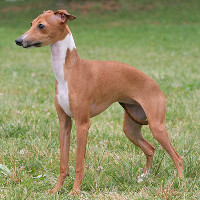 |
| Standard of the Italian Sighthound |
Appearance of the Whippig |
| The Whippig is a slender dog with long legs and a broad chest. Their strong, powerful hindquarters help them reach the high running speeds for which their parent breeds are known. The skull is narrow and the eyes are set to the sides, giving the dog a wide field of vision. The ears are folded forward at the tips, but are generally held back against the skull. Whippigs generally have short, smooth coats, but it is possible for them to have long coats too, although this is rare. Their fur can be any color imaginable, with any variation of markings. Their eyes are generally dark brown, and their nose can be dark brown or black. |
Temperament of the Whippig |
| Like both its parents, the Whippig is a friendly, affectionate dog. They're energetic and playful, but they also like to cuddle or simply be close to their owners. It's a dog that will happily accompany you on your morning jog and spend the evening watching TV on your lap. Because they're so playful and gentle, they make excellent companions for children. However, their bones are delicate, especially when they're young, so you should avoid roughing them up. They can be independent and strong-willed when it comes to training, but if you can show them there's something in it for them, they'll cooperate. Often, affection is the best reward for your Whippig. Italian Greyhounds are notoriously difficult to housebreak, and the same can be true of your Whippig. For this reason, many parents choose to crate their Whippig. Whippigs are generally very friendly towards other dogs, but they need to be socialized from an early age. They have a strong propensity for hunting and may not be comfortable with cats or other small pets. However, if introduced and socialized with them from an early age, they can cope without any problems. Whippigs are intelligent, sensitive and in tune with your moods. If you're stressed, he'll be too. They can develop separation anxiety if left alone frequently for long periods. |
Needs and activities of the Whippig |
| The Whippig is an active breed that needs around 60 minutes of activity a day. Like many breeds, it can become destructive and mischievous if it doesn't get enough exercise. As he has a strong propensity for hunting and can run up to 40 km per hour, it's important to keep him on a leash during walks. He can romp and play in fenced yards, but make sure the fence is high enough so he can't jump over it. Whippigs are excellent dogs for agility trials, as they are intelligent and fast. When exercising, the Whippig makes an excellent house companion, as it loves to snuggle up to you. Whippigs thrive in warmer climates as they are sensitive to the cold and dislike wet weather, but they can adapt as long as they have a warm jacket. |
Maintenance of the Whippig |
| Because of their short, smooth coats and low shedding, Whippigs have minimal grooming needs. Monthly brushing is all that's needed to remove excess dead hair. They should only be bathed when necessary, which is not very often, as they don't tend to smell bad. As their coat is very short, they are very sensitive to the cold and will need sweaters in cooler climates. They probably hate the rain and don't want to go outside when it's wet, not even to relieve themselves. Nails should be trimmed about once a month. Brush your Whippig's teeth every day to minimize bad breath and tartar build-up, and to prevent gum disease. |



 English (United Kingdom)

Comments