Appearance of the Australian Pyrenean Shepherd
|
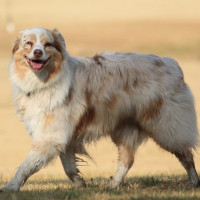
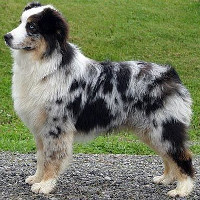
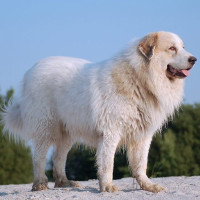
| Most Australian Pyrenean Shepherds will grow large enough to enter the large breed category. Of course, some may be smaller, but be aware that your dog will take up a lot of space in your home. Males are often larger than females. This mixed breed will have a very fluffy double coat. You can expect a lot of shedding throughout the year. These dogs can have medium to long coats, depending on which parent they're named after. The topcoat can be straight or wavy and has a coarse texture. The undercoat is thickest and woolly to the touch. Some males may have thicker fur around the neck. The Australian Pyrenean Shepherd is unlikely to have a solid-colored coat. White may be a dominant shade, but this dog will have white, black, tan, blue merle, red merle, gray or reddish-brown markings. They may have a darker mask around their face and dark fur on their ears. You may find speckled patches of color around their legs. |
Temperament of the Australian Pyrenean Shepherd
|
| Pyrenean Mountain Dogs and Australian Shepherds have been bred to be independent-minded working dogs. Although they are companion animals, they retain many of these traits, making them dominant and strong-willed dogs. This is why Australian Pyrenean Shepherds are not recommended for new owners. These dogs need a loving but firm hand. You and other family members will need to impose yourself as the leader, otherwise you'll find that this dog resists all types of training or commands. Once you've overcome his stubbornness, you'll be hard-pressed to find a more loyal or affectionate dog. He'll follow you everywhere and take every opportunity to cuddle or lie on you like a blanket. The Australian Pyrenean Shepherd is great with children, gentle and very affectionate. That said, these dogs can have strong gregarious tendencies that can manifest themselves around young children. To avoid this, always supervise them around young children. These dogs are wary of strangers, which can be a problem, as Australian Pyrenean Shepherds also tend to be protective of their owners. To avoid any problems, socialize your puppy from an early age. This will make him more at ease with other people. As they are quite sociable, Australian Pyrenean Shepherds can get along with other dogs. However, you'll need to socialize them from an early age to ensure they get on well. It's worth noting that this mixed breed may try to mix with smaller dogs or cats. These dogs like cool or cold climates and thrive in them thanks to their thick coats. They are not as comfortable in warm or moderate climates. If your Australian Pyrenean Shepherd lives in a warmer region, take steps to ensure its safety and comfort. During the hot months, always keep your dog indoors, preferably near a fan or air-conditioning. He should have easy access to fresh water at all times. You should only take your dog out during the coolest part of the day, i.e. early morning or early evening. Avoid taking him for walks or hikes at any other time, as these dogs are prone to overheating. Their size and energy levels make Australian Pyrenean Shepherds unsuitable for apartments. These dogs may also have a tendency to bark when bored or left alone, which may not be suitable if you share walls with your neighbors. Ideally, these dogs should live in a medium-sized house with plenty of space in the yard. They're happiest when they can go in and out of the house all day long. Being able to play in the garden allows them to expend their excess energy and avoid destructive behavior. |
Needs and activities of the Australian Pyrenean Shepherd
|
| One of the reasons why an Australian Pyrenean Shepherd is not suitable for every family is that this breed is very energetic. Bred to be working dogs, these dogs need a great deal of daily exercise. You'll need to exercise this mixed breed for between half an hour and an hour a day. As each dog is different, you'll need to determine the right amount of physical activity for him or her. You can start with a 20-minute session and gradually increase the duration of the exercise. If your dog seems to have a lot of energy to expend after your exercise session, this means he needs more. On the other hand, if he seems exhausted, you should reduce the physical activity. Try to mix up the type of exercise you give your dog. Most of the time, a good long walk is enough, but you can divide it into two sessions so that your dog doesn't get bored during the day. At the same time, try adding a few games of Frisbee or fetch. If your dog follows in the footsteps of his Australian Shepherd parents, you'll find that he loves agility training too. As we said, you need to pay attention to your puppy during his growth phase. Up to the age of 18 months, be careful how you exercise him. It's best to ask your vet what kind of physical activity is acceptable for him. Try to keep your dog away from hard surfaces like concrete. Instead, try to walk him on grass or similar surfaces, which are more comfortable for his bones. This mixed breed is incredibly intelligent and can assimilate a wide variety of commands and tricks. At the same time, this dog has a dominant and stubborn side. That's why you need to introduce yourself and establish yourself as the dominant figure in your family as soon as you bring your puppy home. He'll be more inclined to listen to you if he knows you're in charge. Be firm with his training, but always use positive reinforcement. Your dog will be more committed to learning if you give him affection and treats to guide him. |
Maintenance of the Australian Pyrenean Shepherd
|
| Because of their thick, double coat, these dogs shed all year round. If their coat is similar to that of an Australian Shepherd, they may blow their coat once or twice a year, resulting in more shedding. Despite shedding, it's easy to keep your Australian Pyrenean Shepherd well groomed. To reduce shedding, brush him several times a week. When they shed, switch to once a day. As these dogs have a double coat, use a long-hair brush and an undercoat rake. The latter will help dislodge loose hairs from the lowest layer. During the moulting season, use a brush to clear the undercoat for greater efficiency. It's best to limit the frequency of baths for these dogs. One bath every two months should suffice. Only break this cycle if your dog is very smelly or dirty. |



 English (United Kingdom)

Comments