 |
Norjack |
|
He is not recognized by the F.C.I. |
Origin |
U.S.A. | |
Translation |
Francis Vandersteen |
A brief presentation of the Norjack |
| A delightful blend of the courageous Jack Russell Terrier and the robust Norfolk Terrier, the newly developed Norjack possesses many wonderful attributes from each of its parent breeds. In addition to their determined and courageous personalities, these little dogs are known for their sporting prowess and impressive stamina. Rarely reaching 30 cm in height, Norjacks are certainly small dogs, although they don't seem to know it. They have pretty little faces, with dark, expressive eyes and floppy ears that point towards their cheeks. Spindly and muscular, their compact bodies are clearly designed for running. Their thick fur can be white, brown or black, and a dark face mask is a common feature. |
History of the Norjack |
| The Norfolk Terrier and Jack Russell Terrier are two small English breeds of dog traditionally used to catch rats. In recent decades, they have been deliberately crossed to create the Norjack. A very rare hybrid, little is known about its origins and no one can say for sure when or where this new cross was developed. |
A little of the Norfolk Terrier |
||
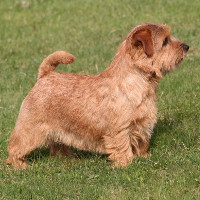
| The Norfolk Terrier originated in East Anglia at the end of the 19th century. A number of similar dogs were used in its creation, including the Border Terrier and the Cairn Terrier. Interestingly, they were created with the intention of having a breeding dog hardy enough to live outdoors in barns and outbuildings and hunter enough to hunt vermin. Many agree that the breed became popular among students at Cambridge's elite university, and that several breeders were Cambridge alumni. It was in the mid-1900s that the original breed was split into two groups: dogs with erect ears, now the Norwich Terrier, and those with hanging ears, the Norfolk Terrier. Although Norfolk Terriers make good pets, they are not a particularly well-known breed worldwide. | ||
 |
||
| Standard of the Norfolk Terrier |
A little of the Jack Russell Terrier |
| The Jack Russell Terrier is a much-loved dog breed with a reputation for being a little terrorized. They are rich in energy and absolutely full of life. The Jack Russell is a descendant of the Fox Terrier and was bred in the early 1800s. Although originally English, the breed was exported to Australia, where it was further developed. Although considered one of the world's best ratiers, the breed was mainly used to hunt rabbits and foxes. As well as being a popular choice of companion dog today, the Jack Russell is renowned for excelling in many disciplines, including flyball, agility and obedience. |
 |
| Standard of the Jack Russell Terrier |
Appearance of the Norjack |
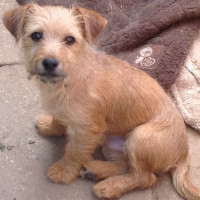
| A small working dog, the Norjack should have a small, compact body built for speed and endurance. They should be built in good proportions and not have exaggerated features. Since both parent breeds were created for a specific purpose rather than a particular appearance, it goes without saying that they have inherited a sporting conformation. Although their limbs are short, they are strong and densely boned, enabling rapid acceleration. They generally have a wedge-shaped muzzle that ends in a prominent black nose. Their eyes are brown and imploring, with a slightly dark expression. Their ears are triangular and fall gently from the top of the skull. An adult Norjack measures between 25 and 33 cm at the withers and weighs between 5.5 and 7 kg, making it a small breed. The Norjack's coat is short to medium. Fawn is the most common color. Many dogs also have a black muzzle and white patches. A dark red color is also seen in some individuals. The dogs can shed a lot and are certainly not a hypoallergenic option |
Temperament of the Norjack |
| A battery-operated Terrier, the Norjack is feisty, energetic and tenacious. They don't seem to have a stop switch and are the first to say yes to any game or activity offered. They require a lot of attention and can become frustrated if they feel they're being left out or not given enough attention. A good companion for older children, they should be supervised when around young children, as they can be impatient. Some dogs may even snap if threatened. Good socialization from an early age and setting limits can help prevent any problems. Although Norjacks can live in harmony with other cats and dogs, they need to be introduced at an early age and may be too brave to live around older animals or calmer breeds. They should never be housed with rabbits or small pets, such as guinea pigs or mice, which would simply be seen as a meal. |
Needs and activities of the Norjack |
| Despite its small size, this hybrid is a very energetic animal and requires a lot of activity to stay healthy and happy. While Norjacks that strongly favor the Norfolk Terrier may be content with an hour of activity a day, most will prefer at least half an hour more. What's more, these dogs are often quick thinkers, and it's beneficial to their bodies and minds to vary their exercise routine. Other activities that may interest these dogs include agility training, earth dog trials, Frisbee competitions and even water sports. These dogs are often too active and too young to become good residents, but they can adapt to regular training and additional daily exercise. |
Maintenance of the Norjack |
| These dogs generally don't need baths more than two or three times a year, provided they are regularly and thoroughly brushed, and bathing them too often can even strip the essential oils from their coats, leaving their skin and coats dry and fragile. Norjacks require weekly brushing to help distribute their natural oils over their coats, remove dirt and debris, and control shedding. In addition to weekly brushing, the wire-haired variety of this dog may require hand stripping two to three times a year, or even the occasional use of thinning and filleting scissors to keep it neat and tidy. |



 English (United Kingdom)

Comments