 |
Bushland Terrier |
|
He is not recognized by the F.C.I. |
Origin |
Great Britain -> U.S.A. | |
Translation |
Francis Vandersteen |
A brief presentation of the Bushland Terrier |
| The Bushland Terrier is a hybrid of the Cairn Terrier and the Scottish Terrier. They are small but bold dogs that know their own mind. They are temperamental companions with a strong sense of identity, which can make them unreliable around children and are therefore best supervised when together. Both parent breeds have several health problems in common. This has implications for the Bushland Terrier, as it could inherit genes from both sides of the family tree and lose the health advantage often associated with hybrids. These include patellar luxation, craniomandibular osteopathy, heart valve disease and a clotting disorder called Von Willebrand disease. |
History of the Bushland Terrier |
| The Bushland Terrier is a hybrid dog and therefore has a relatively short history. However, their parent breeds are well established, with histories dating back to the 16th century. The Cairn Terrier and Scottish Terrier share a common ancestry. Two or three hundred years ago, all dogs of this type were simply called Scottish Terriers. It wasn't until the 1870s that it was recognized that distinct lines had emerged, and so the group was subdivided into Dandie Dinmont Terriers and Skye Terriers. Over time, at the beginning of the 20th century, the Skye Terrier group was subdivided into Cairn Terriers (named after the piles of stones or cairns found in steep Highland regions), Scottish Terriers and West Highland White Terriers. |
A little of the Cairn Terrier |
||
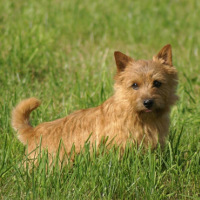
| The Cairn Terrier is descended from working dogs indigenous to the Scottish Highlands. Captain Martin MacLeod is said to have created the first Cairn Terriers on the Scottish island of Skye. These bold dogs were used to hunt foxes and rabbits, and were prized for their strength and determination. | ||
 |
||
| Standard of the Cairn Terrier | ||
A little of the Scottish Terrier |
||
| The original Scottish Terrier, now extinct, may date back to Roman times and was described by Pliny the Elder. This dog is probably the foundation on which later Scottish Terriers developed. What we call the modern Scottish Terrier dates back to the 15th and 16th centuries, when hunters chased game from its lair. This is reflected in the title Terrier, which comes from a Latin word meaning workers of the land. King James I of England (James VI of Scotland) was particularly fond of this breed. He is known to have presented Scottish Terriers to the French monarch. King James's enthusiastic patronage of the breed, together with its distinctive look and thick black coat, made it popular in royal circles at court. | ||
 |
||
| Standard of the Scottish Terrier |
Appearance of the Bushland Terrier |
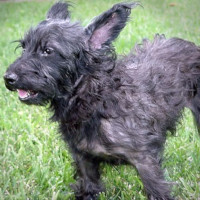
| The Bushland Terrier is a sturdy little dog, longer in body than its size, with a compact profile. The Bushland Terrier's skull has the appearance of a Scottish Terrier, although it has more hair. Their coat is of course thick and double, to protect them from the harsh Scottish climate. The Scottish Terrier's black coat dominates that of the Cairn Terrier, making black the common color. |
Temperament of the Bushland Terrier |
| The term Terrier has many implications as dogs bred for work and hunting. They have a natural hunting instinct, which can make them poor roommates with other pets, such as cats or rabbits. Terriers are also independent thinkers, which can manifest itself in stubbornness. The Bushland Terrier should be well socialized as a young puppy. This improves another terrier trait of being prone to aggression when threatened. With proper handling from an early age, this gives them the right social skills to mix well with people. A Bushland Terrier is unlikely to come across as a fool, and can break very well if mistreated. This has implications when you're around children, so supervision is necessary at all times. |
Needs and activities of the Bushland Terrier |
| The Bushland Terrier loves to play and needs at least 45 minutes to an hour of activity a day. A dog that doesn't get enough exercise will generally have behavioral problems as it gets bored and turns to other activities. A trip to the local dog park, a run around the neighborhood or a long game of fetch are all excellent choices for your Bushland Terrier. They love to run and will do their best in agility competitions, so you might want to try it too. If you don't have a fenced yard, be sure to take your dog out on leash at least once a day to play and get some fresh air. |
Maintenance of the Bushland Terrier |
| Your Bushland Terrier should be brushed at least three or four times a week to prevent matting and reduce shedding. Their long, thick fur can be difficult to brush, so you'll need a metal comb and a stiff bristle brush. Use your fingers to loosen matting and knots rather than the metal comb, which will damage the hair. Clean your dog's ears with a soft cloth or cotton balls and water once a week. Watch for redness, wax build-up and mites. To prevent dental disease, brush your dog's teeth at least two or three times a week with a toothpaste specially formulated for dogs. You should also trim your dog's nails if necessary. |



 English (United Kingdom)

Comments