
 |
Golden Irish |
|
He is not recognized by the F.C.I. |
Origin |
Great Britain <> Ireland -> U.S.A. | |
Translation |
Francis Vandersteen |
A brief presentation of the Golden Irish |
| The Golden Irish is a hybrid dog, a cross between Golden Retriever and Red Irish Setter parents. This treasure of a dog is also known as the Golden Setter. Given that both parents are descended from working dogs, it's not surprising that their offspring are active and need a lot of exercise. Another characteristic inherited from both parents is their exceptional temperament, making them excellent family companions. However, Golden Irish are not for the first-time dog owner. While affectionate and gentle, they can have a persistent tendency and, in the wrong hands, become prone to bad behavior. However, with an experienced owner who gives them plenty of exercise, the Golden Irish is a head-turning canine companion, willing and able to take part in dog-centric sports such as agility or Canicross. |
History of the Golden Irish |
| As with most hybrid dogs, their history actually belongs to that of the pure breeds, in this case the Golden Retriever and the Irish Setter. |
A little of the Golden Retriever |
||
| The development of the Golden Retriever as a breed is attributed to Scottish Lord Tweedmouth. He worked diligently between around 1835 and 1890 to develop a golden dog adept at retrieving waterfowl. He achieved this by selecting golden puppies from litters produced by matings between Tweed Water Dogs, Flat-Coated Retrievers and the now extinct Irish Setters. Officially recognized by the Kennel Club in 1911, they were then referred to as yellow or golden, and it was in the 1920s that the golden moniker was officially adopted. | ||
 |
||
| Standard of the Golden Retriever | ||
A little of the Irish Red Setter |
||
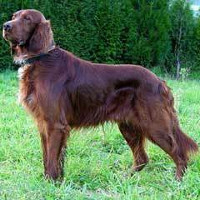
| They originated in the 18th century, and are a mixture of English Spaniels and Setters, with the Gordon Setter. These early representatives of the breed tended to have a mixed coat color of red sprinkled with white. It was the Earl of Enniskillen who is credited with promoting the solid red coat and encouraging its development. In 1875, the first Irish Setter was successfully imported to the USA. This was the beginning of an American craze for this distinctive red-haired breed. However, this led to a diversification within the breed between working dogs and companion dogs. This caused some concern among purists who feared that the heavier working dog was dying out. Some breeders then concentrated on perpetuating the working dog. This is why, today, there are two distinct types of Red Setter: the working dog and the show dog. | ||
 |
||
| Standard of the Irish Red Setter |
Appearance of the Golden Irish |
| As a hybrid dog, genetic inheritance principles imply variations in puppy appearance. While some of the litter will be a true mix of parent breeds, others will lean more towards one or other of the parents. These puppies, which are a true mix of Golden Retriever and Irish Red Setter, will be large dogs with a bone structure slightly finer than that of the Golden Retriever. They'll have a good-length nose and drop ears that hang down their cheeks. Characteristically, their chest is deep, with a slightly upturned waistline. They should have a long, straight tail, well feathered. The coat is long and fine and requires regular attention to keep it in good condition. The coat should be a solid color, most often red, gold, yellow, chocolate or brown. |
Temperament of the Golden Irish |
| Both the Golden Retriever and the Red Irish Setter have remarkable personalities, renowned for their intelligence, loyalty, love and intuition, depending on the owner's mood. However, like all dogs, adult character is partly determined by early life experiences. Good socialization is essential if the dog is to become a well-adjusted, confident adult. While Golden Retrievers are playful but generally level-headed, the Red Irish Setter can be inclined to be very tense and sometimes anxious. This means that a Golden Irish has the potential to develop problems, such as separation anxiety, but this can be improved by good early socialization and the use of reward-based training to boost their confidence. |
Needs and activities of the Golden Irish |
| Golden Irish have a high energy level that will require 60 minutes of activity a day. He has the talent and energy for agility, obedience trials, field competitions and conformation shows. Give him the chance to shine, and he will. He'll need at least two long walks a day, and if you suggest more, he'll be happy. Not destined for apartment life, he'll enjoy a home with a yard where he can let off steam and play. They do well in any climate. |
Maintenance of the Golden Irish |
| The Golden Irish is not considered a hypoallergenic breed. It will shed moderately. Its long, fine coat requires daily brushing. A brush works well to smooth the coat, and once brushed, a comb can be used to remove any remaining tangles. He shouldn't need to bathe often unless he falls in a bit of mud or dirt when he's out in the field or racing. Check his ears often for moisture build-up or dirt. If he's a keen swimmer and gets the chance often, he can develop ear problems if they're not kept clean. Avoid costly bills by brushing his teeth every day and trimming his nails every two months. |



 English (United Kingdom)

Comments