 |
Golden Pyrenees |
|
He is not recognized by the F.C.I. |
Origin |
Great Britain <> France -> U.S.A. | |
Translation |
Francis Vandersteen |
A brief presentation of the Golden Pyrenees |
| The Golden Retriever is one of the world's best-loved and best-known dog breeds. So it's no surprise that their hybrids are becoming just as popular. They are known to make excellent pets, as they are infinitely tolerant and loving. Golden Pyrenees combine them with the Pyrenean Mountain Dog, a giant dog with a naturally protective character and a somewhat reserved personality. Considered by some to be smaller polar bears, Golden Pyrenees are big dogs with thick coats, often white, cream or gray. They have dark eyes and a big black nose, which only adds to their bear-like appearance! Their coats can be high-maintenance, especially if they take more after Pyrenean Mountain Dogs, so owners need to stay on top of their grooming routine. |
History of the Golden Pyrenees |
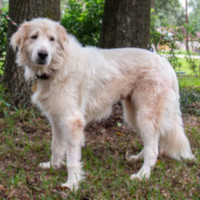
| Golden Pyrenees are thought to have developed within America, as is the case with many newer hybrid dogs. Because they're so new to the scene, we're always learning more about their personalities, and they continue to develop their unique appearance. However, we do know a lot about each parent breed, which can give us a good insight into the Golden Pyrenees. |
A little of the Golden Retriever |
||
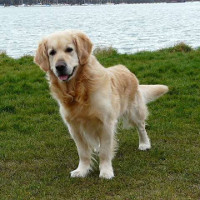
| The development of the Golden Retriever as a breed is attributed to Scottish Lord Tweedmouth. He worked diligently between around 1835 and 1890 to develop a golden dog gifted at retrieving waterfowl. He achieved this by selecting golden puppies from litters produced by matings between the now extinct Tweed Water Dogs, Flat-Coated Retrievers and Irish Setters. Officially recognized by the Kennel Club in 1911, they were then referred to as yellow or golden, and it was in the 1920s that the golden moniker was officially adopted. | ||
 |
||
| Standard of the Golden Retriever | ||
A little of the Pyrenean Mountain Dog |
||
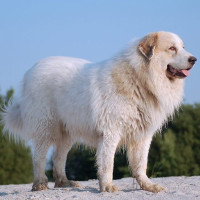
| The Great Pyrenees are also known as the Pyrenean Mountain Dog and are thought to have a much longer history than the Golden Retriever, whose origins date back some 200 years. These dogs have been found in the Pyrenean mountains, fearlessly protecting local farmers' livestock from dangerous predators such as wolves. Natural guardians, these dogs always have a personality that lends itself well to the protection of property and people. In recent times, Pyrenean Mountain Dogs have not proved particularly popular, and many people will never have met one in real life. | ||
 |
||
| Standard of the Pyrenean Mountain Dog |
Appearance of the Golden Pyrenees |
| Although undeniably colossal, Golden Pyrenees manage to maintain their athleticism, which is admirable and has not always been possible in the canine world. They maintain a rather elegant appearance and a confident attitude. Their large, powerful bodies are deep-chested and they stand proudly with a good abdominal tuck. Their limbs are long and strong, with particularly well-developed hind limb muscles. One of their most endearing features is their long, erect tail, often held in a characteristic position all the way to the ground. They have a broad forehead, almond-shaped brown eyes and a muzzle with an upper lip slightly drooping over the lower lip. Their ears hang down but face forward, and are generally widely spaced. Fully grown Golden Pyrenees will weigh an average of 34 to 52 kg and measure 61 to 76 cm at the withers. For many, the Golden Pyrenees' coat is their most attractive physical quality. It's long, thick and straight, perfect for petting all day long. Most will be plain, light colors, such as cream and gold, but they can have patches of brown and black fur. They have a pronounced mane of fur around the neck, making it look even wider and broader than it already is. |
Temperament of the Golden Pyrenees |
| The Golden Retriever and the Pyrenean Mountain Dog have quite different personalities and, as might be expected, the temperament of Golden Pyrenees can be difficult to predict. Most will inherit the sweetness of the Golden Retriever, but will be more protective and less laid-back. They should be energetic and playful, and will never say no to a game. They are friendly and kind to their immediate family, but when it comes to socializing with those outside their circle, they are more wary than the Golden Retriever and may take longer to open up to new people. Because of their size, they are not ideal pets for small children, as injuries can occur when Golden Pyrenees ignore their size and strength compared to toddlers. Suitable guard dogs, Golden Pyrenees are always eager to protect their home and will intimidate even the bravest intrepid with their loud, deep bark. |
Needs and activities of the Golden Pyrenees |
| This dog needs daily exercise to stay fit and healthy. This will also help them stay within a weight range, as they can easily put on excess weight. Play activities can range from running with a ball to tug-of-war. An argument with other dogs in the secure park will help socialize your dog, and it will learn to accept other dogs and people with good grace. With their thick coats, they do not tolerate extreme heat well. |
Maintenance of the Golden Pyrenees |
| Golden Pyrenees have a very thick, soft coat that's pleasant to the touch, but requires extra care to keep it from clumping. Although their coat may not be as thick as that of its relative the Pyrenean Mountain Dog, it will need daily brushing to keep it soft and silky. They don't need to be bathed regularly, only when they really need it, or they risk losing the natural oils in their coat. Other maintenance issues to deal with are nail clipping and tooth brushing to maintain good oral hygiene. Golden Pyrenees will love all the attention, and are bound to let you look after them to perfection. |



 English (United Kingdom)

Comments