
 |
Jatese |
|
He is not recognized by the F.C.I. |
Origin |
Central Mediterranean Basin <> China -> U.S.A. | |
Translation |
Francis Vandersteen | |
This breed is also known as |
Maltichin |
A brief presentation of the Jatese |
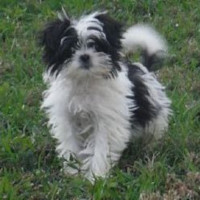
| Cross-breeding the gentle, attention-seeking Maltese with the loyal, affectionate Japanese Spaniel has resulted in a lively, characterful cross-breed known as the Jatese or Maltichin. The Jatese has big, imploring eyes and a circular skull that gives it a cute, puppy-like appearance, even as an adult. The Jatese's soft, plush coat can be white, black or a mixture of both, and will grow long and straight. Although this small-sized dog likes to keep active and busy, it doesn't need much exercise or space and is well suited to city life. They'll never say no to a game or a puzzle, but they don't need excessive attention. It's important to avoid the onset of behavioral problems, such as separation anxiety or small dog syndrome, as these dogs grow older, which can be problematic for some. |
History of the Jatese |
| While it's true that Japanese Spaniels and Maltese come from all over the world, these little dogs actually have a lot in common. Although it's not known when they were first crossed, the resulting Jatese is thought to be a relatively new hybrid dog with a lot to offer. Having only been around for a decade or two, there's not much to write about the Jatese's short history, however, there is plenty to say about each parent breed. |
A little of the Maltese |
||
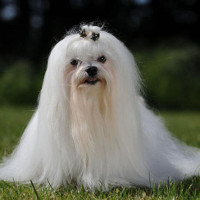
| Maltese can be traced back to truly ancient dogs that existed over 2,000 years ago and are probably best known for their elegant flowing white coat. As with the Japanese Spaniel, experts believe that the Maltese title is a misnomer and that the breed did not originate in Malta but was developed on the ancient island of Meleda, off the Dalmatian coast. Throughout the Mediterranean, Maltese have been kept as a much-loved pet for centuries, and they continue to be excellent pets to this day. The British Kennel Club recognized the breed as early as the 1870s, and it is now part of its toy group. | ||
 |
||
| Standard of the Maltese | ||
A little of the Japanese Spaniel |
||
| The Japanese Spaniel is an Asian breed that originated in China, despite its name, and has always been a popular pet of the upper classes and aristocracy. Contributing breeds include the Cavalier King Charles Spaniel, Pekingese and Tibetan Spaniel. The breed's provenance in Japan is uncertain, although there are several interesting theories. Some believe they were brought by monks, while others claim that the first Chinese imported to Japan were a gift from the Chinese emperor. However they got there, this gentle little dog quickly became a favorite among the elite. Over the years, breed members were exported internationally, and the Japanese Spaniel has become a much-loved toy breed worldwide. | ||
 |
||
| Standard of the Japanese Spaniel |
Appearance of the Jatese |
| Predicting what any hybrid dog will look like as an adult can be a challenge, as it's difficult to know which parent breed they'll inherit most of their genes from. All Jateses are small, measuring just 20 to 28 cm and weighing 3 to 4.5 kg. Their heads are domed and relatively small. Some have the stunted muzzle of the Japanese Spaniel, while others have the longer muzzle of the Maltese breed. Their eyes are dark brown and occupy a large part of their small face. They have hanging ears that will fall to the side of the head or slightly forward. Their bodies are slender and elegant, with fine bone structure and light musculature. Their sophisticated tail is carried high over their back and arches considerably. Their long, fine fur is one of their most beautiful features. Renowned for its luxurious coat, the Jatese has a long, silky fur that can be black, white or black and white, also known as Pie. Those with a black and white coat often have spots and markings of color. |
Temperament of the Jatese |
| A dedicated family dog, the Jatese is happiest when around people, and will sit affectionately and lie on them whenever possible. Loving and gentle, those who take on a Jatese will immediately be seduced by their charm. They don't like to be left alone and can be prone to separation anxiety, especially if they have to spend long periods alone. Playful and curious, the vast majority of Jateses enjoy being in homes with children and most other pets. As they are fully socialized from an early age, they should not show aggression or frustration when in their company, and should tolerate them very well. Caution is advised when children are young, as they may be tempted to carry or play roughly with the Jatese. Such a small, lightweight dog can break bones, even if it's only a minor injury. |
Needs and activities of the Jatese |
| Although this dog is an energetic animal, it can expend a lot of energy without considerable effort on your part. This crossbreed will certainly enjoy short walks around the neighborhood, but it's best to take frequent breaks, about every twenty minutes or so. Don't forget that this hybrid has only a single layer of hair and may therefore be more sensitive to the cold. If you live in a colder climate, sweaters and jackets designed for your canine companion may be a good investment. Jatese dogs, which have inherited the short, broad muzzle of the Japanese Spaniel, can also become overheated, so don't overdo the sports in hot weather. Puzzles and toys designed for dogs and games of hide-and-seek are enough to keep their active little minds occupied. They generally make pleasant housemates, even in smaller spaces. |
Maintenance of the Jatese |
| The Jatese's grooming requirements may vary a little from dog to dog, depending on the coat it has inherited, but generally not much. Both parent breeds require baths every three to four weeks, which is more than most dogs of the same size as their offspring, but unless their coat is clipped, those who inherit the Japanese Spaniel's longer coat will need to be combed and brushed daily. The Japanese Spaniel also has a silky, single-layer coat, but it's a little shorter than the Maltese's and less prone to tangling. Brushing a few times a week is therefore sufficient for their coat. Both parent dogs are low-loss dogs that have been classified as hypoallergenic, and Jatese dogs share this classification. |



 English (United Kingdom)

Comments