 |
American Bull-Aussie |
|
He is not recognized by the F.C.I. |
Origin |
U.S.A. -> U.S.A. | |
Translation |
Francis Vandersteen |
A brief presentation of the American Bull-Aussie |
| The American Bull-Aussie is a hybrid breed made from the American Bulldog and the Australian Shepherd. They are a fairly new type of dog, and little has been discovered or documented about them. The best way to determine the appearance and behavior of your American Bulldog-Aussie is to consider the appearance and temperament of the two parent breeds. As both breeds are fairly active, it's safe to assume that the designer breed will also have similar needs. Your dog will need to be exercised regularly, but will make an excellent companion who is devoted to his family, and calm with children too. |
History of the American Bull-Aussie |
| This hybrid breed is modern and therefore little documented. Although the history of the American Bull-Aussie is largely unknown due to their recent creation, we do know the origins of the American Bulldog and the Australian Shepherd Dog. |
A little of the American Bulldog |
||
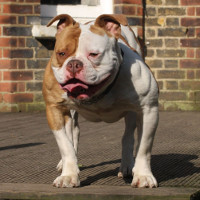
| The American Bulldog was developed as a general-purpose farm dog in the southern United States, with a specialty in catching pigs and cattle. The breed is a direct descendant of the old English Bulldog, now extinct, and is widely regarded as the modern breed in appearance, temperament and use closest to its ancestor. The American Bulldog was almost extinct by the middle of the 20th century, but was revived by the efforts of two breeders, John D. Johnson and Alan Scott, who subsequently developed two distinct lines that were named for them. In recent years, the American Bulldog has experienced a massive increase in popularity and is one of the fastest-growing breeds in the USA. Many have classified this breed as a type of Pit Bull, a member of a group of dogs collectively known as Bully Breeds, but this is totally inaccurate and regarded with great distaste by the vast majority of lovers of both American Bulldog and American Pit Bull Terrier. The two varieties of American Bulldog are sometimes referred to as the Southern White, Old Southern Whites and American Pit Bulldogs. The Scott type is also known as the Standard or Performance type, and the Johnson type is also called the Bully or Classic type. | ||
 |
||
| Presentation of the American Bulldog | ||
A little of the Australian Shepherd |
||
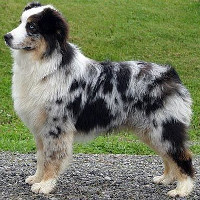
| The Australian Shepherd, which is not actually from Australia but originated in the Pyrenees, quickly found its way to ranches in the USA, where they proved qualified for breeding. Today, this breed excels in many canine sports and activities, such as agility, obedience, search and rescue, trick training, retrieving, observation and guarding, police work and drug detection. | ||
 |
||
| Standard of the Australian Shepherd |
Appearance of the American Bull-Aussie |
| These cute hybrid dogs will adopt the physical characteristics of both parent breeds. They will have a long tail but short, floppy ears. The American Bulldog has a powerful, robust build with a large head and strong jaws. They have a broad, deep chest with a strong neck that tapers from the shoulders to the head, which is large, broad and square. The eyes are rounded and the stop is defined. Their muzzle is square and broad, and will have either a scissor bite or a uniform pincer bite. The front flap of cropped, pink or half-pricked ears can all be seen on this breed. The straight legs are strongly boned, and the hind legs will be muscular, broad and thick. The tapered tail is low. This dog's other parent, the Australian Shepherd, is a medium-sized dog that is slightly longer than it is tall. They have a deep chest and stand upright, with a muzzle the same length as the top of their head. Their medium-sized oval eyes, like their coats, can come in a variety of colors. Triangular ears are set high and erect on top of their heads, and these dogs will have manes around their necks and feathers on the backs of their legs. It's hard to know what percentage of each parent your American Bull-Aussie will have, but they'll be a combination of both breeds. |
Temperament of the American Bull-Aussie |
| This specific crossbreed is intelligent, loyal and protective of its family. They are intelligent and will be relatively easy to train. Although alert, these dogs will not be good as watchdogs as they are not big barkers. They are playful and calm, and get on very well with children. The American Bulldog is known for being a loyal, non-hostile dog that protects its family and loves children. To prevent them from becoming reserved towards strangers or aggressive with other dogs, these dogs will need appropriate socialization and training. Australian Shepherds are courageous, devoted and easy to get along with. They're also great with children, and with their high intelligence, they're also easy to train. These dogs are calm around their families but devoted and aggressive when doing their job, which is herding livestock. Although they are not generally aggressive towards other dogs, they still need to be socialized and trained early in life, as do all breeds. It's impossible to know for sure what personality the American Bull-Aussie will develop, but it's safe to assume that it will be similar to that of its parents. |
Needs and activities of the American Bull-Aussie |
| The American Bulldog will need plenty of exercise and stimulation, both mental and physical, or they may become difficult to manage. The Australian Shepherd could also become destructive and upset if not sufficiently active. While all dogs are different and the exact amount of exercise depends on the individual, be prepared to devote at least 45 minutes to an hour of exercise for your American Bull-Aussie. |
Maintenance of the American Bull-Aussie |
| The American Bull-Aussie is a dog with a moderate shedding level and should therefore be brushed about once a week. While grooming, use a grooming glove for best results. To reduce the risk of developing infection or other problems, your dog should have his ears cleaned and checked every week. To keep your dog's teeth clean and healthy, teeth brushing should be carried out three times a week or, better still, every day. In terms of nail trimming, this hybrid breed should receive the same care as all other dogs. This means that they should be trimmed once or twice a month, unless they wear naturally, in which case less often might suffice. You should start playing with your dog's feet and mouth at an early age to make grooming a pleasurable experience as he grows. |



 English (United Kingdom)

Comments