
 |
Aussie Silk Terrier |
|
He is not recognized by the F.C.I. |
Origin |
Australia -> U.S.A. | |
Translation |
Francis Vandersteen |
A brief presentation of the Aussie Silk Terrier |
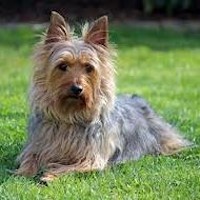
| Aussie Silk Terriers are classified as a Toy breed and are a cross between pure-bred Australian Terriers and silky-haired Australian Terriers. Aussie Silk Terriers are bred to be companion dogs due to their small size, as well as loyal and friendly big dog personalities. This breed is playful, intelligent and full of character. Although small, Aussie Silk Terriers are very energetic and require regular exercise and mental stimulation. The breed is known to be sometimes barky like a Silky Terrier, but more laid-back (in Terrier world) like an Australian Terrier. Like many small dogs, they have a relatively long average lifespan of 12 to 15 years, and have long, straight coats that require regular trimming, washing and brushing. |
History of the Aussie Silk Terrier |
| The name Aussie Silk Terrier is a combination of the nicknames of its two parent breeds, the Australian Terrier or "Aussie" and Australian Silky Terrier or "Silk". The two breeds are very similar in personality, appearance (with the exception of coat texture) and origin. The Australian Terrier and Australian Silky Terrier are well known for their intelligence and ability to kill small animals such as snakes and vermin. As a hybrid breed, the Aussie Silk Terrier is relatively new, and there is no exact date of origin for it. The breed is not yet widespread or extremely popular, but it is celebrated among Terrier fans for its friendly big-dog personality. |
A little of the Australian Terrier |
||
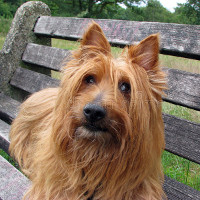
| Australian Terriers are thought to have been developed from a mixture of European Terrier breeds as companion and guard dogs in Tasmania in the mid-1800's. They first gained popularity in Melbourne, Australia, but quickly penetrated British homes in the late 1800's. In 1925, Australian Terriers came to the United States, where they were recognized by the American Kennel Club (AKC) in 1960. | ||
 |
||
| Standard of the Australian Terrier | ||
A little of the Australian Silky Terrier |
||
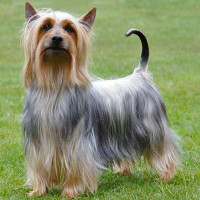
| The Australian Silky Terrier has a complicated history. It was bred in two parts of Australia, leading to confusion in classification from the early to mid-1900s. It is known for having the adventurous tendencies of its close relative, the Yorkshire Terrier. Originally known as the Sydney Silky Terrier, its name was changed to the Australian Silky Terrier in 1955. Finally, the name was changed again, simply to Australian Silky Terrier, and recognized by the AKC in the same year. | ||
 |
||
| Standard of the Australian Silky Terrier |
Appearance of the Aussie Silk Terrier |
| Aussie Silk Terriers are low to the ground and longer than they are tall. It is compact, but agile enough to be an efficient vermin hunter. This breed is classified as a toy, with an average weight of 3.5 to 4.5 kilos and an average height of 23 to 25 centimeters. It has erect, triangle-shaped ears, an alert expression and a short, tapering muzzle. The Aussie Silk Terrier has small cat-like paws and a high, erect tail. Their silky coat is straight and long. Generally, Aussie Silk Terriers are either silver and beige or black and beige, with the extremities of their coat being the darker color. |
Temperament of the Aussie Silk Terrier |
| This breed has strong guarding instincts, like their silky-haired Australian Terrier relative, and can be very attached to strangers, small children and other dogs. However, these traits are softened by its Australian Terrier lineage, which is known to be relatively more adaptive than many Terrier breeds. Because the Aussie Silk Terrier is so intelligent, he's very receptive to training, especially at a young age. He'll quickly learn commands, routines and tricks, but also has a reputation for being stubborn and mischievous at times. Overall, the Aussie Silk Terrier is a gentle and loyal companion, but can be stubborn. |
Needs and activities of the Aussie Silk Terrier |
| Aussie Silk Terriers are known for their strong character and big-dog personality. They are generally energetic, intelligent and territorial. If not sufficiently entertained, Aussie Silk Terriers bark or become hyperactive. What's more, Aussie Silk Terriers love to explore and often chase or dig in their quest for adventure. |
Maintenance of the Aussie Silk Terrier |
| Aussie Silk Terriers have a long, odorless coat that resembles human hair. Because of its long coat, many owners have their pets groomed regularly. Others, however, just wrap it around their eyes, ears and paws for easy maintenance. In any case, Aussie Silk Terriers should be bathed every two weeks, including shampooing and conditioning. What's more, because of the coat's length, it's prone to tangles and matting. Daily brushing will reduce matting and help Aussie Silk Terriers retain their shine. As with all dogs, owners should brush their teeth daily and trim their nails once or twice a month. |



 English (United Kingdom)

Comments