 |
Aussietare |
|
He is not recognized by the F.C.I. |
Origin |
U.S.A. <> Great Britain -> U.S.A. | |
Translation |
Francis Vandersteen |
A brief presentation of the Aussietare |
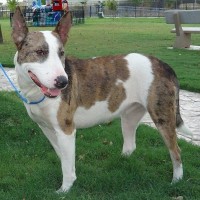
| An Aussietare is a combination of a pure-bred Australian Shepherd and a Bull Terrier. Aussietares are bred to be active companion dogs. The breed is known to be protective, playful and sometimes aggressive due to its Terrier and Bulldog lineage. Because they are social, Aussietares don't like to be alone for long periods and need regular exercise. They are best suited to energetic couples or families with older children. They are large-breed dogs with an average lifespan of 11 to 15 years, a weight of 22.5 to 32 kilos and a height of 51 to 58.5 centimeters. Their coat is medium to short in length, comes in many of the colors common to Australian Shepherds and Bull Terriers, and can have vague or strong Australian Shepherd markings. |
History of the Aussietare |
| The name Aussietare is a play on the names of its two parent breeds, the Australian Shepherd, also known as the Aussie, and the Bull Terrier, which is also known as the Bully or English Gladiator. The hybrid of these two breeds is a relatively new and atypical hybrid, so its personality and appearance have not yet stabilized. As such, it is not widely recognized and lives in the shadow of the more popular Australian Shepherd hybrid breeds. Nevertheless, breeders have found that, so far, Aussietares retain the protective and playful qualities of their parent breeds. Note, however, that Aussietares are not recognized by the AKC, so Aussietare breeders should be thoroughly researched if you intend to buy from them. |
A little of the Australian Shepherd |
||
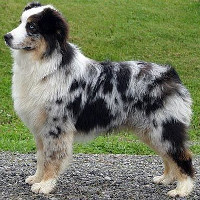
| The Australian Shepherd originated, not in Australia, but in the western United States, where it was probably bred from Collie varieties in the early 1900s for flocks of sheep. Australian Shepherds gained in popularity during the 1950s and are now employed as handicap guides, therapy dogs, drug detectors, search and rescue agents and of course beloved pets. | ||
 |
||
| Standard of the Australian Shepherd | ||
A little of the Bull Terrier |
||
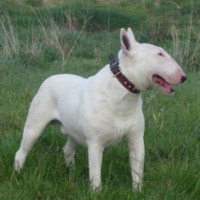
| The Bull Terrier was originally a mainly white-coated cross between Bulldogs and various Terriers, first known as Bull-and-Terriers. Eventually, it was mixed with Spanish Pointers to add size. These dogs gained popularity in the early 1800s when they were used for various sporting activities and dog fights in Europe. After dogfighting was banned, the Bull Terrier gained a reputation as a fashionable companion of high society, particularly because of its impressive white coat. In 1885, Bull Terriers were recognized by the American Kennel Club (AKC). Later, they were crossed with Staffordshire Bull Terriers to develop more color variations. Today, the white Bull Terrier remains the most popular and best-known Bull Terrier. | ||
 |
||
| Standard of the Bull Terrier |
Appearance of the Aussietare |
| Aussietares generally resemble muscular, less fluffy shepherds with Terrier characteristics. They are generally a large breed. The average weight is 22.5 to 32 kilos and the average height is 51 to 58.5 centimeters. Their short to medium coat can be straight or wavy, as well as smooth and thick. The extent of coat variation within each parent breed explains the wide range of Aussietare patterns and colors. They generally have a lighter base color with light Australian Shepherd accents, patches or markings of white, gray, black, brown and beige. The paws are round, compact and thickly padded, while the tail is short to medium. Aussietares have a watchful, intelligent expression, with high, often flapping triangle-shaped ears, a relatively flat forehead and small triangular eyes for its large size. |
Temperament of the Aussietare |
| The Aussietare doesn't bark frequently, but can be more buccal, likely to nip or bite when playing, than many other breeds. They can also be aggressive towards small animals, other dogs and people, especially if they don't know them well. Because Australian Shepherds and Bull Terriers are so easy to train, however, Aussietares respond well to discipline at an early age to counter these aggressive impulses and behavioral problems. |
Needs and activities of the Aussietare |
| Aussietares are known to be very energetic and playful with people, including children and other dogs. They are active, social creatures who enjoy being around others. The breed tends to be particularly affectionate and protective of family members, and develops strong attachments to the people and other pets in its life. Like many high-energy breeds, if left alone for long periods, Aussietares can be destructive and mischievous. They also have a strong desire to move around, so Aussietares must be closely supervised when outside confined spaces. |
Maintenance of the Aussietare |
| The Aussietare is a relatively low-maintenance breed. Its short to medium-length coat, which is not hypoallergenic, does not generally require trimming or styling. Occasional brushing should help reduce the breed's moderate shedding and keep its coat shiny, although this is not always necessary. Owners should aim to bathe the Aussietare once a month or as needed. As with all breeds, Aussietare owners should brush their pet dog's teeth daily, trim its nails every month or so, and take particular care to keep its eyes and ears clean. Aussietares are not known to drool or smell if they are healthy and clean. |



 English (United Kingdom)

Comments