
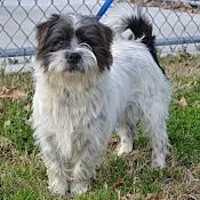
 |
Blue Tzu Heeler |
|
He is not recognized by the F.C.I. |
Origin |
Australia <> Tibet -> U.S.A. | |
Translation |
Francis Vandersteen | |
This breed is also known as |
Cattle Tzu |
A brief presentation of the Blue Tzu Heeler |
| The Blue Tzu Heeler is a cross between the Australian Cattle Dog and the Shih Tzu. They are bred to be companion dogs and are known to be friendly, lively and affectionate, though occasionally obstinate. They need moderate exercise and lots of human attention. They have an average lifespan of between 10 and 14 years, a height of 28 to 46 centimeters and a weight of 7 to 16 kilos. Blue Tzu Heelers resemble shaggy cattle dogs with some Shih Tzu characteristics. Because it's a relatively new breed, its standards haven't stabilized and it's not recognized by the American Kennel Club, although it can be found on the Designer Breed Registry's list of hybrids. |
History of the Blue Tzu Heeler |
| The name Blue Tzu Heeler is a nod to the breed's color and the names of its two parent breeds: the Australian Cattle Dog, also known as the Queensland Heeler, Blue Heeler, or Hall's Heeler, and the Shih Tzu, a companion dog that dates back to 17th-century Tibet. |
A little of the Australian Cattle Dog |
||
| The Australian Cattle Dog, a descendant of the Collie and Dingo varieties, was bred in Australia in the mid-1800s in herds. Eventually, the mixed breed known for its endurance and work ethic, was mixed with a Dalmatian and a Sheepdog. It was recognized by the AKC in 1980. | ||
 |
||
| Standard of the Australian Cattle Dog | ||
A little of the Shih Tzu |
||
| The Shih Tzu is said to be a Tibetan mountain dog crossed with a Pekingese. It was known as a holy dog, and Shih Tzus were owned and bred by royal families during the Ming and Manchu dynasties. As a show dog in China in the 1930s, it was called a Lhasa Terrier or Tibetan Poodle. Later, it became a Lhasa Lion Dog. In the mid-1900s, China offered a Shih Tzu as a gift. As a result, the breed made its way to Europe and North America, where it was recognized by the AKC in 1969. | ||
 |
||
| Standard of the Shih Tzu |
Appearance of the Blue Tzu Heeler |
| Blue Tzu Heelers generally resemble small Australian Cattle Dogs with shaggy coats and certain Shih Tzu characteristics, such as round, close-set eyes. They are generally small, medium-sized dogs. The average weight is 7 to 16 kilos and the average height is 28 to 46 centimeters. Their medium-length coats are wavy, with parts in the middle of the head and down the muzzle, creating a Terrier look. They are generally blue, marbled or spotted, or black and white with tan markings. Their medium-length tails are covered by their wavy coats. Blue Tzu Heelers have high, sometimes pendulous triangular ears, a short, square muzzle with a black nose and an alert, playful expression. |
Temperament of the Blue Tzu Heeler |
| Blue Tzu Heelers are known to be very friendly and eager to please older children and familiar adults. They are not great with other dogs or small children, who might tease or taunt them. What's more, the Blue Tzu Heeler gets the stubbornness of its two parent breeds, so it's not the easiest dog to train. Yet these dogs are true companions, loving their people with fervor and loyalty. Blue Tzu Heelers are spirited, sometimes silly animals that enjoy moderate exercise and playing games with their owners. If they don't get enough attention, they can become puffy, overly excited or try to talk by barking or whining. Overall, Blue Tzu Heelers thrive in social, affectionate households, where they are disciplined at a young age. This breed could adapt very well to city life, and would do well in an apartment if given sufficient time and moderate, but regular, exercise. |
Needs and activities of the Blue Tzu Heeler |
| The Blue Tzu Heeler requires only a moderate amount of exercise. They should have at least one short walk a day, combined with playtime with their owner and other family members. Blue Tzu Heelers do well in any type of climate and would be very happy in a social home with space for energetic play. Both parent breeds of the Blue Tzu Heeler have strong impulses to hunt and roam, so this breed should be closely supervised if off-leash. Although Blue Tzu Heelers love to be outdoors, they are primarily indoor animals content to socialize and snuggle with their people. |
Maintenance of the Blue Tzu Heeler |
| Blue Tzu Heelers are not completely hypoallergenic, but produce fewer allergens due to the hair-like coat they inherit from their Shih Tzu parent breed. Owners can reduce shedding and matting by brushing weekly and giving their Blue Tzu Heeler monthly baths. Owners should pay particular attention to inspecting their pet's ears and eyes when they are bathed. Like all dog breeds, Blue Tzu Heelers should let their teeth be brushed daily and their nails trimmed 1-2 times a month. Because Blue Tzu Heelers have a medium-length wavy coat, it's advisable to trim around the head, ears, tail and feet for convenience, although some owners opt for regular professional grooming. |



 English (United Kingdom)

Comments