
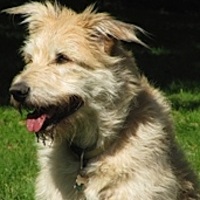
 |
Bouvador |
|
He is not recognized by the F.C.I. |
Origin |
Belgium / France <> Canada -> U.S.A. | |
Translation |
Francis Vandersteen |
A brief presentation of the Bouvador |
| The Bouvador is a designer breed, a combination of two pure breeds, the Bouvier des Flandres and the Labrador Retriever. The Bouvador will be a great breed. Athletic and intelligent, this hybrid loves a job to do. It's a strong, muscular dog that can get the job done and is happy to relax at the end of the day. He can be assertive but responds well with the right training. The Bouvador is not a dog for someone looking for their first dog. He's best suited to an active household with plenty of space for him to live. |
History of the Bouvador |
| Because the Bouvador is a modern breed, their documented history is limited. |
A little of the Flanders Cattle Dog |
||
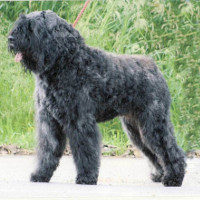
| The Flanders Cattle Dog originated in Flanders and was bred to be a shepherd and farm dog. Flanders Cattle Dog means "Flanders cow breeder" in French. The Flanders Cattle Dog is thought to be the result of crossing Irish Wolfhounds and Scottish Deerhounds with local farm dogs. The breed not only guarded and protected flocks, but was also strong enough to pull carts. The Flanders Cattle Dog almost disappeared during the First and Second World Wars. It wasn't until 1965 that breed standards were agreed by several kennel clubs. Today, the breed works as a guide dog, police dog and military dog. Flanders Cattle Dog compete in canine agility, carting, obedience, canine showmanship and breeding. | ||
 |
||
| Standard of the Flanders Cattle Dog | ||
A little of the Labrador Retriever |
||
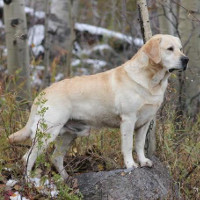
| The Labrador Retriever originated on the island of Newfoundland, off the coast of Canada. They were originally called the St. John's dog, after the capital of Newfoundland. The Labrador Retriever is thought to be a direct ancestor of the Avon. The Avon was a breed native to Newfoundland, used for hunting and as a draft dog. The first direct descendants of the Labrador Retriever are thought to have been exported to England in 1820. During the 1880s, the 3rd Earl of Malmesbury, the 6th Duke of Buccleuch and the 12th Earl of Home developed the first breed standards. Today's Labrador Retriever is an excellent hunting dog, therapy dog, search and rescue dog and service dog. They are highly trainable and excel in agility and obedience competitions. | ||
 |
||
| Standard of the Labrador Retriever |
Appearance of the Bouvador |
| The Bouvador will have the characteristics of both its parents. It will be a large, strong, muscular dog, and may have Labrador Retriever legs that enable it to excel in the water. His head may be broad with a wide muzzle that could have flared nostrils, typical of the Bouvier des Flandres parent. His eyes are dark and alert. He will have a dense medium to long coat. Thick and perhaps water-repellent like the Labrador Retriever, colors will include brown and black, and perhaps even brindle. The Bouvador will have floppy ears and its tail will probably be long and broad. |
Temperament of the Bouvador |
| The Bouvador will have a combination of Labrador Retriever and Bouvier des Flandres temperaments. The Bouvier des Flandres can be a little bossy, but the Labrador Retriever has a gentle disposition and likes to please its owner. The Bouvador makes an excellent watchdog. A herding instinct may be an innate trait that persists despite the fact that your hybrid has no sheep to herd, it can herd the family children and cat if you don't work hard to keep it under control. Highly intelligent, the Bouvador loves to be given a job and will be cheerful in his work. Obedience training is a good idea because of its size, but also because of its desire to learn and to be kept busy. The Bouvador really doesn't like to be left alone and can suffer from separation anxiety. He'll be happiest in a home where people are often present. |
Needs and activities of the Bouvador |
| Your Bouvador will enjoy his daily walks and should be walked at least twice a day, more often if you have the time. Your Bouvador will love the water, and a hybrid that spends a lot of time at the cottage or on the beach will be the happiest. At the very least, a large house in the suburbs with a fenced-in yard is necessary. This hybrid needs to stretch its legs regularly and can be prone to mischief if it doesn't get the energy expenditure it needs. Agility training, go-karting, therapy work and obedience trials are fun activities for you and your Bouvador. |
Maintenance of the Bouvador |
| The Bouvador can have a dense medium to long double coat, which should be brushed regularly. The coat of the Bouvier des Flandres therefore tends to mat, and this can happen in the Bouvador. A very important part of the Bouvador's maintenance routine will be to check the ears for excessive moisture and dirt. As your hybrid will love water and be active outdoors, the combination of moisture and dirt can lead to dirty, smelly ears, the perfect breeding ground for bacteria and infection. The Bouvier parent can have sensitive skin, so be sure to check for redness when brushing and cleaning your pet. This active hybrid can wear its nails naturally, but if not, trim them every two weeks. Don't forget to take care of your dog's teeth: brushing them every two or three days is the best way to avoid dental work. |



 English (United Kingdom)

Comments