
 |
Bullboxer Staff |
|
He is not recognized by the F.C.I. |
Origin |
Germany <> U.S.A. -> U.S.A. | |
Translation |
Francis Vandersteen |
A brief presentation of the Bullboxer Staff |
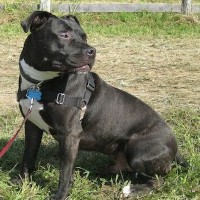
| Bullboxer Staff are affectionate, protective and playful companion dogs. They are known for their devotion to their owners and family members. Their average lifespan is 10 to 14 years, they generally weigh between 27 and 36 kilos and grow to between 46 and 63.5 centimeters in height. Although gentle, Bullboxer Staffs can be hostile to other dogs, so assiduous training is necessary for this breed, ideally from a young age. The Bullboxer Staff has probably been in development for decades, but has not yet completely stabilized its form or personality. As such, it can vary considerably in size and appearance, and is not recognized by the American Kennel Club's list of purebred dogs. Many owners will say it's a hybrid that demands attention, but is worth every ounce of effort. |
History of the Bullboxer Staff |
| The name Bullboxer Staff is a combination of the names of the dog's parent breeds: the Boxer and the American Staffordshire Terrier, also known as the Pit Bull Terrier. |
A little of the Boxer |
||
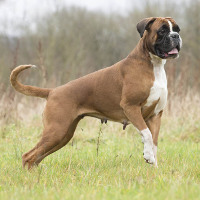
| There are many theories about where and when the Boxer parent came from. Theories range from ancient Tibet to 16th-century France. For simplicity's sake, however, it is commonly accepted that the Boxer is a Bulldog cousin. Boxers became a favorite in Germany during the 1800s and were developed as hunting and sporting companions. In the late 1800s, the Germans made efforts to stabilize the breed. Eventually, Boxers won fans in North America and were registered by the AKC in 1904. Later, Boxers were used as guards and ammunition carriers in both World Wars. Soldiers returning to the United States from Europe eventually brought Boxers home as pets, boosting their popularity in North America. | ||
 |
||
| Standard of the Boxer | ||
A little of the American Staffordshire Terrier |
||
| The American Staffordshire Terrier became popular in the early 1800s when it was developed in the English region of Shaffordshire for dog fighting. It was originally called the "Bull and Terrier" and was probably an Old English Bulldog and Terrier mix. Eventually, dogfighting was banned and the breed migrated to the USA, where breeders sought to increase the weight and size of the dog's head. This variety became known as the Pit Bull Terrier and was recognized by the AKC in 1936. In 1972, it was renamed the American Shafford Terrier, although the Pit Bull moniker has remained true to the breed. Bullboxer Staffs may have been bred for decades, given the long history of the two related breeds in the USA. However, they have only recently been recognized as a designer hybrid, but not by the AKC. | ||
 |
||
| Standard of the American Staffordshire Terrier |
Appearance of the Bullboxer Staff |
| A Bullboxer Staff is a big, strong, muscular dog. In many cases, it resembles a larger, less stocky American Staffordshire Terrier with Boxer facial features. This breed has a thick neck, a relatively flat forehead, hanging ears and a square muzzle, often covered with white or black markings, which ends in a broad black nose. The Bullboxer Staff has a short, smooth, dense coat that can come in many colors such as gray, fawn, brown, black, brindle with white or black markings. The Bullboxer Staff's legs are large, heavily padded and arched to support its agile movements and considerable muscle mass. |
Temperament of the Bullboxer Staff |
| This sensitive, energetic hybrid bonds closely with its family, even children. Conversely, it prefers to be dominant over other dogs and animals. Consequently, it's best to introduce new furry friends slowly. Both breeds of Bullboxer Staff parents have been bred to be deferential and respectful towards humans, so these animals require a lot of attention from their owners. In return, however, owners enjoy a loyal pet that appreciates human affection and family leisure time. Bullboxer Staff don't bark frequently, but they are hypersensitive to changes in their environment. It follows that Bullboxer Staffs thrive in stable environments with a relatively consistent schedule and regular exercise to avoid agitation. Beyond that, Bullboxer Staffs are intelligent animals, which makes them moderately easy to train. They do, however, have a stubborn steak. As such, early and consistent training is particularly important in forming a well-adjusted Bullboxer Staff. |
Needs and activities of the Bullboxer Staff |
| Bullboxer Staff love to play and exercise regularly with their owners. They require a moderate to long daily walk or trip to the dog park combined with playtime with family members. If they don't get this kind of activity, they can become irritable and hyper-tensioned. Because Bullboxer Staffs require a good amount of exercise, they thrive in suburban and rural environments where they have a fenced yard to let off steam. Keep in mind that Bullboxer Staffs have a moderate inclination to hunt and roam, so they should always be supervised outdoors, especially if they're in off-leash areas. Note that this breed is sensitive to heat and should not be overexercised in hot climates. Overall, Bullboxesr Staffs will be happy if they get 45 to 90 minutes of physical activity a day and spend quality time with their owners in the evenings. |
Maintenance of the Bullboxer Staff |
| On the whole, Bullboxer Staffs are low-maintenance pets. Their short coats are not prone to shedding, and they don't require regular grooming. However, they are not hypoallergenic and are not suitable for allergy sufferers. These dogs should only be bathed when necessary, so that their coat retains its natural oils and shine. Note that some owners choose to occasionally brush their Bullboxer Staffs with a firm bristle brush to remove dead hairs. Bullboxer Staffs should also have their nails trimmed 1-2 times a month, although toenails can sometimes wear naturally depending on the terrain they walk on. Bullboxer Staff should have their teeth brushed every day and have an annual dental check-up by their vet. |



 English (United Kingdom)

Comments