 |
Bullhuahua |
|
He is not recognized by the F.C.I. |
Origin |
Great Britain <> Mexico -> U.S.A. | |
Translation |
Francis Vandersteen |
A brief presentation of the Bullhuahua |
| The Bullhuahua is a fearless, gentle and social pet. It is a cross between the Bulldog and the Chihuahua. As a result, Bullhuahuas have the robust, muscular build of a Bulldog, while retaining many Chihuahua-like facial features. Although Bullhuahuas need regular exercise to stay healthy, they are discreet pets who love to relax with their families. They have an average lifespan of 11 to 14 years, weigh 9 to 14 kilos and stand 23 to 30.5 centimeters tall. Their coats are short, smooth and dense, and come in many of the same colors as the Bulldog and Chihuahua. A courageous addition to any family, the Bullhuahua is a friendly, low-maintenance dog. |
History of the Bullhuahua |
| The name Bullhuahua is a combination of the names of the dog's two parent breeds, the Bulldog and the Chihuahua. There is no known date of origin for the Bullhuahua, and its personality and appearance have not yet stabilized. As such, the Bullhuahua is not widely recognized and lives in the shadow of the more popular Chihuahua hybrid breeds. |
A little of the English Bulldog |
||
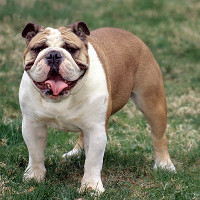
| The Bulldog is a fairly ancient breed, and its origins are something of a mystery. Some experts believe they are a descendant of a Mastiff and a Pug, while others think the Mastiff line descended from the Bulldog. Whatever the case, we know that these dogs were used to control, guard and bait bulls. To this end, Bulldogs of the 1800s were bred to be much more aggressive and tenacious than today, with an extremely high pain tolerance. This also made them excellent candidates for fighting other dogs and, because of this trait, they were instrumental in the development of the American Pit Bull Terrier and the American Staffordshire Terrier. When these violent "sports" became illegal in 1885, the breed was nurtured by Bulldog enthusiasts who chose to breed for a more pleasurable nature, and today's English Bulldog is generally a docile animal capable of adapting to many situations. | ||
 |
||
| Standard of the English Bulldog | ||
A little of the Chihuahua |
||
| The Chihuahua is the smallest and one of the oldest dog breeds known. Its origins are debated, but it is generally accepted that Chihuahuas were present in Mexico as early as the 9th century AD. The same theory traces the breed back to its presumed predecessor, the "Techichi", a small dog first domesticated by the Toltecs, a Mesoamerican civilization. The Toltecs may have crossed the Techichi with a breed of dog that lived in the Chihuahua mountains, called the Perro Chihuahueno. When the Aztecs conquered the region, they embraced the Techichi, using the dog in spiritual ceremonies. When explorers arrived in South America from Western Europe, the Techichi was bred with other small dogs to produce the Chihuahua we know today. The Chihuahua became popular in North America from the late 1800s to the early 1900s and was registered by the American Kennel Club in 1904. | ||
 |
||
| Standard of the Chihuahua |
Appearance of the Bullhuahua |
| Bullhuahuas have robust, muscular bodies and Chihuahua facial features, including perky ears. They are low-set and longer than they are tall. Bullhuahuas tend to be the size of a French Bulldog, weighing between 9 and 14 kilos and measuring between 23 and 30.5 centimeters. Bullhuahuas have short necks and tails, as well as arched, fleshy legs. They have round, dark eyes and a short muzzle with a broad, strong jaw and a broad black nose. The wide range of coat variations within each parent breed explains Bullhuahua's broad spectrum of colors. Their short, smooth, thick coats can be blue (gray), black, chocolate, cream, fawn, fallow, red, brindle, with tan and white markings. |
Temperament of the Bullhuahua |
| Bullhuahuas are known for being courageous, gentle and people-oriented pets. They are bold, yet sensitive animals, hyper attuned to their environment. They generally inherit the loving personality of their Bulldog parent and are gentle with children. At the same time, Bullhuahuas can be wary of strange dogs and people, so it's best to make new introductions slowly. Once Bullhuahuas get to know new friends, furry or otherwise, they can be quite friendly. Bullhuahuas need regular exercise to stay fit and healthy. They also like to play occasionally with their owners, but are generally discreet pets. This breed is happiest when hanging out, or even better, snuggling, with family members. Note that training Bullhuahuas may require more effort than other breeds. As such, early and diligent training is an important element in raising a well-bred Bullhuahua. Overall, this breed is well suited to loving, stable family households. |
Needs and activities of the Bullhuahua |
| The Bullhuahua is a moderately energetic breed that requires regular but modest exercise to stay healthy. A short walk or discreet play session with other dogs is sufficient for this breed. Note that Bullhuahuas do not do well in hot weather and should not be taken on long runs or walks. Because they tend to be gentle pets, Bullhuahuas do well in all types of domestic environments if they receive sufficient human attention and have a place to walk or play outdoors, such as a park or yard. Although owners must be diligent in exercising their pets to avoid weight gain and health problems, Bullhuahuas are primarily indoor dogs who prefer to relax and be entertained by their owners. |
Maintenance of the Bullhuahua |
| Bullhuahuas are not hypoallergenic dogs, making them unsuitable for owners with allergies. Because of their short, smooth coat, Bullhuahuas don't require much grooming. They are, however, moderate shedders. Bullhuahuas should be bathed only when necessary, so that their coats retain their natural oils and shine. Owners should, however, clean facial or body wrinkles daily to avoid skin infections that occur between the folds. In addition, owners may choose to brush their pets from time to time with a firm bristle brush to remove dead hair. Bullhuahuas should also have their nails trimmed 1-2 times a month to prevent painful overgrowth or nail fractures. Like all breeds, Bullhuahuas should let their teeth be brushed daily. |



 English (United Kingdom)

Comments