 |
Bullsky Mastiff |
|
He is not recognized by the F.C.I. |
Origin |
Great Britain <> Siberia -> U.S.A. | |
Translation |
Francis Vandersteen |
A brief presentation of the Bullsky Mastiff |
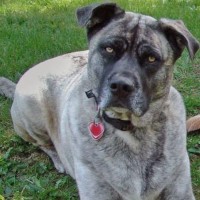
| The strong Bullmastiff and the superb Siberian Husky are the parent breeds of the wonderful Bullsky Mastiff. They are large but gentle dogs that will make calm, protective pets as well as alert watchdogs. These dogs will need a large yard to run as they have high energy levels, but must not be overworked when it's too hot. They have a lifespan of around 10 to 13 years and few health problems. Since they can take on the stubbornness of their parents, this breed may not be the best choice for owners inexperienced with dogs. |
History of the Bullsky Mastiff |
| In recent years, the popularity of creative breeds seems to be on the rise. Consequently, due to their recent development, little is documented about the creation of the Bullsky Mastiff breed. |
A little of the Bullmastiff |
||
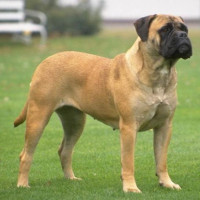
| Bullmastiffs are a breed created from 60% Mastiff and 40% Bulldog. They were first bred in England in 1795. They were originally used to track, fight and contain poachers for gamekeepers. Although intimidating and strong, they would be trained not to harm intruders. Today, however, these dogs are known as excellent watchdogs, family companions and protection dogs. | ||
 |
||
| Standard of the Bullmastiff | ||
A little of the Siberian Husky |
||
| The Yatsuk region of northern Siberia is where the Siberian Husky was found. They were used as sled dogs, which was the main source of transportation for the Chukchi. When not pulling sledges, these dogs spent time with women and children, making them such friendly, non-aggressive pets. In 1909, Siberian Huskies were sent to Alaska. A team of Siberian Huskies owned by Charles Fox Ramsay and led by John Johnson were the winners of a 650-kilometer race held in 1910. From then on, and for a decade afterwards, this breed was used by sled-racing enthusiasts everywhere. There was a diphtheria epidemic in 1925 in Nome, Alaska, and the fastest way to transport much-needed antitoxin over 1,000 kilometers was by dog sled. Siberian Huskies were used for this heroic task, which helped them become better known and respected in the USA. This breed also contributed to the Second World War, where they were used by the US Army for search and rescue units in the Arctic Circle. | ||
 |
||
| Standard of the Siberian Husky |
Appearance of the Bullsky Mastiff |
| These cute dogs will be about the same size as their Bullmastiff parents. Their tails are Husky-like, long and curly. Bullmastiffs are described as tall, symmetrical and powerful. Their heads are broad and wrinkled, and the muzzles are short and dark, with a slight underbite. They have dark, pendant-shaped ears and tall, tapering tails long enough to reach their hocks. One of the striking features of the Arctic Siberian Husky is its eyes, which can be brown, striking blue or one of each. Their muzzles taper gradually towards the tip and are of medium length. Their noses can be black, liver, flesh-colored or snowy, depending on coat color. Their triangular, slightly rounded ears are set high on the crown of the head and erect. They have thick tails that curve and rest on their long, straight backs when alert, but drag when relaxed. |
Temperament of the Bullsky Mastiff |
| The Bullsky Mastiff hybrid breed generally takes many personality traits from its Husky parent. As a result, they can be independent, confident and stubborn, which means you'll have to prove yourself as the leader of the pack right from the start to earn their respect. They are very sociable and enjoy spending time with people of all ages. These dogs are also excellent with children, and this breed seems to be sensitive to sound signals. Therefore, using sounds such as clicking or snapping during training will help them understand and respond. Bullmastiffs are fearless but docile. They will protect their loving family at all costs, but will not be violent or hurtful. This breed is not easily provoked and is excellent with children. Bullmastiffs can be stubborn and require patience to train, so keep in mind that your Bullsky Mastiff can be the same. They are excellent pets, as they are not aggressive towards other dogs and are indifferent to strangers. However, they do need a lot of exercise and proper training, which can be too much for new dog owners. |
Needs and activities of the Bullsky Mastiff |
| These dogs need daily exercise. A nice long walk will do them good, as will playtime in a large yard. But they'll also enjoy relaxing and spending time with you. They are athletic and agile, with the ability to run fast and jump high. If your Bullsky Mastiff is similar to a Bullmastiff, they shouldn't be overworked during the summer, as it's too hot for them. Siberian Huskies are very energetic and certainly need an active lifestyle or they can get out of hand. |
Maintenance of the Bullsky Mastiff |
| Grooming needs for the Bullsky Mastiff will be similar to those of the Siberian Husky and Bullmastiff. The latter is easy to maintain in terms of coat care, but will need to have the wrinkles on their face cleaned out. They need to pour a medium amount and should be brushed regularly, but don't need to be bathed unless they're dirty. Siberian Huskies, on the other hand, are heavier excretors and need to be brushed at least once a week. They also won't need baths unless necessary, as they are clean dogs who generally groom themselves. Additional maintenance needs for all dogs include brushing teeth, cleaning ears and trimming nails. Bullmastiffs are prone to bad breath, so it's important to brush your Bullsky Mastiff's teeth at least two or three times a week, although daily is preferred. Clean and check your dog's ears once a week to keep them healthy and infection-free. Depending on your dog's activity level, nails may need trimming once or twice a month. |



 English (United Kingdom)

Comments