
 |
Bully-Tzu |
|
He is not recognized by the F.C.I. |
Origin |
Great Britain <> Tibet -> U.S.A. | |
Translation |
Francis Vandersteen |
A brief presentation of the Bully-Tzu |
| The Bully-Tzu is a cross between a Bulldog and a Shih Tzu. The Bulldog may be one of many working dog breeds that have been used for many purposes, from driving cattle to market to the now extinct practice of bull baiting. Today, the Bulldog is a gentle, protective companion who much prefers to sleep on the sofa next to a family member. The Shih Tzu originated in China. It's a dog that has been the companion of nobles for centuries. Your Bully-Tzu will be a gentle dog with an independent spirit and perhaps a stubborn streak. All in all, if you're looking for a dog that likes to be with its human, the Bully-Tzu will be the dog for you. Be prepared to take him everywhere, as he can be prone to separation anxiety and loneliness. |
History of the Bully-Tzu |
| As there isn't much information on the Bully-Tzu, we have to turn to its parent breeds to understand what the Bully-Tzu hybrid looks like. |
A little of the English Bulldog |
||
| Thought to have been first developed in the 13th century, the tenacious English Bulldog is one of many working dog breeds that have been used for many purposes, including the now defunct practice of bull baiting. Today, the English Bulldog is very different from the tough, aggressive dog of the baiting and fighting ring. Now a dog of limited endurance, he's a gentle, protective companion who prefers to join you on the sofa rather than exert himself too much. It is currently the 4th most popular dog among families, according to the American Kennel Club. | ||
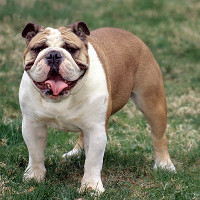 |
||
| Standard of the English Bulldog | ||
A little of the Shih Tzu |
||
| The Shih Tzu originated in Tibet and has roots in China, where it was once called the lion dog. Depicted in 16th-century works of art, it was considered a royal dog. At one point, Chinese nobility refused to export the dog outside their country. In the 1930s, however, the first pair was exported to England and from there to the United States. In 1969, the Shih Tzu joined the American Kennel Club in the Toy Group. | ||
 |
||
| Standard of the Shih Tzu |
Appearance of the Bully-Tzu |
| The Bully-Tzu is generally a medium-sized dog, weighing around 13.5 kilos. It will have a curly tail and a somewhat flat face with erect ears. His head will be round with a round body and legs proportionate to his size. The coat will vary in length and color. Bully-Tzus are often brown, white, black or tricolored. Some Bully-Tzus have a chin beard. Brown eyes and a winning smile complete the look. |
Temperament of the Bully-Tzu |
| The Bully-Tzu is alert and curious. They are generally easy-going, happy dogs. They are gentle and intelligent. With early socialization, the Bully-Tzu will do quite well with children and other animals. The Bully-Tzu is an excellent family dog. It loves to cuddle and is eager to please its family. Bully-Tzus will need a family who will be home a lot, as they tend to suffer from separation anxiety. Training generally goes well, but a friendly, firm tone is needed when teaching commands and asking for a recall. |
Needs and activities of the Bully-Tzu |
| The Bully-Tzu is more inclined to nap than to take part in vigorous exercise, so it's fair to assume that the Bully-Tzu is a low-energy dog. It does, however, need daily activity. A daily walk with you is sufficient exercise for the Bully-Tzu. You must be careful not to overload the Bully-Tzu. Dogs with a brachycephalic facial structure have difficulty breathing, and vigorous exercise can be more harmful than beneficial for the Bully-Tzu. |
Maintenance of the Bully-Tzu |
| The Bully-Tzu is likely to have longer hair than its Bulldog relative, and it can be silky, so the Bully-Tzu will have fairly high grooming requirements. He may shed frequently, and will require daily brushing with a soft bristle brush. The Bully-Tzu is not recommended for allergy sufferers, due to the potentially high quantity of excretions. Only bathe him if necessary. His ears will need weekly cleaning with a dog cleaning solution and a cotton ball. Make sure they're completely dry, though, as yeast and bacteria can build up, causing redness and possibly infection. You should brush your Bully-Tzu's teeth at least three times a week, as breeds with small, tight teeth are prone to cavities and periodontal disease. |



 English (United Kingdom)

Comments