
 |
Carillon |
|
He is not recognized by the F.C.I. |
Origin |
Great Britain<> France and Belgium -> U.S.A. | |
Translation |
Francis Vandersteen | |
This breed is also known as |
Cairn Papillon
|
A brief presentation of the Carillon |
| Carillons are intelligent, loyal and playful companion dogs. They are people-oriented and form strong bonds with their owners and family members. Their average lifespan for small breed dogs is between 12 and 15 years. They generally weigh between 5 and 6.5 kilos and measure between 23 and 30.5 centimeters in height. The breed has the compact torso of a Cairn Terrier and some of the delicate characteristics of a Papillon. The breed's exact date of origin is unknown, but it is thought to be a relatively new hybrid. As a result, its form and personality have not fully taken root, and this hybrid is not listed as a purebred by the American Kennel Club. |
History of the Carillon |
| The name Carillon is a combination of the two names of its parent breeds: the Cairn Terrier and the Papillon. It is suspected that the product of these two breeds, the Carillon, originated in the early to mid-1900s, when both parent breeds were in North America. |
A little of the Cairn Terrier |
||
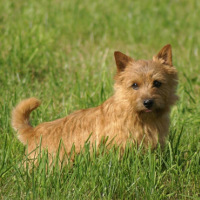
| The Cairn Terrier, originating on the Isle of Skye in Scotland, is the result of a long history of division in the Terrier breed. There is evidence to suggest that early versions of the Cairn Terrier existed in the 15th century and were used to hunt foxes, badgers and otters. The name is derived from the breed's ability to hunt otters from cairns, piles of stones used as landmarks or memorials in those days. In 1873, the breed was divided into the Dandie Dinmont and Skye Terrier based on color. The Cairn Terrier was placed in the Skye Terrier category. In 1881, Wirehaired Terriers were identified as a breed distinct from Skye Terriers, again changing the categorization of the Cairn Terrier. Eventually, Wirehaired Terriers were separated into Scotch, West Highland White and what we know today as the modern Cairn Terrier. Many of the earliest Cairn Terriers were white, but many color variations have appeared in this breed since the early 1900s. It was recognized by the AKC in 1913. Famously, Toto from The Wizard of Oz was a Cairn Terrier. | ||
 |
||
| Standard of the Cairn Terrier | ||
A little of the Continental Toy Spaniel |
||
| The Papillon was born around 700 years ago in France. Italian frescoes and paintings dating as far back as the 13th century also depict this small canine breed. A popular companion of European royalty and the elite, this breed did not originally have the "butterfly wing" ears for which it is known today. Papillon is French for butterfly, and once the breed migrated from Europe to North America, its popularity increased. The American Kennel Club added this courageous breed to its list in 1915. | ||
 |
||
| Standard of the Continental Toy Spaniel |
Appearance of the Carillon |
| A Carillon is a small to medium-sized dog with the compact body of a Terrier and the slender features of a Papillon, including slender legs, slightly arched paws and a tapered muzzle. The breed has large, rounded-tipped ears of the drop variety. Carillons' eyes are round and dark, conveying an alert, cheerful expression. Carillons weigh between 5 and 6.5 kilos and measure between 23 and 30.5 centimeters in height. They have a strong, active body with a relatively large rib cage for their size and a medium-length, often feathered tail. Carillons' medium-length coats are straight and thick, and vary considerably in color. They can be various combinations of black, cream, white, silver, gray, red with the possibility of a brindle pattern and black markings, masks and spots. |
Temperament of the Carillon |
| Carillons retain many desirable qualities from their two parent breeds, and are known as loyal family companions that crave human attention and affection. They are courageous, mischievous animals who like to let off steam indoors with their owners. Chimes inherit the protective instincts of their Terrier lineage, as well as its tendency to bark relatively frequently. This means they can be slightly aggressive towards other dogs and strangers. Note also that Chimes have a strong hunting impulse, so they may chase other small animals when given the chance. As such, introductions to new people and pets should be made with care, and Chimes should be supervised around children. Nevertheless, they are quite friendly with humans and familiar dogs. Because both parent breeds are intelligent, Chimes respond well to obedience training and have a naturally cheerful disposition when in a comfortable environment. They are happiest when at their owner's side, active or snuggling up to them. |
Needs and activities of the Carillon |
| Carillons are agile, active dogs that require constant, moderate exercise. As they are playful, Carillons are indoor toys and chase balls. They also enjoy a moderate walk or trip to the dog park, depending on how friendly they are with other dogs. Chimes tend to chase other animals and wander, so they should always be supervised in off-leash areas. The size and energy level of Carillons make them suitable for all types of environment - urban, rural, suburban - as long as they get enough exercise. Beyond that, they're well suited to all types of climate. However, like all dogs, they should not be overexercised in hot weather. On the whole, Carillons will be happy and healthy if they lead a decently active life alongside their owner. |
Maintenance of the Carillon |
| Carillons are not completely hypoallergenic, but produce fewer allergens due to the hair-like coat they inherit from their Papillon parent. They have a low tendency to drool and shed, and do not require intensive grooming. Carillons like to be brushed regularly, which will help keep their coats free of dead hairs. Owners should also consider trimming longer pieces of their coat around the eyes, ears and legs to avoid infections or impediments to mobility. Like all breeds, Carillons need to have their teeth brushed daily and their nails trimmed once or twice a month to avoid painful proliferation or cleavage. |



 English (United Kingdom)

Comments