 |
Cheenese |
|
He is not recognized by the F.C.I. |
Origin |
Mexico <> Western Mediterranean Basin -> U.S.A. | |
Translation |
Francis Vandersteen | |
This breed is also known as |
Havachi |
A brief presentation of the Cheenese |
| The Cheenese is a hybrid breed in which the Chihuahua is crossed with the Havanese. The Cheenese is a small dog, usually with a long, straight coat. Training your Cheenese can be difficult, as this hybrid can have an independent streak and may require a good deal of patience on the part of the owner. Most Cheeneses like to socialize and will be loyal and attentive to their family, in fact, a Cheenese will prefer not to be left alone. Cheenese owners describe them as cheerful, friendly, sensitive and dashing. |
History of the Cheenese |
| The Cheenese is not recognized by the American Kennel Club; only thoroughbreds are. The deliberate crossing of two pure breeds for the offspring it creates has gained in popularity over the past 30 years, becoming almost a trend in recent years. They've been dubbed designer dogs and have had a mixed reception among dog lovers due to the increase in bad breeding and puppy mills that the trend towards owning them has caused. Be careful who you buy from and try to consult your local rescue shelters as an option to avoid adding to the problem. Designer dogs aren't always perfect blends of the best of both parents, despite what you might be promised. While some breeders may be careful about the bloodlines they use, many are not. You could end up with a puppy that has all the worst of both parents, or more likely a mixture of both. Even littermates can be different in appearance and personality. As with most designer dogs, the Cheenese has no information on where and why it was first bred, but we can look at the parents to get an idea of its origin. |
A little of the Chihuahua |
||
| There are several theories about the origin of the parent breed, the Chihuahua. One theory is that the breed appeared in Egypt 3,000 years ago. Another is that the Chihuahua breed originated in China and was imported elsewhere by Spanish traders. It is thought that the dog was then crossed with small dogs native to the region. A third theory is that the Chihuahua originated in Central and South America, descended from an indigenous dog called the "Techichi". The Techichi was small and mute, and was sometimes used in sacrificial ceremonies, as a small red dog was believed to have the ability to guide the soul to the underworld. What is certain is that around 1850, three small dogs were found in Chihuahua, Mexico. A small number of dogs were eventually brought to America, though they received little attention. When Xavier Cugat regularly brought his Chihuahua with him in public, the breed began to attract American attention and became very popular. | ||
 |
||
| Standard of the Chihuahua | ||
A little of the Havanese Bichon |
||
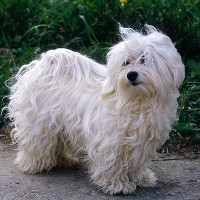
| The Havanese Bichon is known as Cuba's national dog. Related to the Bichon Frise, the breed originated in the Mediterranean and was brought to Cuba by Spanish traders in an effort to encourage trade relations, the dogs were presented to Cuban women, and became a symbol of wealth. Specifically bred for the ruling class, the breed's dogs were never sold, only received as gifts. Some of the breed's dogs were trained as performers because they wanted to be the center of attention. Being seen in performances helped increase their popularity. Wealthy families emigrated to the United States during the Cuban revolution, although many were unable to bring their dogs. In the 1970s, a woman named Mrs. Goodale, a dog breeder, sought out Cuban refugees in Florida who had brought their dogs with them and began breeding them. She was able to continue the breed with six dogs from Cuba in the USA and five dogs from Costa Rica. The Havanese Bichon was recognized by the American Kennel Club in 1996. | ||
 |
||
| Standard of the Havanese Bichon |
Appearance of the Cheenese |
| The Cheenese is a hybrid of the Chihuahua and the Havanese. These loyal, loving dogs are generally small, weighing from 1.8 to 7 kilos and measuring from 15 to 23 centimeters in height. The coat is generally long, straight and silky, and can be seen in brown, gold, white, black, chocolate and cream. Cheenese ears can be erect, or soft and hairy. The eyes are dark and round, and can be domed like the Chihuahua, depending on the genes of the most dominant parents. |
Temperament of the Cheenese |
| The Cheenese is generally a loyal, friendly dog that likes to socialize with people. These hybrid dogs tend to be bright, responsive and generally happy. Its independent spirit is usually balanced by a uniform nature, which makes the Cheenese not too difficult to train. Most Cheeneses are sensitive and don't like to be left alone. Very alert, they may bark to let you know someone's coming. Most Cheeneses don't do well with young children and should be in homes with adults and older children. If the dog is raised with young children as a puppy, it may do well in a home with them, however, children must learn to be gentle with this little dog. Socialization from an early age will be helpful, and supervision will be necessary when surrounded by young children. The Cheenese will do well with other pets and dogs, especially if socialized early. |
Needs and activities of the Cheenese |
| The Cheenese is an active dog who enjoys regular exercise. Because of your hybrid's small size, it will live well in an apartment, and even if a yard isn't necessary, it will enjoy outdoor space for running and playing. Regular walks, several a day, and trips to the dog park will be useful to ensure that the Cheenese gets enough activity and socialization. Mental stimulation will also be important, as both parent breeds are intelligent and enjoy activities that allow them to express themselves. The Cheenese always seems to be thinking, and is courageous and alert. |
Maintenance of the Cheenese |
| Grooming requirements for the Cheenese are low to moderate, if your dog's coat resembles that of a Chihuahua, it will shed a moderate amount and require regular brushing, three times a week. If his coat is more like that of a Havanese, he will shed very little. The pin brush works very well in both coat types, removing tangles and making the coat shiny. Regardless of his coat, bathing should only take place when necessary, as too many baths can damage his natural oils. Teeth should be brushed two or three times a week, and ears checked and cleaned once a week. Cheenese's nails should be trimmed as required. |



 English (United Kingdom)

Comments