
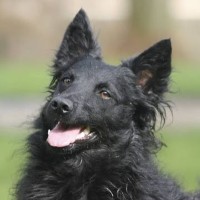
 |
Croatian Sheepsky |
|
He is not recognized by the F.C.I. |
Origin |
Croatia <> Siberia -> U.S.A. | |
Translation |
Francis Vandersteen | |
This breed is also known as |
Croatian Sheep Husky |
A brief presentation of the Croatian Sheepsky |
| The Croatian Sheepsky is a small to medium-sized dog, a specific cross between the Croatian Sheepdog, a capable sheep and cattle dog from Croatia, and the Siberian Husky, an adept and athletic sled dog from Russia. This crossbreed is a highly intelligent, active dog that is happiest when it has a job to do. The Croatian Sheepsky requires a significant amount of exercise to burn off all that energy, and can do so with a number of appropriate activities such as the pulling and herding activities enjoyed by the parent breeds, as well as agility training, flyball and even the free form of dance. They can also inherit the Croatian Shepherd Dog's innate guard dog abilities and bark a lot, especially if not exercised enough. Because of their high activity and noise levels, these dogs are not well suited to apartment living. |
History of the Croatian Sheepsky |
| The Croatian Sheepsky is a specific cross between an exceptional sheepdog from Croatia known as the Croatian Shepherd Dog and the Siberian Husky, an ancient Russian breed. |
A little of the Croatian Shepherd Dog |
||
| Written accounts describing the Croatian Shepherd Dog date back to the 14th century, and although the breed has grown a little since those original writings, it seems to have remained the same ever since. Writings detailing information on the Croatian Shepherd Dog, then known as Canis Pastoralis Croaticus, indicate that these dogs excelled at breeding and herding animals, including not only cows and sheep, but also pigs and horses. Although the breed has not yet been recognized by the American Kennel Club, it has been accepted by both the FCI in Belgium and, more recently, by the United Kennel Club in 2006. | ||
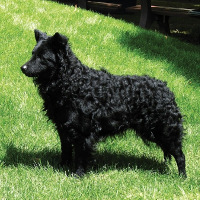 |
||
| Standard of the Croatian Shepherd Dog | ||
A little of the Siberian Husky |
||
| Siberian Huskies were developed by an indigenous Russian tribe known as the Chukchi at some point in prehistoric times. The original Siberian Husky or their ancestors were probably accustomed to hunting and, at some point, began pulling the sledges of the nomadic peoples they lived with, enabling them to travel further and faster. They were an integral part of Chukchi daily life and were bred not only to be energetic and hardy, but also to be sociable. In the early 1900s, Siberian Huskies were imported to Alaska as sled dogs, where they excelled. Several Siberian Husky teams won annual competitions before they were cancelled due to the First World War. Then in 1925, a diphtheria epidemic struck the small town of Nome, endangering everyone in the region, some 10,000 people. In order to deliver the serum to the villagers, twenty sled drivers and over a hundred dogs, the majority of them Siberian Husky, undertook the grueling 1060-kilometer journey to collect the necessary medicine from a town known as Nulato and bring it back to Nome. A journey that should have taken twenty-five days was completed in just under six, and under unbearable conditions. The final leg of the journey was led by Gunnar Kaasen, but conditions prevented him from seeing the lead dogs, let alone their destination. It was the dogs who sailed through the storm to bring the serum to Nome. It was not long after this, in 1930, that the Siberian Husky was recognized by the AKC and is the 12th most popular dog breed to this day. | ||
 |
||
| Standard of the Siberian Husky |
Appearance of the Croatian Sheepsky |
| The Croatian Sheepsky is a small to medium-sized dog with a rectangular silhouette and athletic build. The head of this hybrid is generally wedge-shaped, with a medium-length muzzle that is often tapered. They have medium-sized triangular ears that point and may or may not be erect, as well as almond-shaped eyes that are most often brown but can also be blue and multicolored, and generally have a lively, alert face and friendly expression. The Siberian Husky has a long, straight tail that extends behind him or hangs down when he's at rest, but the Croatian Sheepsky is often born without a tail, and those that have one wear it over their backs when they're alert. The double-layered coat consists of a thick, dense undercoat with either a medium-length coat of smooth, straight guard hairs or a soft, wavy coat. This crossbreed can come in many different colors, but black is generally more predominant than other colors. White markings are commonly seen on both parent breeds, so are likely to occur on the Croatian Sheepsky too. |
Temperament of the Croatian Sheepsky |
| These are generally high-energy dogs with a strong work drive. Both parent breeds are intelligent and able to assess and react quickly to unexpected situations, part of the reason these breeds are able to do their jobs so well is their ability to work independently when needed. However, this dog can inherit a certain stubbornness, and training should start at an early age for best results. The Croatian Sheepsky is also an intelligent dog that can be reserved for strangers and, thanks to the Croatian Shepherd Dog, also serves as a guard dog. These crosses are also family pets, being much happier and healthier animals when fully integrated into the family unit. Croatian Sheepskies left alone for too long can develop separation anxiety. In most cases, this hybrid should get along with other dogs, however, there may be a tendency to chase other small animals. |
Needs and activities of the Croatian Sheepsky |
| Both the Siberian Husky and the Croatian Sheepdog have been bred for their enthusiasm and stamina. A double dose of energy from both parent breeds ensures that the Croatian Sheepsky is a very active animal, and they don't slow down until they've decided they're done with whatever it is they're doing, whether it's herding cattle, training on agility courses, or chasing a ball. You want to make sure your Croatian Sheepsky gets at least an hour and a half to two hours a day of vigorous activity, although two would be even better. While this breed is unlikely to mind a walk or a run, they can also be well suited to alternative exercises such as flyball, Frisbee or dock jumping. Their high level of activity makes them much more suited to homes with yards than apartments. |
Maintenance of the Croatian Sheepsky |
| Although both parent dogs have a double-layered coat of thick, dense undercoat protected by a layer of more waterproof guard hairs, the texture of the undercoat is quite different. Although they both have medium-length coats, the outer layer of the Siberian Husky will be stiff and straight, while the Croatian Shepherd Dog has a soft, wavy or curly coat. This means that if your dog resembles its Croatian Shepherd Dog parent in coat types, it will only need an occasional bath and regular brushing with a pin or smoother brush. If your dog has inherited a coat more reminiscent of the Husky range, bathing needs may still be infrequent, but brushing will be a daily requirement. Dogs with a more Husky-type coat will also shed more, and may have periods of heavy shedding in spring and autumn. |



 English (United Kingdom)

Comments