
 |
Dualanese |
|
He is not recognized by the F.C.I. |
Origin |
Cuba <> Italy -> U.S.A. | |
Translation |
Francis Vandersteen |
A brief presentation of the Dualanese |
| The Dualanese is a toy breed and is a cross between a pure-bred Havanese and a pure-bred Bolognese. They generally weigh up to 6.5 kilos and common colors are white, black, black and tan, sand and gray. The Havanese has a thick, silky, soft and light coat, while the Bolognese has a long, fluffy coat. The Bolognese is intelligent and playful, and doesn't need much exercise to be happy and content. A Havanese will need more exercise, so it will depend on which parent breed the Dualanese takes most after how much exercise it needs. A Havanese is affectionate and loving but hates to be left alone. |
History of the Dualanese |
| The Dualanese is a combination of a Bolognese and a Havanese, the latter being Cuba's national dog. |
A little of the Havanese Bichon |
||
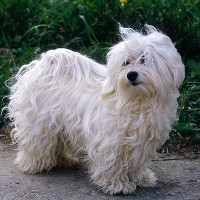
| Havanese Bichon were developed from the now extinct Blanquito de la Habana, the "little white dog of Havana". It is thought that the Blanquito was crossed with other types of Bichon, including the Poodle, to create the Havanese. They are thought to have been brought on ships with the first settlers to Cuba, and it is assumed that they were the Tenerife dog, which is the common ancestor of the whole Bichon family. Spanish settlers in Cuba took a liking to the little dogs and kept them as pets in their homes. When Cubans fled to the USA during the revolution, many left their dogs behind. However, some did make it to the U.S. and were officially recognized by the American Kennel Club in 1996, and are now one of the club's fastest-growing dog breeds. | ||
 |
||
| Standard of the Havanese Bichon | ||
A little of the Bolognese Bichon |
||
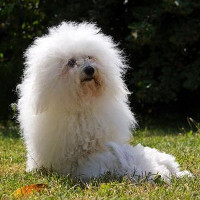
| The Bolognese Bichon belongs to the Bichon family of dogs and is named after Bologna in northern Italy, where the breed is thought to have been established. Other Bichon breeds include the Coton de Tulear and the Maltese. Bolognese dogs were cherished pets of noble Italian families, and were also owned by Catherine the Great of Russia and the Marquise de Pompadour, mistress of Louis XV of France. The breed is depicted in tapestries made by Flemish craftsmen as early as the 17th century. They were then imported to England and exhibited at the Crufts dog show in 2002. The breed is not yet recognized by the American Kennel Club. | ||
 |
||
| Standard of the Bolognese Bichon |
Appearance of the Dualanese |
| The Dualanese is a toy breed composed of a cross between a pure-bred Havanese and a pure-bred Bolognese. Common colors are white, black, black and tan, sable and gray, and the coat can vary according to the most dominant parent breed. The Havanese has a thick, silky, soft and light coat, and sometimes has watery eyes that cause tear stains. The eyes are generally almond-shaped and dark brown. They are sturdy little dogs with their tails carried over their backs and ears that droop and fold. A Bolognese is also quite robust, with large, round eyes and ears set high on the head. The tail is also carried curved over the back. |
Temperament of the Dualanese |
| A Dualanese is likely to resemble the parent breeds, which means they will be very affectionate dogs who can be entertaining and love attention. They will make excellent companion dogs and love to be with the family and not left alone for too long. Small children will need to be supervised, but they are good with older children and other pets, even cats. They are intelligent dogs and love to play, but are happy to do whatever the owner does most of the time. Like the parent breeds, these are dogs that need early socialization to avoid the formation of bad habits, but can be trained fairly easily. They will respond best to positive reinforcement, especially when trained at home. They won't need much exercise to stay healthy and fit, and will often become attached to someone they follow devotedly. They may be a little wary of strangers. |
Needs and activities of the Dualanese |
| Dualaneses are energetic dogs, but won't need much more than 30 minutes of exercise a day to maintain their fitness. They will happily play with their owners and do well with people of all ages. They can thrive in any house or apartment as long as they get daily exercise, either on walks, playing ball games in the yard or playing indoors in the evening. Like all dogs, they behave best when exercised regularly to avoid the formation of bad habits. They prefer warmer weather, so shouldn't be left outside when it's cold. |
Maintenance of the Dualanese |
| Dualanese will need a moderate amount of grooming to keep them looking good. They should be brushed two or three times a week to remove loose hair and get rid of mats and dirt. They may need trimming, as both parent breeds tend to do, and also to wipe away tear stains around their eyes. Dualanese is likely to be hypoallergenic, so it's good for allergy sufferers and they won't have a strong smell, but a regular bath will keep their coat in good condition. Try to brush your dog's teeth every day and check the ears for any dirt, which can then be gently wiped off with the damp cotton ball. Nails should also be checked to see if they need trimming. |



 English (United Kingdom)

Comments