 |
Eskenji |
|
He is not recognized by the F.C.I. |
Origin |
U.S.A. <> Democratic Republic of Congo -> U.S.A. | |
Translation |
Francis Vandersteen |
A brief presentation of the Eskenji |
| The Eskenji is a mix of the parent breeds American Eskimo Dog and Basenji. It will be a medium-sized dog with a gentle, loyal personality. He will probably be a hunter, like his parent breed Basenji. He is likely to be very energetic, as are both parent breeds. He'll need plenty of exercise to keep him from becoming destructive. He also enjoys activities with his family. Perhaps a bit of an escape artist, his parent breed Basenji uses wooden and chain-link fences to get up and go in search of adventure. Overall, he'll enjoy being with his family, whether at the dog park, hiking or even swimming. |
History of the Eskenji |
| There isn't much information on the Eskenji breed itself, but we can learn more about the parent breeds to understand what to expect from the hybrid breed. |
A little of the American Eskimo Dog |
||
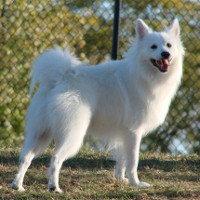
| The American Eskimo Dog has German roots. Of European descent, it has links with the Pomeranian, German, Keeshond and Italian Spitz. The American Eskimo Dog, formerly known as the American Spitz, began to gain popularity in the USA when he took to the stage as a circus performer. His glossy white coat made him stand out in the crowd. Before his circus career brought him to the USA, he was mainly a companion on farms. Today, he is a member of the non-sporting group of the American Kennel Club, and has been since 1994. | ||
 |
||
| Presentation of the American Eskimo Dog | ||
A little of the Basenji |
||
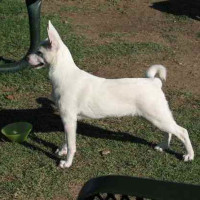
| The Basenji is known as an "unbarking" dog. It originated in Africa. It is one of the oldest breeds of dog. In fact, it usually barks only once, then falls silent. It is thought that hunters desired this trait in Basenjis' ancestors. Some experts also believe that he is more of a wild dog than a domestic animal. More like a wild canid, experts say. Even female Basenjis can only reproduce once a year, just like their wild counterparts. The Basenji was imported to the USA in the 1930s. Previous attempts to import the Basenji to Europe failed when the imported dogs died of disease. The Basenji Club of America was formed a few years later, in 1942. | ||
 |
||
| Standard of the Basenji |
Appearance of the Eskenji |
| Your Eskenji may have a medium to long fluffy white coat or a smooth or wiry chestnut red. Sometimes seen as tricolored or black, the Eskenji can vary in appearance depending on parental dominance. If he has markings in his fur, they will be prominent. Most often, the ears are straight and the body size is that of a small to medium-sized dog. His muzzle will be long with a black nose, and his piercing eyes will be either brown, hazel or amber. The tail curls over the back and moves in time with its determined gait. |
Temperament of the Eskenji |
| Your Eskenji will be both intelligent and independent, as well as affectionate and alert. He's inclined to chase what he sees as possible prey, keep this in mind outdoors, he's best suited to a home with a fenced area for him to play. He can be destructive, so it's best not to leave anything important within his reach. The Basenji parent is known to climb kitchen counters to get what he wants, so keep an eye on dinner when he's nearby. He can be dangerous to cats unless he's been raised with them and considers them a member of the family. A good watchdog like the parent American Eskimo Dog, your Eskenji may be wary of strangers. Give your Eskenji many tools to become a versatile dog, obedience training and socialization are essential. |
Needs and activities of the Eskenji |
| The Eskenji is a hunter and worker at heart, and will need daily exercise. A walk twice a day is the minimum, but some will need more rigorous play. The Eskenji is known to be an escape artist and should never be allowed to wander alone in the backyard. He may be happy in an apartment or small house if he gets enough exercise, but ideally a house with a fenced yard is the best option. He may be able to climb chain links and wooden fences, so he should never be left unattended in the yard. |
Maintenance of the Eskenji |
| The care routine will depend on the coat your Eskenji inherits. If its appearance resembles that of the Basenji parent, its coat will be smooth and glossy, requiring little brushing. The Basenji coat is fine and doesn't shed much. However, the American Eskimo Dog coat is prone to mats and tangles. Daily to weekly brushing is preferable. Not being known as a dirt-loving dog, bathing should not be necessary often. The Basenji parent is actually a groomer and is often described as a cat insofar as it cleans itself. Because your hybrid's ears will be upright, they should be kept clean, but check them from time to time just in case. Brush his teeth every day and trim his nails every few weeks. |



 English (United Kingdom)

Comments