Great Weimar

He is not recognized by the F.C.I.

Origin
Germany -> U.S.A.
Translation
Francis Vandersteen

A brief presentation of the Great Weimar

The Great Weimar is a specific cross between the Great Dane and the Weimar Pointer, sometimes with a small amount of Labrador Retriever. This hybrid was conceived as a family companion and is generally a healthier dog than the Great Dane and calmer than the Weimar Pointer. Although they are generally very tolerant and playful with children and other animals until they reach full maturity, the Great Weimar may be better suited to a family with older children rather than to toddlers who can be knocked over during enthusiastic play. Due to their size, higher energy levels and rather vocal nature, these dogs are definitely not suited to apartment living.

History of the Great Weimar

The Great Weimar is a specific cross between two different types of hunting dog of German origin. The Weimar Pointer is a versatile, highly intelligent pointer, and the Great Dane, a giant dog originally developed to hunt wild boar in Europe.


A little of the Great Dane

        
The Great Dane, as we know the breed, is a Molosser-type dog that has been selectively bred for tenacity, strength and intelligence for at least 400 years. They are widely regarded as the descendants of crosses between English Mastiffs and Irish Greyhounds and were developed specifically for the purpose of hunting European wild boar, an extremely wild and dangerous prey. They became particularly popular in Germany in the early 1500s, and by 1876 the Great Dane had been declared the national dog of Germany, where it is known as the Deutsche Dogge. The breed became popular in the United States in the late 1800s and was recognized by the American Kennel Club in 1887.
of the Great Dane

A little of the Weimaraner

The Weimaraner is a slightly more recent breed than the Great Dane, developed in the 1800s by the nobles of Weimar, a German city dating back to 899 BC. The breeding program that produced this unusually colorful breed was developed with an eye to exceptional tracking skills as well as speed, courage and durability. Originally developed for deer and bear hunting, they were converted to fur and feather dogs in the late 1800s when the popularity of big game hunting began to decline and they became prized as waterfowl retrievers because of their soft mouths. The Weimar Hound Club that began in Germany was particularly strict about what could and could not be considered a Weimar Hound, and would not allow anyone outside the Club to own a Weimar Hound. It wasn't until avid American sportsman and dog breeder Howard Knight was accepted into the Weimaraner Club that the breed was allowed into the U.S.A. for the first time. Although the first dogs imported by Mr. Knight were neutered animals, he was eventually able to acquire breeding stock, and just before the outbreak of World War II and in 1941, he founded the American Weimaraner Club and served as its president until his death in 1965.
Standard of the Weimaraner

Appearance of the Great Weimar

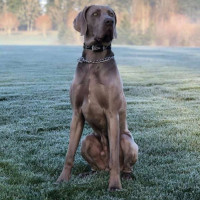
Great Weimars are generally very athletic but elegant animals, with long, straight legs, deep chests and powerfully muscled bodies that usually reach over 61 centimeters high at the shoulders and often weigh over 45 kilos. They can have the solid, rectangular head of the Great Dane, the longer, more aristocratic head of the Weimaraner, or anything in between, and their slightly almond-shaped eyes can be almost any color, including amber, blue, blue-gray, brown and gray, although they are rarely, if ever, particolored. The uncropped ears of this hybrid are generally lobular, set high and folding towards the cheeks, and the tail is long and tapering with only a slight curve. Great Dane owners often choose to dock their dogs' ears, while Weimaraners often have docked tails, so Great Weimaraner owners can choose to dock one or the other, both or neither, obviously within the law of the land. These dogs generally have short, smooth, soft coats. Occasionally, Great Weimars will inherit a rare long-haired gene from the Weimar Pointer, producing a double-layered coat with a light undercoat covered by a dense, wavy coat of soft, silky fur.

Temperament of the Great Weimar

This cross generally produces a friendly, reliable dog who relishes time with his family. Although separation anxiety can occur in the Great Weimar due to their desire for human companionship, it is quite rare and this dog is generally a reliable and loyal family member. They are, however, prone to boredom and don't particularly like being confined, so plenty of space and mental stimulation are essential to avoid destructive behavior. These large to giant dogs are generally affectionate and gentle towards children and other animals, but good socialization is important to fully reinforce these tendencies and prevent shy or aggressive behavior from taking root. That said, any interaction between children and dogs must be fully supervised. These are large, powerful animals that can be a little exuberant, especially during adolescence, and close supervision can help prevent bumps and bruises. They are extremely easy dogs to train, but training methods should be as pleasant and positive as possible, as harsh training methods will encourage resentment and mistrust.

Needs and activities of the Great Weimar

The Weimaraner is an extremely active breed of dog, requiring plenty of exercise and mental stimulation to prevent hyperactivity and destructive behavior. Fortunately for Great Weimer owners, Great Danes don't require as much activity, and in many cases this can ease the exercise requirements of this particular crossbreed somewhat, with only an hour to an hour and a half of vigorous activity needed instead of at least two hours a day. Great Danes and Weimaraners tend to be particularly playful when young, but it's important to remember that too much activity and activities involving jumping or leaping can cause stress and joint damage in very large, giant breed dogs, so walks should be relatively short and frequent, and excessive roughness should be avoided. The Great Weimar requires a lot of space, mental stimulation and attention, and doesn't generally thrive in an apartment.

Maintenance of the Great Weimar

Grooming this crossbreed is relatively straightforward due to its short, simple coat. Due to the heritage of the Weimar Pointer, its coat is generally both water and dirt resistant, and both dogs tend to have very little doggy odor, so bathing is only occasionally necessary. The Great Weimar tends to shed a lot throughout the year and requires frequent brushing to remove dead hairs and add shine and luster to the coat. This hybrid's long, pendulous ears can also be prone to infection, both internally and externally, and need to be checked and cleaned regularly.

Comments

Latest page updates

  • Telomian

    Telomian He is not recognized by the F.C.I. Origin Malaysia Translation Francis Vandersteen A brief presentation of the Telomian The Telomian is a very rare breed of dog, and the only one native to Malaysia to have been bred outside the country. They were originally bred by the indigenous people of Malaysia to combat parasites such as snakes, rats,...
  • King Wheaten -- Cavalier King Charles Spaniel X Irish Soft Coated Wheaten Terrier

    King Wheaten He is not recognized by the F.C.I. Origin Great Britain <> Ireland -> U.S.A. Translation Francis Vandersteen A brief presentation of the King Wheaten The King Wheaten is a small dog with a heart this big and a playful disposition. Borrowing the energy and soft-coated waves of the Irish Soft Coated Wheaten Terrier and the size and...
  • Spanierd -- English Springer Spaniel X German Shepherd

    Spanierd He is not recognized by the F.C.I. Origin Great Britain <> Germany -> U.S.A. Translation Francis Vandersteen A brief presentation of the Spanierd The Spanierd is a hybrid dog. Its parent breeds are the English Springer Spaniel and the German Shepherd. They have an affable personality. He's known for entertaining family and friends with his...
  • Alaskan Goldenmute -- Alaskan Malamute X Golden Retriever

    Alaskan Goldenmute He is not recognized by the F.C.I. Origin U.S.A. <> Great Britain -> U.S.A. Translation Francis Vandersteen This breed is also known as Alaskan GoldenGoldenmuteAlaskan Gold Retriever     A brief presentation of the Alaskan Goldenmute The Alaskan Goldenmute is a descendant of two great dog breeds: the Alaskan Malamute and the Golden...
  • French pointing dog Pyrenean type

    French pointing dog Pyrenean type FCI standard Nº 134 Origin France Translation Mrs. Peggy Davis Group Group 7 Pointing Dogs Section Section 1.1 Continental Pointing Dogs « Braque » Type Working With working trial Acceptance on a definitive basis by the FCI Tuesday 18 January 1955 Publication of the official valid standard Tuesday 01 August 2023 Last...
  • French pointing dog Gascogne type

    French pointing dog Gascogne type FCI standard Nº 133 Origin France Translation Mrs. Peggy Davis Group Group 7 Pointing Dogs Section Section 1.1 Continental Pointing Dogs « Braque » Type Working With working trial Acceptance on a definitive basis by the FCI Monday 17 January 1955 Publication of the official valid standard Tuesday 01 August 2023 Last...
  • Vucciriscu

    Vucciriscu He is not recognized by the F.C.I. Origin Sicily Translation Francis Vandersteen En français, cette race se dit Vucciriscu Diese Norm ist in deutscher Sprache sichtbar Vucciriscu En español, esta raza se dice Vucciriscu In het Nederlands, wordt dit ras gezegd Vucciriscu This breed is also known as Sicilian Vucciriscu Sicilian Butcher...

© 2026 Groupe Milouchouchou ASBL. Tous droits réservés. En savoir plus

Protected by Copyright01
We use cookies

We use cookies on our website. Some of them are essential for the operation of the site, while others help us to improve this site and the user experience (tracking cookies). You can decide for yourself whether you want to allow cookies or not. Please note that if you reject them, you may not be able to use all the functionalities of the site.

Ok