 |
Griffonland |
|
He is not recognized by the F.C.I. |
Origin |
Belgium <> Great Britain -> U.S.A. | |
Translation |
Francis Vandersteen |
A brief presentation of the Griffonland |
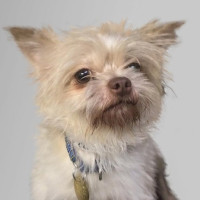
| A lively dog with lots of love to share, the Griffonland is a sturdy little companion ready for action. Although affectionate, this hybrid is independent and won't want to spend all his time on your lap. A cross between the Griffon Bruxellois and the West Highland White Terrier, a beautiful coat and an expressive face make this hybrid a favorite. This intelligent addition to your family will enjoy training classes and family interaction. His coat can tangle, so be prepared to brush him gently a few times a week. |
History of the Griffonland |
| The Griffonland is a modern dog with little documentation. The history of its parents can help to understand its instincts and background: the Griffon Bruxellois and the West Highland White Terrier. |
A little of the Brussels Griffon |
||
| The Brussels Griffon dates back to the 1800s, when this small Terrier-like breed was used to hunt and kill mice and rats in Brussels, Belgium. They were particularly common in the stables where cab horses were kept, and cab drivers kept the dogs with them while driving to use them as a deterrent against theft. The breed was created from the English Toy Spaniel, where it got its big eyes, the Affenpinscher, where it got its stiff coat, and the Pug, where it got its dark muzzle and amusing expressions. The smooth-coated Griffon Bruxellois is also thought to be related to the Yorkshire Terrier. The breed standard was developed in Europe in 1883 and they began to be shown in competitions in 1889. The Queen Consort of the Belgians, Marie Henriette, really loved the breed and owned several. The American Kennel Club (AKC) began recognizing the Brussels Griffon in 1910, making it the 97th most popular dog breed. | ||
 |
||
| Standard of the Brussels Griffon | ||
A little of the West Highland White Terrier |
||
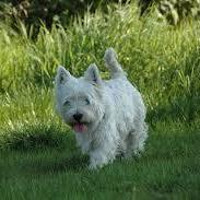
| The West Highland White Terrier originated in Scotland in the 1800s from the Cairn Terrier, Dandie Dinmont Terrier, Skye Terrier and Scottish Terrier. They were originally popular for their hunting ability and were particularly adept at hunting vermin, badgers, otters and foxes. The reason the dog was bred to be white was due to the owner, Colonel Malcolm de Poltalloch, after his dog was accidentally shot when mistaken for a fox. The English Kennel Club (EKC) recognized the little white Terrier in 1906 and it was subsequently noticed and accepted by the AKC in 1908, where it is the 41st most popular dog breed. | ||
 |
||
| Standard of the West Highland White Terrier |
Appearance of the Griffonland |
| Griffonland Terriers can be gray, cream or white, depending on the coloration of each parent breed and the most important traits. Their coat may not be a single color, and is likely to have traces of gray or gold beneath the main color. The coat is generally of medium length, dense and can be soft or rough, but is generally straight. They have small heads, hairy, triangular ears that hang down when relaxed and perk up when listening, black noses and large brown eyes. Their legs are short but muscular, and their bodies long and strong. |
Temperament of the Griffonland |
| This breed is feisty and courageous, but also adorable and friendly to almost everyone. They get on well with your other pets, but need to be socially trained to get along with other animals and strangers. They need to be supervised with children, as they can become surly when agitated. Don't squeeze or hold it too tightly or it could also become irritated with you. Training shouldn't be difficult, as the Griffonland is eager to please and loves to learn. Although they don't bark excessively, if left alone for too long they can get bored and get into mischief. |
Needs and activities of the Griffonland |
| The Griffonland has a moderate activity level with high energy levels, so it needs at least 60 to 90 minutes of vigorous exercise a day. This can include taking him for a walk, letting him run alongside your bike, taking him to play at the dog park, swimming and even hiking in your local park. If your dog doesn't get as much exercise as he needs, he may develop behavioral problems such as excessive scratching, aggression and barking. This breed is also good at agility training and may enjoy taking part in competitions or playing Frisbee or flyball. As they are small, playing ball in the house can be a good activity on rainy or cold days. |
Maintenance of the Griffonland |
| Griffonland grooming may take a little time, but the results are worth it. Their long, thick fur requires brushing at least three or four times a week with a pin brush and metal comb. You should take care to loosen mats or tangles with your fingers before trying to comb to reduce damage to the hair. Once a week, you should thoroughly clean his ears with damp cotton balls and look for any signs of wax build-up, mites or redness and irritation. To prevent dental problems, you should also brush your dog's teeth with a toothpaste specially formulated for dogs. Also, be sure to trim your dog's nails when necessary, as cracks or breaks can be painful. |



 English (United Kingdom)

Comments