
 |
Hava-Apso |
|
He is not recognized by the F.C.I. |
Origin |
Western Mediterranean <> Tibet -> U.S.A. | |
Translation |
Francis Vandersteen |
A brief presentation of the Hava-Apso |
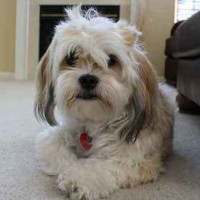
| The Hava-Apso is a small, specific cross-breed of the Havanese Bichon and the Lhassa Apso. Although they haven't been around long, they've made a name for themselves as happy, outgoing, fun-loving dogs that love children as well as other pets, including cats. This dog typically weighs around 5.5 kilos and averages around 25.5 centimeters in height, has long, silky fur that can be any color, and was originally bred in the USA in the 2000s as a companion dog. They are smart, quick learners, but can be hard-headed and so may need professional training if you don't have the time and patience for lengthy training. |
History of the Hava-Apso |
| The Hava-Apso is a modern dog with little documentation. The history of its parents can help to understand its instincts and background: the Havanese Bichon and the Lhassa Apso. |
A little of the Havanese Bichon |
||
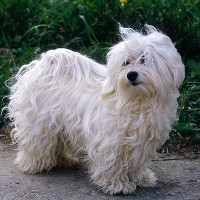
| The Havanese Bichon was born in Cuba in the 1700s, where this little ball of fur was bred to become a companion dog. This toy breed is said to be descended from the Bichon à poil frisé, Bichon bolognais and Coton de Tuléar. It was named after Cuba's capital, Havana, where the breed became most popular. Some say the breed was introduced to Cuba by Spanish settlers in the 1700s after being found in the Mediterranean by migrants, and may be related to the Blanquito de le Habana and the Bichon Tererife. Both breeds are now extinct, but appeared on the manifests of ships sailing from Spain in the 18th century. In 1959, some of these Havanese Bichon somehow found their way to the United States. Some people believe they came with Cuban refugees during the Cuban Revolution. In 1979, the Havanese Bichon Club of America was formed and today has around 400 members. The American Kennel Club officially recognized the breed in 1996, making it the 23rd most popular dog breed in America. | ||
 |
||
| Standard of the Havanese Bichon | ||
A little of the Lhassa Apso |
||
| The Lhassa Apso originated in Tibet and was bred by Buddhists to guard Tibetan monasteries and temples in ancient times. Some believe they were bred from Tibetan Terriers, and DNA studies have revealed that they were in fact related to wolf-like ancestors. In 1933, the Dalai Lama gave several of these dogs to the Cutting family in New Jersey, and the breed became increasingly popular thereafter. The breed was registered with the AKC in 1935 and is the 71st most popular dog breed in America. | ||
 |
||
| Standard of the Lhassa Apso |
Appearance of the Hava-Apso |
| This breed is a small dog, usually no more than 25.5 centimeters high and weighing around 5.5 kilos. Their dark brown eyes show intelligence and a spark of ardor, and they tend to look like puppies throughout their lives. Their black nose is small with a short, broad muzzle, leading them to have brachycephalic syndrome in most cases. Their long, straight, silky coat is dense and can be almost any color, including black, gray, brown, red, cream, fawn, blue, white, piebald and brindle. Their bodies are compact and robust, and the tail is carried over their back like a plume. |
Temperament of the Hava-Apso |
| Your Hava-Apso is a happy breed that loves to play and will continue to act and look like a puppy throughout its life. Although they tend to be difficult to train, if you're patient and use positive reinforcement, you should be able to get them to listen to reason. However, housetraining can be difficult, and some owners resort to professional training or use puppy pads in the house. These are small, fearless dogs who will attack a much larger animal if they see it as a threat to their family. However, they love children and other pets in the house and get on well with other dogs in the dog park if well socialized. |
Needs and activities of the Hava-Apso |
| This breed can be a little lazy, and you may need to encourage it to get out and exercise. Because they are considered small dogs, they tend to become overweight if they don't get enough exercise and will need at least 30 to 45 minutes of vigorous activity a day. To avoid boredom and obesity, you should take your Hava Apso out for a brisk walk or jog twice a day, or play a long game of fetch. Your dog may also enjoy a trip to the dog park to play with other dogs, or perhaps a hike in your local park. |
Maintenance of the Hava-Apso |
| Your Hava-Apso needs moderate maintenance. You should brush at least three or four times a week with a pin brush and a metal comb. They don't shed like other dogs, so they're considered hypoallergenic, although you should brush them daily during the shedding season to remove loose hair. Only bathe them when absolutely necessary, and use a mild dog shampoo and conditioner recommended by your vet. Bathing too often can dry out the skin. Trim their nails with a suitable nail clipper if necessary, clean their ears with a soft cloth or cotton ball once a week and brush their teeth once a week. |



 English (United Kingdom)

Comments