
 |
Japeke |
|
He is not recognized by the F.C.I. |
Origin |
China -> U.S.A. | |
Translation |
Francis Vandersteen |
A brief presentation of the Japeke |
| The alert, affectionate and sometimes mischievous Japeke is a specific modern cross between two dogs of Chinese origin, the Japanese Spaniel and the Pekingese. The resulting hybrid is a regal and courageous companion in the size of a toy. Although this hybrid is an excellent alarm barker, most owners can expect the Japeke to lead a quiet life full of naps on their owner's lap. |
History of the Japeke |
| The Japeke is a toy-sized hybrid of two beloved ancient Chinese breeds, the Japanese Spaniel and the Pekingese. As a specific crossbreed dog, the history of the Japeke has yet to be written, however, both parent breeds have royal histories to share with the Japeke. |
A little of the Japanese Spaniel |
||
| The Japanese Spaniel, despite its nomenclatural links with Japan, is an ancient breed from China. Like other Chinese breeds, the Japanese Spaniel was highly regarded by the imperial nobility, who maintained secret breeding programs. However, the Chinese court often offered the Japanese Spaniel to foreign dignitaries, so the little dog made its way to Japan. In Japan, the dog was regarded as a separate being above all other dogs and earned its title, the chin. The Japanese Spaniel made its way to Europe and the United States through trade with the West from the 19th century onwards, but retained a rare status for many years, although it was recognized by the American Kennel Club in 1888. | ||
 |
||
| Standard of the Japanese Spaniel | ||
A little of the Pekingese |
||
| The Pekingese is one of China's best-known breeds, partly because of its reference to the imperial capital, Beijing, and partly because of its long and once-secret history as an imperial favorite. The breed was well guarded and not allowed to leave the imperial palace, giving it a mystique. The Pekingese was first discovered by the West during the Opium War in 1860 when British troops found a group of five dogs guarding the body of their mistress, who had committed suicide rather than be captured. The five dogs were taken to England and offered to the nobility, including one to Queen Victoria. Despite its secretive beginnings in China and subsequent introduction to the West, the Pekingese quickly gained recognition. Pekingese joined the ranks of the American Kennel Club in 1906, and the breed enjoyed moderate popularity. | ||
 |
||
| Standard of the Pekingese |
Appearance of the Japeke |
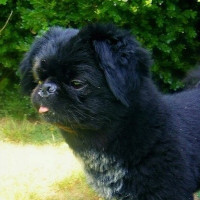
| The Japeke is a mix of two Chinese breeds and may lean more towards one or the other, but this hybrid is a toy-sized dog with long, soft hair. The Japanese Spaniel adds a little more height and delicacy to the Japeke, whose stocky, compact Pekingese relative is low to the ground. However, the Japeke is not as delicate as the Japanese Spaniel. Both parents have brachycephalic skulls, and the nose will be on the same plane as the forehead for the Japeke. The eyes are large for its size and dark brown to black, and the nose is black. The nose can sometimes appear brown in brown-coated varieties. The Japeke's coat may or may not have an undercoat, depending on which parent the mix most closely resembles. The Japanese Spaniel has only a soft, silky outer coat, while the Pekingese has a dense double coat. Regardless of the coat, a Japeke's hair is soft and long, with extensive feathering on the tail, which is often curled over the back. |
Temperament of the Japeke |
| The Japeke is a cheerful, alert hybrid that's excellent for the family. As a toy-sized dog, this hybrid is much better suited to families with older children, but the Japeke displays affection for children of all ages. Despite its small size, the Japeke is a good watchdog that will alert the family to strangers and threats. This hybrid much prefers to be the only dog in the house and is not particularly friendly to other pets. However, with early and consistent socialization, the Japeke can adapt to a multi-pet household. Training can be a little tricky as this hybrid tends to be stubborn, but a calm, consistent and gentle voice will help the Japeke learn. The Japeke prefers the quiet life of a pocket dog and generally has low energy levels. As an indoor hybrid, the Japeke can usually get all its exercise needs in a short time, indoors. |
Needs and activities of the Japeke |
| The Japeke is not very active and has low energy levels. However, daily exercise is still necessary, as this hybrid has a moderate tendency to gain weight. Given the low energy levels, the Japeke doesn't need high-intensity activity and shouldn't be pushed to exercise hard or long. This is partly due to the hybrid's size, but even more so to the Japeke's respiratory problems. The brachycephalic face means that the airways are more restricted than in other dogs, and intense exercise can lead to respiratory problems, including overheating. |
Maintenance of the Japeke |
| No parent breed is considered hypoallergenic, so the Japeke is not a hypoallergenic hybrid. What's more, the Japeke is a moderately shedding dog with a thick, dense coat. Weekly brushing with a small bristle brush is ideal, but giving the coat a little water before brushing will prevent breakage. The Japeke drools very little, but given its flat face, this hybrid gasps more often than others due to breathing difficulties. Keeping teeth clean with twice-weekly brushing will also help keep the Japeke's breath fresh, although daily tooth brushing is recommended. Owners should avoid frequent bathing and use grooming techniques to keep the coat clean and free of debris. The long hairs on the Japeke's hind legs and rear require special attention, as do the ears, which are often hidden under thick, long hair. |



 English (United Kingdom)

Comments