 |
Malanees |
|
He is not recognized by the F.C.I. |
Origin |
U.S.A. <> France -> U.S.A. | |
Translation |
Francis Vandersteen |
A brief presentation of the Malanees |
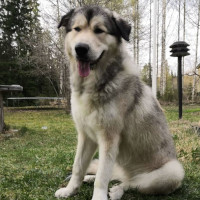
| Malanees are an equal blend of the two parent breeds, the Alaskan Malamute and the Pyrenean Mountain Dog. As can be imagined, this is a very large and beautiful breed, whose main traits are those of the working group dogs. Malanees have long, thick coats that often shed but require very little maintenance to keep them clean. They have a beautiful, athletic body, both graceful and strong. Built to pull and act as guardians, Malanees have great strength and willful determination, both classic examples of a working-class dog. Although powerful and dignified, this breed is also very affectionate, calm, gentle and patient, making it a wonderful companion even for the smallest of children. If you're thinking of adding a Malanees to your home, bear in mind that it will lose a lot and can be extremely independent. This willful nature can make Malanees a difficult dog to train, classifying it as one that can be a challenge for new dog owners. However, if you too are a strong-willed person, don't let their independence put you off. With consistent, strong leadership, Malanees will do just fine and be an excellent addition to any family. |
History of the Malanees |
| Although it may seem that a combination of the Alaskan Malamute and the Pyrenean Mountain Dog should have existed for some time, the Malanees is in fact a relatively new breed. For this reason, the breed doesn't have a very in-depth history of origin. Origins are very important, as they explain why the breed was created and which traits were deemed most important for the breed. Fortunately, although Malanees don't yet have a rich history, both its parent breeds do, so we can learn a lot of really useful information about Malanees from its parents. |
A little of the Alaskan Malamute |
||
| The Alaskan Malamute is famous for its love of pulling and its ability to shed enough fur to create a whole new dog. These amazing dogs were created many years ago in Alaska by the Inuit. This nation of people were known as nomads and relied on strong dogs to help carry their main means of transport, sledges. The Alaskan Malamute lived for such a profession, and that urge to pull still runs through its veins today. However, the breed had other jobs besides pulling sledges. They were also hunters, helping their humans to seek out polar bears and other animals for food. They have a fearless, independent nature that makes them wanderers with big, loving hearts. People relied on dogs for everything from transportation to warmth. Dogs were very close to their people and considered them part of their pack, which is why the Malamute loves people so much today and doesn't do well on its own. This breed became extremely important during the gold rush of 1896, when miners paid good money for reliable dogs and fast sleds. While this may have seemed like a good time for the Alaskan Malamute, it was actually a very dangerous time for the breed. People wanted them faster, so overproduction and mixing of the breed with other dogs took place. Fortunately, the Malamute genes were strong and the breed didn't change much. In 1935, the American Kennel Club recognized the Alaskan Malamute as a breed and they have since become popular as working dogs and loyal companions. | ||
 |
||
| Standard of the Alaskan Malamute | ||
A little of the Pyrenean Mountain Dog |
||
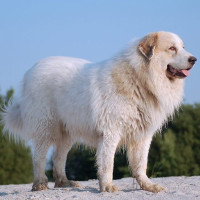
| The Pyrenean Mountain Dog is a magnificent giant that was originally created as a herding dog in the French Pyrenees. Faithfully watching over the herds, Pyrenean Mountain Dogs had to be large to protect the animals from hunters such as wolves and bears. You might think that with such a large dog, Pyrenean Mountain Dogs would be aggressive and aloof, but this is not the case. This breed is highly prized for its calm, patient and affectionate attitude. Their trademark white coat was a must for their work, as it allowed the breed to blend in with the sheep they were protecting. This gave them an element of surprise against their biggest attackers. Pyrenean Mountain Dogs were so famous for their bravery that they were eventually chosen to protect important figures too, such as King Louis XIV, who made the breed part of his domestic guard. It took a long time for these beautiful dogs to make their way to America, but once they did, Pyrenean Mountain Dogs were recognized by the American Kennel Club in 1933. They are now mainly used as pets and house guards. | ||
 |
||
| Standard of the Pyrenean Mountain Dog |
Appearance of the Malanees |
| Because Malanees are a cross between the Alaskan Malamute and the Pyrenean Mountain Dog, their appearance can vary greatly. Despite this fact, the two parent breeds are relatively similar in size and body type, so the biggest differences that can appear on Malanees are mainly in the shape of the ears and the coloring of the coat. Because both parent breeds have thick, double-layered coats, Malanees are a breed that will obviously do best in cold weather. They will shed frequently and blow their coats twice a year. Coloration will vary from pure white, gray, brown, beige, badger, red and black. Malanees' eyes can vary from brown, hazel and blue, they have an attractive almond shape and always seem to have a spark of mischief in the color. While Pyrenean Mountain Dogs have loose, folded ears, the Alaskan Malamute does not. Given the Malamute's strong genes, it's very likely that Malanees generally have large, traingular rather than folded ears. They can measure from 58.5 to 81 centimeters and weigh from 32 to 45.5 kilos. |
Temperament of the Malanees |
| The Malanees combines all the best and some of the worst traits of its two parent breeds. They are affectionate, intelligent, calm, great with children of all ages and an excellent companion for those who like to be active. However, as with any dog, some negative traits can be difficult to overcome. Barking, a strong independent nature, a tendency to overeat and stubbornness are all traits Malanees can inherit and can be trying for an owner. It's important to remember that these dogs, while wonderful, require a lot of work and patience. They're not for everyone. Your yard will need to have high fences, as the Alaskan Malamute side is very good at escaping, and you may need to warn your neighbors about barking, as Pyrenean Mountain Dogs love to be heard. With these things in mind, Malanees really do make a wonderful pet in spite of everything. They are excellent guardians and very gentle with children and other animals. With early socialization, training and a clear leader, Malanees will be an excellent addition to any family. |
Needs and activities of the Malanees |
| While both the Alaskan Malamute and the Pyrenean Mountain Dog are working dogs, they are actually only moderately active dogs, which means that while they need exercise, neither breed is excitable or overly energetic. For this reason, Malanees will need a decent amount of exercise time during the day, but you don't have to worry about never doing anything because you're too busy trying to tire your puppy out. By simply taking a long walk, short, jog, workout, playing fetch or even teaching your Malanees to pull something for a job, you can exhaust your dog and keep him in great shape. |
Maintenance of the Malanees |
| While Malanees' coats don't need much maintenance as far as bathing is concerned, a lot of brushing will be necessary. Malanees' fur will have the same type of oils as the Pyrenean Mountain Dog and the Alaskan Malamute, meaning they are waterproof and free from bad dog odors. So, while bathing only needs to take place once or twice a year for this breed, unless he gets into something naughty, regular grooming is a completely different story. Malanees will shed a lot all year round, twice a year he'll tend to get a bit worse as he loses the mass of his winter coat. You'll want to brush your dog daily with a regular pin brush to remove loose hair and dirt, as well as brushing at least once a week with a detangling tool. This will help keep shedding at a slightly more manageable level. In addition to brushing and bathing, be sure to trim your dog's nails a few times a month to keep his paws healthy. |



 English (United Kingdom)

Comments