New Shep

He is not recognized by the F.C.I.

Origin
Germany <> Canada -> U.S.A.
Translation
Francis Vandersteen

A brief presentation of the New Shep

The New Shep is a specific cross between the German Shepherd, an unflappable sheepdog best known for its role in police forces and military companies around the world, and the Newfoundland, a tough, gentle dog that loves to swim. The result is generally a confident, highly intelligent dog that is also generally approachable and tolerant of children and small animals, although reckless breeding can result in dogs with a tendency towards aggression or nervousness, as well as dogs with physical health problems. Although recognized by the Designer Breed Registry and the International Designer Canine Registry, this hybrid is not particularly popular at the moment, so finding a reputable breeder can take some work and is extremely important to avoid having a dog with aggression problems or fear of their genetic history.

History of the New Shep

The New Shep is a designer dog, the intentional cross between the German Shepherd, a dog originally bred for shepherding, but more commonly considered a guard dog and often associated with military and police protection, and the Newfoundland Hound, a gentle giant that seems almost more at home in the water than on land.


A little of the German Shepherd

        
The German Shepherd breed was developed and standardized in the early 1900s by Captain Max Emil Friedrich von Stephanitz, a career cavalry officer and dog breeder who focused on the utilitarian traits of intelligence, structural efficiency and stable temperament. The breed was initially developed as a sheepdog that could easily convince sheep to return to the fold without nipping, and that was big and healthy enough to trot alongside sheep over long distances and protect them from predators. As the need for sheepdogs diminished, Captain Max von Stephanitz began promoting the breed as a police dog, which is how the breed is best known today. The German Shepherd breed was recognized by the American Kennel Club in 1908 and has been one of the most popular breeds ever since, second only to the Labrador Retriever.
Standard of the German Shepherd

A little of the Newfoundland Dog

The Newfoundland Dog is an ancient and somewhat mysterious dog, and while its true ancestral heritage may never be known, we do know that it provided constant companionship for fishermen along the Canadian coast and was known as the original “ship's dog”. Called Great St. John's Dogs in the 1700s, these dogs were closely related to the Little St. John's Dog, an extinct predecessor of the Labrador Retriever, and like their smaller cousins, most Newfoundland Dogs spent their days retrieving ropes, nets and fish from icy waters, as well as the occasional shipwreck survivor. By the 1800s, the Newfoundland breed had gained popularity in England and the United States, where it became well known not only for its prowess in the water, but also for its exceptionally gentle nature with children.
Standard of the Newfoundland Dog

Appearance of the New Shep

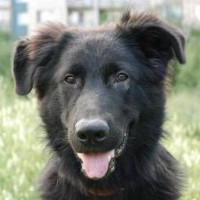
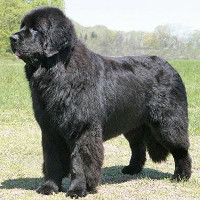
The New Shep is generally a very big dog, often venturing into the realm of giants, a robust dog with heavy bones and an athletic build. There are certainly differences from dog to dog when it comes to New Shep hybrids, while both parent breeds have straight, strong backs that are slightly longer than the dogs are tall, the Newfoundland Dog's back is generally level while the modern German Shepherd's back often has a decidedly sloping back, especially those that come from dog show lines, and the Newfoundland Dog has a much deeper chest and wider skull. The German Shepherd Dog's muzzle is longer and more tapered than that of the Newfoundland Dog, and although they generally have brown eyes and pointed ears, the Newfoundland Dog's eyes are generally smaller and not as almond-shaped as the German Shepherd Dog's, and the German Shepherd Dog's ears are erect, whereas the Newfoundland Dog's ears fold forward. Both the German Shepherd and the Newfoundland have a double coat, with a soft, dense undercoat and a coarse outer layer of short to medium fur that is usually slightly wavy, and this is usually passed on to their offspring as well. New Shep crosses can inherit physical traits from either of the parent breeds, so even puppies from the same litter can vary considerably in appearance.

Temperament of the New Shep

In most cases, the combination of these dogs will produce a confident, well-mannered dog, big enough to intimidate, but usually with an approachable manner. However, there are German Shepherd and Newfoundland lines that can develop anxiety, shyness and aggression. It is therefore essential to ensure the good health and temperament of both parents with this cross. Although all interactions between dogs and young children must be carefully monitored, these powerful dogs are generally tolerant of children and often have a calmer temperament than many other dogs of their size, and are less likely to cause bumps and bruises from over-exuberant behavior. They tend to get on well with other pets in the home if socialized early on, and although they are not overly gregarious with other dogs, most dog-to-dog interactions are likely to be good-natured, although same-sex aggression does occasionally occur, particularly in male dogs. Good socialization can also help prevent the formation of some of New Shep's more negative behavioral traits, as can early and advanced training sessions. Training is not easy with these dogs as they are likely to have a little independence, but when engaged, they are extremely trainable dogs and can excel at learning a variety of skills such as advanced obedience training, military and rescue work, tracking, and pulling small carts and sleds.

Needs and activities of the New Shep

German Shepherds and Newfoundlanders are known for their stamina and strength, and like their parents, New Sheps require daily exercise to maintain these qualities. To stay fit and healthy, these dogs need at least one hour of vigorous activity a day. It's important to remember not to allow growing dogs of this size to exercise or play too roughly, or to jump from high surfaces, as these activities can sometimes cause irreversible damage to rapidly growing bones and joints. This crossbreed is both too active and too large for most apartments, and is better suited to a larger home with a yard.

Maintenance of the New Shep

Although this particular hybrid doesn't need to be bathed too frequently, the New Shep's coat does require significant effort on the part of the owner to keep it free of dirt, debris and tangles. Not only does the soft undercoat tend to tangle, but the Newfoundland Dog has a coat that seems to attract dust and debris, and the German Shepherd breed is prone to heavy shedding, making daily brushing sessions necessary to manage tangles, debris and loose hair. Moulting is particularly important for both parent breeds in spring and autumn, and you may need to increase frequency even further to compensate during these months.

Comments

Latest page updates

  • Telomian

    Telomian He is not recognized by the F.C.I. Origin Malaysia Translation Francis Vandersteen A brief presentation of the Telomian The Telomian is a very rare breed of dog, and the only one native to Malaysia to have been bred outside the country. They were originally bred by the indigenous people of Malaysia to combat parasites such as snakes, rats,...
  • King Wheaten -- Cavalier King Charles Spaniel X Irish Soft Coated Wheaten Terrier

    King Wheaten He is not recognized by the F.C.I. Origin Great Britain <> Ireland -> U.S.A. Translation Francis Vandersteen A brief presentation of the King Wheaten The King Wheaten is a small dog with a heart this big and a playful disposition. Borrowing the energy and soft-coated waves of the Irish Soft Coated Wheaten Terrier and the size and...
  • Spanierd -- English Springer Spaniel X German Shepherd

    Spanierd He is not recognized by the F.C.I. Origin Great Britain <> Germany -> U.S.A. Translation Francis Vandersteen A brief presentation of the Spanierd The Spanierd is a hybrid dog. Its parent breeds are the English Springer Spaniel and the German Shepherd. They have an affable personality. He's known for entertaining family and friends with his...
  • Alaskan Goldenmute -- Alaskan Malamute X Golden Retriever

    Alaskan Goldenmute He is not recognized by the F.C.I. Origin U.S.A. <> Great Britain -> U.S.A. Translation Francis Vandersteen This breed is also known as Alaskan GoldenGoldenmuteAlaskan Gold Retriever     A brief presentation of the Alaskan Goldenmute The Alaskan Goldenmute is a descendant of two great dog breeds: the Alaskan Malamute and the Golden...
  • French pointing dog Pyrenean type

    French pointing dog Pyrenean type FCI standard Nº 134 Origin France Translation Mrs. Peggy Davis Group Group 7 Pointing Dogs Section Section 1.1 Continental Pointing Dogs « Braque » Type Working With working trial Acceptance on a definitive basis by the FCI Tuesday 18 January 1955 Publication of the official valid standard Tuesday 01 August 2023 Last...
  • French pointing dog Gascogne type

    French pointing dog Gascogne type FCI standard Nº 133 Origin France Translation Mrs. Peggy Davis Group Group 7 Pointing Dogs Section Section 1.1 Continental Pointing Dogs « Braque » Type Working With working trial Acceptance on a definitive basis by the FCI Monday 17 January 1955 Publication of the official valid standard Tuesday 01 August 2023 Last...
  • Vucciriscu

    Vucciriscu He is not recognized by the F.C.I. Origin Sicily Translation Francis Vandersteen En français, cette race se dit Vucciriscu Diese Norm ist in deutscher Sprache sichtbar Vucciriscu En español, esta raza se dice Vucciriscu In het Nederlands, wordt dit ras gezegd Vucciriscu This breed is also known as Sicilian Vucciriscu Sicilian Butcher...

© 2026 Groupe Milouchouchou ASBL. Tous droits réservés. En savoir plus

Protected by Copyright01
We use cookies

We use cookies on our website. Some of them are essential for the operation of the site, while others help us to improve this site and the user experience (tracking cookies). You can decide for yourself whether you want to allow cookies or not. Please note that if you reject them, you may not be able to use all the functionalities of the site.

Ok