
 |
Peke-A-Boo |
|
He is not recognized by the F.C.I. |
Origin |
China <> Italy -> U.S.A. | |
Translation |
Francis Vandersteen |
A brief presentation of the Peke-A-Boo |
| The Peke-A-Boo is a hybrid breed composed of a cross between a pure-bred Pekingese and a pure-bred Bolognese. They have a distinctive underbite from their Pekingese ancestry and can have short or long coats. They have short, stubby legs and large brown eyes with a friendly expression. A Peke-A-Boo generally resembles the Bichon Bolonais when it comes to getting along with children and other dogs, but it's always a good idea to keep an eye on children around small breeds who can snap if treated roughly. These dogs make excellent pets, but love to go their own way, so a firm hand is needed. They don't shed much, so a weekly brushing is usually enough. Common colors are white, black, brown and tan. |
History of the Peke-A-Boo |
| The Peke-A-Boo is a hybrid breed made up of a combination of a Pekingese and a Bolognese, both with royal connections. |
A little of the Pekingese |
||
| Despite their size, DNA studies reveal that Pekinese dogs are among the closest genetically to wolves. They are an ancient breed, first recorded in the Tang dynasty of the 8th century. Other names for them are Lion Dog, Peking Lion Dog, Pelchie Dog or Peke. Only royalty could own them, and anyone who stole them faced the death penalty. It was in 1860, during the Great Chinese War, that this breed first came to the attention of the Western world. Franco-British forces marched on Peking and looted the Summer Palace. Inside, they found five Pekingese guarding the body of the emperor's aunt, who had committed suicide during the invasion. They were taken to England and one was given to Queen Victoria, who named her “Looty”. She lived at Windsor Palace until her death 10 years later. The dogs were first registered by the American Kennel Club in 1906, while the Pekingese CLub of America became a member of the AKC in 1909. | ||
 |
||
| Standard of the Pekingese | ||
A little of the Bolognese Bichon |
||
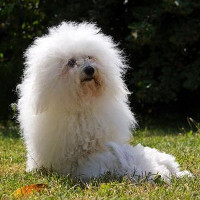
| Sharing their name with an Italian sauce, Bolognese are small, fluffy white dogs of the Bichon type, originally from Italy. They are one of several similar white dogs, including the Bichon frise, Coton de Tuléar and Maltese Bichon, dating back some 2,000 years. Bolognese Bichons take their name from Bologna, where they were popular with Italian aristocrats. Over the following centuries, they found favor in a number of royal courts across Europe. Queen Maria Theresa of Austria had her little dog preserved by a taxidermist after her death, and it can still be seen in Vienna's National History Museum. Americans Bert and Dorothy Goodale discovered the Bolognese while researching the Havanese breed. They imported the first Bolognese to the USA in 1985. | ||
 |
||
| Standard of the Bolognese Bichon |
Appearance of the Peke-A-Boo |
| The Peke-A-Boo is a specific cross between a pure-bred Pekingese and a Bolognese. They are toy breeds and fairly small, weighing up to 6.5 kilos. They generally reach a height of up to 23 centimeters. Their coats can be long or short, depending on which parent breed the hybrid follows most closely. Their eyes are large and brown, and they have flat faces with hanging black noses and ears. They often have the distinctive underbite on the Pekinese side. Common colors are white, black, brown and tan, and their tails usually curve over their backs. |
Temperament of the Peke-A-Boo |
| A Peke-A-Boo is an intelligent dog but will need a firm hand, as they can be full of complacency and are masters at going their own way. But they make excellent companions, especially for those who don't have children and want a dog to devote themselves to. They are not the best dogs for people with young children, as they can bite if handled roughly. This breed is fairly easy to train, but will need plenty of positive reinforcement as it does not respond well to harsh discipline. Early training and socialization will be needed to help them get along with other dogs. A Peke-A-Boo is loving and affectionate towards its owners and will not want to spend too much time alone. They will suit elderly people who are not very active, as the Peke-A-Boo will be more than happy to curl up on the sofa. They are quite wary of strangers and will bark if they see someone approaching. They are quite protective and make good watchdogs. |
Needs and activities of the Peke-A-Boo |
| A Peke-A-Boo is an active, energetic dog, but doesn't need much exercise to be satisfied. He'll be happy to hang around the house as long as he has company. These are good dogs for those who live in an apartment or a house with a small garden. They shouldn't be exercised when it's too hot, and when the temperature rises, they should be kept indoors with the air conditioning on. Your pet will enjoy games and visits to the dog park or beach. These will also help them acquire socialization skills, and they'll enjoy playing with other dogs. |
Maintenance of the Peke-A-Boo |
| Depending on the length of your Peke-A-Boo's coat, it should be brushed daily or several times a week to prevent matting. A Bichon Bolonais is hypoallergenic, which is good for allergy sufferers, whereas a Pekingese is not, so it will depend on which parent breed your dog follows most. These breeds need their face and eyes cleaned regularly as they can develop tear stains under the eyes and also to avoid any developmental problems with facial skin folds. Bathe your pet from time to time if necessary. Trimming may be necessary, including the hair on the feet. Ears should also be checked for dirt, and teeth brushed daily if possible. Nails should also be trimmed if necessary. |



 English (United Kingdom)

Comments