Pom-Kee

He is not recognized by the F.C.I.

Origin
Germany -> U.S.A.
Translation
Francis Vandersteen

A brief presentation of the Pom-Kee

The Pom-Kee hybrid is a mix of German Toy Spitz / Pomeranian and German Wolfsspitz / Keeshond. This hybrid mix is very interesting, combining two pure breeds, one of which was bred for hunting, chasing and killing animals while the other was not. The German Toy Spitz / Pomeranian was initially a larger dog and was bred for breeding duties, while the German Wolfsspitz / Keeshond was initially bred solely for companionship, guarding and protection. Eventually, in the 17th and 18th centuries, even the gentle, loving, sweet-tempered German Wolfsspitz / Keeshond had to demonstrate its versatility by adapting to hunting and killing rats and other vermin while guarding ships and their cargo.

History of the Pom-Kee

The Pom-Kee is a hybrid mix of the German Toy Spitz / Pomeranian and the German Wolfsspitz / Keeshond, a fairly new hybrid dog with little or no information available on the hybrid itself. So that we can get an idea of your pet's appearance and behavior, we'll take a brief look at the history of the parent breeds. The Pom-Kee hybrid itself is recognized by the Dog Registry of America, Inc.


A little of the German Toy Spitz / Pomeranian

        
The German Toy Spitz / Pomeranian, a very old breed whose date of origin is unknown, can be traced back to the Prussian region of Pomerania, now known as Germany and Poland, with its heritage including varieties of ancient Spitz. We know that it didn't really become public until around 1870, when it was recognized by the Kennel Club in England. Queen Victoria, who became very fond of this little breed, is credited with breeding it down to the size we see today. Its initial size was around 14 kilos and the breed was used in breeding tasks, an image that is really hard to imagine looking at it today. The toy version we know today became even more popular as a pet and companion (yes, a small dog of course) for the royal family, wealthy and famous throughout the centuries, some of the most notable figures being Marie Antoinette, Thomas Edison and Michelangelo as well as Queen Victoria herself. The breed was shown in the Miscellaneous class at American Kennel Club shows as early as 1888, with full recognition in the Toy class in 1900.
Standard of the German Toy Spitz / Pomeranian


A little of the German Wolfsspitz / Keeshond

The German Wolfsspitz / Keeshond is another very old dog breed, dating back at least to the 13th and 14th centuries, and originating in Germany. The German Wolfsspitz / Keeshond was loved and appreciated by the farming community for its assurance as a guard dog and for the security of companionship with their families offered by the breed. Later, in the 1800s, the German Wolfsspitz / Keeshond proved to be a versatile dog, ready to guard almost anything, including riverboats and farms. They adapted to hunting and killing rats and other vermin in these environments. Their heritage is thought to incorporate : Samoyed, Finnish Spitz, Norwegian Elkhound, German Toy Spitz / Pomeranian, Chow Chow and Siberian Husky. The German Wolfsspitz / Keeshond came to England around 1910 and to the United States in 1923, gaining recognition from the American Kennel Club in 1930.
Standard of the German Wolfsspitz / Keeshond

Appearance of the Pom-Kee

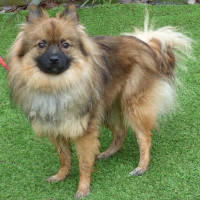
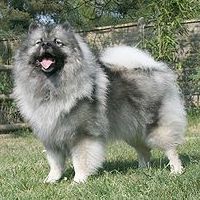
The Pom-Kee is a hybrid mix of German Toy Spitz / Pomeranian and German Wolfsspitz / Keeshond and, as such, can inherit appearance characteristics from one or both parent breeds. The Pom-Kee has been described as a “large German Toy Spitz / Pomeranian”, measuring from 15 to 46 centimeters in height at the withers and weighing between 1.5 and 20.5 kilos. Both parent breeds sport long, luxuriant fluffy coats and tails described as “feathers on a woman's hat” that curl at least once over their backs. Their faces are similarly structured, with long, thin, tapering snouts that resemble foxes, small, erect ears and dark, bright, almond-shaped eyes that create an alert expression. Both have scissor-like bites, compact, well-balanced bodies, on different sizes of course, and carry themselves with confidence.

Temperament of the Pom-Kee

Your hybrid-furred family member Pom-Kee, being a mix of German Toy Spitz / Pomeranian and German Wolfsspitz / Keeshond, can inherit temperament qualities from one or both parent breeds. As a result, your pet may be: affectionate, alert, friendly, gentle, energetic, cheerful, intelligent, playful, independent, lively, loyal, social and outgoing. As early socialization is a key part of any dog's training, early socialization ensures that your Pom-Kee will be great with children as well as strangers. He's very affectionate with his family and wants to be with them, not really tolerating long periods of being alone. He will also get on quite well with other dogs, but the family cat may find himself an object of playful pursuit from time to time. His level of intelligence ensures that he will be easily trained using positive training methods, but be aware that he can be a barker, making it difficult for those living in low-noise areas. Proper training can moderate this trait.

Needs and activities of the Pom-Kee

The Pom-Kee, a hybrid mix of German Toy Spitz / Pomeranian and German Wolfsspitz / Keeshond, is a moderately active dog. Your Pom-Kee will need around 30 to 60 minutes of moderate exercise a day. Daily vigorous walks, romping in the dog park or fenced yard, combined with interactive games of fetch and Frisbee, will keep him sufficiently exercised both physically and mentally. If he's left alone for long periods and left outside in the yard without being able to interact with his beloved human family, he'll probably develop the annoying habit of barking inopportunely. This can be a problem if you live in a low-noise area. If you spend long periods away from home, this hybrid may not be your best choice of family companion. He can live in an urban or rural setting, in an apartment, condo or family home with or without a fenced yard, provided he has ample opportunity for exercise to keep him healthy, happy and fit. He will probably tolerate cooler temperatures due to his dense coat, and should be kept in air-conditioned or fan-ventilated areas during warmer temperatures.

Maintenance of the Pom-Kee

Your Pom-Kee hybrid family dog is considered to be in the moderate maintenance category, with moderate amounts of shedding making it non-hypoallergenic. As such, it will need to be brushed at least twice a week to remove loose hair, debris, tangles and mats, and to properly maintain the oils distributed throughout its coat. She should be bathed as needed - weekly, monthly or quarterly, depending on her activities. During her weekly brushing sessions, be sure to check her ears and clean them with a cotton ball and an approved canine ear cleaning solution to protect them from infection. His nails should also be checked weekly, trimmed if necessary, unless he can keep them worn down with his normal exercise routine. Dental check-ups and cleanings, along with brushing at least twice a week at home, will help reduce the risk of developing periodontal disease and the tooth loss that accompanies it. And more good news, it falls into the low drool and odor category.

Comments

Latest page updates

  • Telomian

    Telomian He is not recognized by the F.C.I. Origin Malaysia Translation Francis Vandersteen A brief presentation of the Telomian The Telomian is a very rare breed of dog, and the only one native to Malaysia to have been bred outside the country. They were originally bred by the indigenous people of Malaysia to combat parasites such as snakes, rats,...
  • King Wheaten -- Cavalier King Charles Spaniel X Irish Soft Coated Wheaten Terrier

    King Wheaten He is not recognized by the F.C.I. Origin Great Britain <> Ireland -> U.S.A. Translation Francis Vandersteen A brief presentation of the King Wheaten The King Wheaten is a small dog with a heart this big and a playful disposition. Borrowing the energy and soft-coated waves of the Irish Soft Coated Wheaten Terrier and the size and...
  • Spanierd -- English Springer Spaniel X German Shepherd

    Spanierd He is not recognized by the F.C.I. Origin Great Britain <> Germany -> U.S.A. Translation Francis Vandersteen A brief presentation of the Spanierd The Spanierd is a hybrid dog. Its parent breeds are the English Springer Spaniel and the German Shepherd. They have an affable personality. He's known for entertaining family and friends with his...
  • Alaskan Goldenmute -- Alaskan Malamute X Golden Retriever

    Alaskan Goldenmute He is not recognized by the F.C.I. Origin U.S.A. <> Great Britain -> U.S.A. Translation Francis Vandersteen This breed is also known as Alaskan GoldenGoldenmuteAlaskan Gold Retriever     A brief presentation of the Alaskan Goldenmute The Alaskan Goldenmute is a descendant of two great dog breeds: the Alaskan Malamute and the Golden...
  • French pointing dog Pyrenean type

    French pointing dog Pyrenean type FCI standard Nº 134 Origin France Translation Mrs. Peggy Davis Group Group 7 Pointing Dogs Section Section 1.1 Continental Pointing Dogs « Braque » Type Working With working trial Acceptance on a definitive basis by the FCI Tuesday 18 January 1955 Publication of the official valid standard Tuesday 01 August 2023 Last...
  • French pointing dog Gascogne type

    French pointing dog Gascogne type FCI standard Nº 133 Origin France Translation Mrs. Peggy Davis Group Group 7 Pointing Dogs Section Section 1.1 Continental Pointing Dogs « Braque » Type Working With working trial Acceptance on a definitive basis by the FCI Monday 17 January 1955 Publication of the official valid standard Tuesday 01 August 2023 Last...
  • Vucciriscu

    Vucciriscu He is not recognized by the F.C.I. Origin Sicily Translation Francis Vandersteen En français, cette race se dit Vucciriscu Diese Norm ist in deutscher Sprache sichtbar Vucciriscu En español, esta raza se dice Vucciriscu In het Nederlands, wordt dit ras gezegd Vucciriscu This breed is also known as Sicilian Vucciriscu Sicilian Butcher...

© 2026 Groupe Milouchouchou ASBL. Tous droits réservés. En savoir plus

Protected by Copyright01
We use cookies

We use cookies on our website. Some of them are essential for the operation of the site, while others help us to improve this site and the user experience (tracking cookies). You can decide for yourself whether you want to allow cookies or not. Please note that if you reject them, you may not be able to use all the functionalities of the site.

Ok