
 |
Rus-A-Pei |
|
He is not recognized by the F.C.I. |
Origin |
Great Britain <> China -> U.S.A. | |
Translation |
Francis Vandersteen |
A brief presentation of the Rus-A-Pei |
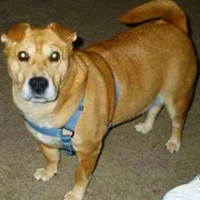
| The Rus-A-Pei is a designer dog, an intentional hybrid between the Chinese Shar Pei, an ancient Chinese breed used as a guard and protection dog for thousands of years, and the Parson Russell Terrier, an intense and determined foxhunter. Rus-A-Pei are active, independent and quick-witted animals with a tendency to be stubborn. Rus-A-Pei owners with little or no training experience are therefore encouraged to put their dogs through obedience classes and work with more experienced handlers. Although difficult to train, these dogs are highly intelligent. If you find the right mix of exercise, attention and mental stimulation, they can blossom into loyal, charming and well-behaved pets. |
History of the Rus-A-Pei |
| The Rus-A-Pei is not a breed as such, but a name used to describe a designer dog, a deliberate cross between the Shar Pei, a capable and aggressive farm guard that was later used for dog fighting, and the Parson Russell Terrier, a very energetic Terrier with a strong propensity for hunting. |
A little of the Parson Russell Terrier |
||
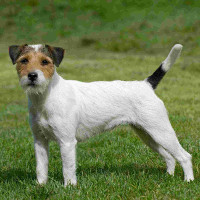
| The Parson Russell Terrier is a much more recent breed than the Shar Pei, named after the breed's founder, a shepherd named John Russell, often referred to as Jack. He was so immediately taken with the little white dog he spotted walking with a milkman in 1819 that he bought him on the spot, naming him “Trump”. The pastor was an avid foxhunter who also bred Foxhounds, and he saw in Trump the basis for a breed of dogs small enough to go foxhunting, but with legs long enough to follow them. The Parson Russell Terrier is registered with the American Kennel Club and the United Kennel Club, and is often referred to as the Jack Russell Terrier. It's important to note, however, that there are also Jack Russell Terrier clubs in both countries that recognize a different standard, although it is not considered an official breed by the Kennel Clubs at present. This standard results in a less uniform dog, with differences in temperament and medical conditions. This dog often has a longer back and shorter legs than the Parson Russell Terrier due to infusions of Dachshund and Corgi in its background. | ||
 |
||
| Standard of the Parson Russell Terrier |
A little of the Shar Pei |
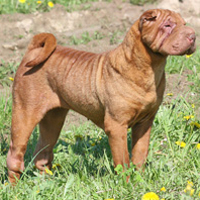
| The history of the Shar Pei is long and somewhat mysterious; records indicate that an ancient variety of this breed was employed as a versatile farm dog in southern China some 2000 years ago, where it protected not only the master's home but also livestock when hunting wild boar. In dogfights, their loose skin, natural aggression and determination made them good candidates for the fighting ring, until some of the more recent Western dogs, such as the Bulldog and Bull Terrier, were imported to China. When those who bred fighting dogs stopped breeding Shar Peis and turned to other dogs, the Shar Pei population declined sharply. In the 1940s and 1950s, the Shar Pei was one of many Chinese breeds decimated by famine, fear of biological warfare and government policies. The breed might have died out if the May 1971 issue of DOGS hadn't highlighted what it called “perhaps the last surviving specimen of the breed”, prompting Hong Kong Shar Pei owners and enthusiasts to revive the breed and export large numbers to the U.S.A., to ensure its survival. |
 |
| Standard of the Shar Pei |
Appearance of the Rus-A-Pei |
| Although there may be the occasional dog that inherits the slightly larger size of the Chinese Shar Pei or the smaller size of the Parson Russell Terrier, the majority of Rus-A-Peis fall somewhere in between, generally between 13.5 and 18 kilos as adults. The structure of this cross can vary considerably from dog to dog, as the parent breeds are very different. Dogs that most closely resemble the Shar Pei tend to have a thicker body with a slightly broader, flatter head and a muzzle that is both broad and deep, while dogs that draw more inspiration from the Terrier side of the family will have a slightly rounded but balanced head shape with a square muzzle that is slightly finer than that of the Shar Pei. They have dark, almond-shaped eyes, usually with dark rims, and their triangular ears may fold forward towards the eyebrows or back to the sides at rest, but may sometimes stand up or partially stand up when the dog is at attention. |
Temperament of the Rus-A-Pei |
| The Parson Russell Terrier is known to be an extremely intense and active dog, often to the point of hyperactivity, and like most Terriers has an extremely high hunting instinct. The inclusion of the calmer, well-bred Chinese Shar Pei will often reduce the activity level of this hybrid and its hunting instinct may be somewhat attenuated, but its intensity often remains unchanged, although it can be more controlled. This hybrid is likely to be somewhat aggressive towards other dogs and very reluctant to back down if challenged, regardless of the size of the opponent, which is not necessarily the best choice for multi-dog households. They tend to be rather independent and some can even be a little dominant, so early training and socialization are essential if you want a stable, well-behaved dog. It's also important to remember that this canine is quite quick-witted, and a lack of mental stimulation usually leads to destructive or obsessive behavior. |
Needs and activities of the Rus-A-Pei |
| Parson Russell Terriers, whatever the standard used, are extremely active animals, with an incredibly intense drive to pursue prey. The Rus-A-Pei is still an active dog, but thanks to the inclusion of the Chinese Shar Pei, its activity requirements are somewhat reduced and it is much less likely to be hyperactive than its terrier parent. One hour of vigorous activity a day is usually sufficient for this crossbreed, which can be achieved through activities such as long walks, ball games, flyball competitions and agility training. Although these dogs are certainly small enough to adapt comfortably to an apartment-type environment, they are generally too curious and active for this type of setting and will prefer a larger home with their own yard to run around in. |
Maintenance of the Rus-A-Pei |
| In most cases, Rus-A-Pei grooming doesn't take much time. Bathing is done as needed, and it's especially important to make sure the dog is thoroughly dried after bathing if it has inherited any of the characteristic Chinese Shar Pei folds, as irritating and smelly molds can develop. Most Rus-A-Peis have a short, soft, one- or two-layer coat, although some have inherited the rough coat of the short-haired Parson Russell Terrier. While weekly brushing is sufficient for all these coat types, hard, broken coats may also require stripping once or twice a year to maintain the proper texture. Care of teeth and nails is also an important part of the routine. |



 English (United Kingdom)

Comments