 |
Schip-A-Pom |
|
He is not recognized by the F.C.I. |
Origin |
Belgium <> Germany -> U.S.A. | |
Translation |
Francis Vandersteen |
A brief presentation of the Schip-A-Pom |
| The Schip-A-Pom, also known as the Pomerke, is a deliberately crossbred dog known as a designer dog. This hybrid is a combination of two curious, mischievous canines bred as pets, the Schipperke and the German Toy Spitz / Pomeranian. While these dogs are pleasant, outgoing companions for adults and older children, they may not be the best choice for young children, as they don't tolerate teasing or rough handling. They generally require more time for grooming than most other dogs. Although they are highly intelligent, they can sometimes be difficult to train, as they can become stubborn, inattentive and even manipulative when they're not in the mood to learn. |
History of the Schip-A-Pom |
| The Schip-A-Pom is a designer dog, an intentional hybrid, in this case, a cross between two small companion dogs, the Belgian Schipperke and the German Toy Spitz / Pomeranian that was refined in a region of Poland and Germany formerly known as Pomerania. |
A little of the Schipperke |
||
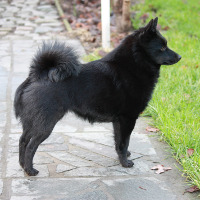
| The Schipperke also has a distinctive Spitz appearance, with its erect triangular ears and bushy double coat, but this breed is not really a Spitz. The breed is actually descended from a now extinct local sheepdog breed called Leauvenaar, and many Schipperkes have retained some of their herding instincts, even today. They became very popular with craftsmen and canal workers in the 1600s, and in 1690 the popularity of this little dog led to one of the first breed-specific dog shows, with large numbers of Schipperke converging on the Grand Palais in Brussels, often wearing specially designed decorative collars of carved or hammered brass. Schipperke dogs were not introduced to the United States until almost two hundred years later, in 1888, and were recognized by the American Kennel Club in 1904. | ||
 |
||
| Standard of the Schipperke |
A little of the German Toy Spitz / Pomeranian |
| The German Toy Spitz / Pomeranian is a small ball of fur with a bold, inquisitive personality that has been a popular pet since the 1800s. Although the German Toy Spitz / Pomeranian is currently the smallest of all Spitz dogs, this wasn't always the case, as the German Toy Spitz / Pomeranian of the 1800s typically weighed around 13.5 kilos, instead of the 1.5 to 3 kilos it weighs today. In 1888, Queen Victoria obtained a very small, red-headed German Toy Spitz / Pomeranian named Marco, which popularized the breed and encouraged breeders to produce smaller dogs with the characteristic hairball appearance. |
 |
| Standard of the German Toy Spitz / Pomeranian |
Appearance of the Schip-A-Pom |
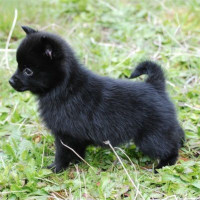
| Although there is a definite difference in size between the two breeds, there are also several similarities between them. The Schip-A-Pom dog is generally a little larger than the German Toy Spitz / Pomeranian and a little smaller than the Schipperke, usually reaching a mature weight of 3 to 5.5 kilos, with a final height of around 20 to 25.5 centimeters. They are rather squarely built with a well-proportioned head that tends to be slightly rounded at the top, and a fox-like face, although those favoring the Schipperke heritage will have longer muzzles than those favoring the German Toy Spitz / Pomeranian, with oval rather than almond-shaped eyes. The Schip-A-Pom's eyes are generally very dark, and the small triangular ears are set high on the head and carried upright. The coat is thick and double-layered, with a short, dense undercoat covered by a longer, coarser-textured undercoat. This second layer will be more abundant in dogs that have inherited the qualities of the German Toy Spitz / Pomeranian, and can often be shorter on the face, legs and ears of dogs that more closely resemble the Schipperke. Although this hybrid can come in many different colors, the most common color is black. |
Temperament of the Schip-A-Pom |
| The Schip-A-Pom, like its parent breeds, is an inquisitive, impulsive animal with a lively mind and mischievous nature. They tend to be more attentive to their surroundings than other dogs, and are quick to alert their owners, making them excellent watchdogs. On the other hand, their tendency to bark can become uncontrollable if not controlled from an early age. Although bred to be pets, these small dogs are not necessarily the best companions for young children, as they can be sensitive and generally do not tolerate teasing or rough handling. If properly socialized, most of these dogs will be friendly with other dogs, but some can become rowdy or bossy with other dogs. This hybrid can be difficult to train, as it can be stubborn, bossy and even manipulative in getting what it wants. Consistent training with short, varied sessions and lots of praise is recommended. |
Needs and activities of the Schip-A-Pom |
| Although this dog is quite active and energetic, he's generally content with around 45 minutes of vigorous activity a day, although this activity is more effective if it's broken down into several shorter sessions throughout the day. He'll be particularly happy if part of this exercise gives him the opportunity to run around outside, but it's important to ensure that this dog is kept on a leash or supervised in a secure yard to prevent him from chasing fast-moving objects and animals. He can be well suited to life in an apartment if offered sufficient outdoor activities and taught to properly control his tendency to bark at everything. |
Maintenance of the Schip-A-Pom |
| This hybrid requires a little more grooming than some canines due to its long, dense coat, and more frequent bathing is generally recommended for both parent breeds. Basic maintenance grooming for the Schip-A-Pom generally includes a bath every week or two, and thorough brushing several times a week to remove dead hairs, untangle knots and tangles, and properly distribute the dog's natural oils throughout its coat. Small dogs like the Schip-A-Pom are often prone to developing dental disease, so it's very important to check and clean their teeth regularly to avoid tooth loss and other dental disorders as they age. |



 English (United Kingdom)

Comments