Schnese

He is not recognized by the F.C.I.

Origin
Germany <> Western Mediterranean Basin -> U.S.A.
Translation
Francis Vandersteen

A brief presentation of the Schnese

The Schnese is a hybrid of the Miniature Schnauzer and the Havanese Bichon. This combination of related breeds brings out the best in both, resulting in a lively, fun-loving and loyal dog. As the Havanese Bichon has always been bred to sit on your lap, this hybrid has the same velcro dog character as the parent breed, making it the happiest dog on the planet when on your lap. Its talents aren't limited to the lap, as it has competitive obedience, search and rescue, tracking and agility skills in its canine repertoire.

History of the Schnese

The Schnese is a hybrid of the Miniature Schnauzer and the Havenese. There is little information available on where and when the hybrid originated, but there is information on parent breeds from which we can glean some information on what makes your hybrid what it is. The Schnese hybrid itself is recognized by the American Canine Hybrid Club, the Designer Breed Registry, the Designer Dogs Kennel Club, the Dog Registry of American. and the International Designer Canine Registry.


A little of the Miniature Schnauzer

        
The Miniature Schnauzer is an ancient breed that originated in Germany. Paintings of dogs resembling the Miniature Schnauzer have been found as early as the 1400s, but it wasn't recognized as a specific, distinct breed until the late 1800s. The Miniature Schnauzer's ancestors are thought to be the Standard Schnauzer, Affenpinscher and Poodle, and some enthusiasts include the Miniature Pinscher, Wire Fox Terrier and Zwergspitz. The Miniature Schnauzer was originally developed as a slightly smaller version of the Standard Schnauzer and was particularly useful for tracking down and killing rats and other vermin known to inhabit farms in Germany. Miniature Schnauzers arrived in North America and breeding is said to have begun around 1924, with recognition by the American Kennel Club in 1926. The breed continues to grow in popularity and today is one of the most popular breeds in the U.S.A., especially for companionship.
Standard of the Miniature Schnauzer


A little of the Havanese Bichon

The Havanese Bichon is a breed originally from Cuba. Also known as “the silk dog of Havana”, it's a small dog that's described as everyone's friend. The Havanese Bichon is the only dog breed known to have originated in Cuba. It was created in the late 1800s and early 1900s, for the sole purpose of keeping company and guarding knees. The Havanese Bichon came to the United States from Cuba in 1970 and is currently bred in this country, although breeders are hard to find. The Havanese Bichon breed was recognized by the American Kennel Club in 1996.
Standard of the Havanese Bichon

Appearance of the Schnese

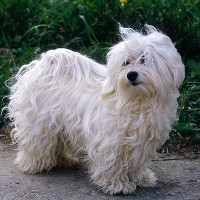
Your Schnese hybrid is a mix of Miniature Schnauzer and Havanese Bichon and, as such, can take on the appearance characteristics of either or both parent breeds. The Schnese has been described as measuring between 25.5 and 33 centimeters and weighing between 3 and 7 kilos. If the Schnauzer parent is dominant in the biological mix, it may have bushy eyebrows and a beard, and its coat is probably soft, fine and straight, the most common colors being black, brown, silver, gray and white. Puppies are said to have black and brown coloring, which turns gray or silver as they age. His eyes are dark and small, almond-shaped or sunken, his nose is black and he has a scissor bite. Its ears are floppy and its tail can vary in length.

Temperament of the Schnese

Your hybrid Schnese is a mix of Miniature Schnauzer and Havanese Bichon and, as such, may inherit temperament traits from one or both of its parent breeds. Breeders and owners have described its temperament as affectionate, loving, friendly and intuitive to the needs of its human family. It's also fun-loving, playful and eager to please, making it easier to train than a variety of other breeds. You'll probably find him lively, loyal, energetic and intelligent, and more than willing to bond with you in everything you do. This is not, however, a dog that will do well if left outside or alone for long periods, suffering from the separation anxiety that is common to Velcro dogs. You can expect to have to socialize her appropriately from an early age to ensure that she gets on well with children, strangers and other animals. As she's a small dog, it's also very important to teach your children the proper ways to touch and play with her. He'll probably get on quite well with the other animals in your home, especially if he's been raised with them. Be aware that he has a strong propensity for hunting, which may cause him to go on the prowl when confronted with other small animals. It will probably have some of the Schnauzer's stubbornness in the biological mix, but should otherwise be moderately easy to train.

Needs and activities of the Schnese

Your Schnese is an active little dog who will need a few daily walks, playtime in the dog park or fenced garden and interactive games of fetch, frisbee and fly ball to manage its energy levels. Obedience and agility training and practice are also good ways to manage his energy and zest for life. So it's important to keep him on a leash when he's outside the house, unfenced yard or similar enclosure. If you're not careful at this stage, you'll find yourself chasing him through brambles and heather, wherever a small animal or an interesting scent leads him. Because of his small size and the fact that he doesn't bark much, he can live very well in an apartment or condominium, provided he is offered appropriate exercise opportunities. He can also live well in a family home, with or without a fenced yard, in an urban or rural environment. It can tolerate both hot and cold climates, provided it has appropriate protection against extreme temperatures.

Maintenance of the Schnese

Your Schnese hybrid falls into a moderate maintenance category, requiring daily brushing unless its coat is kept short. Although he sheds moderately and you should expect to vacuum frequently, both parents of the breed are considered hypoallergenic. His ears should be checked weekly and cleaned if necessary with a cotton ball and an approved canine ear cleaner. While you're checking his ears, take a look at his toenails, trimming them if necessary, unless they're worn down by his normal physical activity. As with almost every dog breed on the planet, we recommend brushing at least two or three times a week, although daily brushing is optimal. This will help prevent the development of periodontal disease and the tooth loss that goes with it. Its odor level is considered low, as is its drool level.

Comments

Latest page updates

  • Telomian

    Telomian He is not recognized by the F.C.I. Origin Malaysia Translation Francis Vandersteen A brief presentation of the Telomian The Telomian is a very rare breed of dog, and the only one native to Malaysia to have been bred outside the country. They were originally bred by the indigenous people of Malaysia to combat parasites such as snakes, rats,...
  • King Wheaten -- Cavalier King Charles Spaniel X Irish Soft Coated Wheaten Terrier

    King Wheaten He is not recognized by the F.C.I. Origin Great Britain <> Ireland -> U.S.A. Translation Francis Vandersteen A brief presentation of the King Wheaten The King Wheaten is a small dog with a heart this big and a playful disposition. Borrowing the energy and soft-coated waves of the Irish Soft Coated Wheaten Terrier and the size and...
  • Spanierd -- English Springer Spaniel X German Shepherd

    Spanierd He is not recognized by the F.C.I. Origin Great Britain <> Germany -> U.S.A. Translation Francis Vandersteen A brief presentation of the Spanierd The Spanierd is a hybrid dog. Its parent breeds are the English Springer Spaniel and the German Shepherd. They have an affable personality. He's known for entertaining family and friends with his...
  • Alaskan Goldenmute -- Alaskan Malamute X Golden Retriever

    Alaskan Goldenmute He is not recognized by the F.C.I. Origin U.S.A. <> Great Britain -> U.S.A. Translation Francis Vandersteen This breed is also known as Alaskan GoldenGoldenmuteAlaskan Gold Retriever     A brief presentation of the Alaskan Goldenmute The Alaskan Goldenmute is a descendant of two great dog breeds: the Alaskan Malamute and the Golden...
  • French pointing dog Pyrenean type

    French pointing dog Pyrenean type FCI standard Nº 134 Origin France Translation Mrs. Peggy Davis Group Group 7 Pointing Dogs Section Section 1.1 Continental Pointing Dogs « Braque » Type Working With working trial Acceptance on a definitive basis by the FCI Tuesday 18 January 1955 Publication of the official valid standard Tuesday 01 August 2023 Last...
  • French pointing dog Gascogne type

    French pointing dog Gascogne type FCI standard Nº 133 Origin France Translation Mrs. Peggy Davis Group Group 7 Pointing Dogs Section Section 1.1 Continental Pointing Dogs « Braque » Type Working With working trial Acceptance on a definitive basis by the FCI Monday 17 January 1955 Publication of the official valid standard Tuesday 01 August 2023 Last...
  • Vucciriscu

    Vucciriscu He is not recognized by the F.C.I. Origin Sicily Translation Francis Vandersteen En français, cette race se dit Vucciriscu Diese Norm ist in deutscher Sprache sichtbar Vucciriscu En español, esta raza se dice Vucciriscu In het Nederlands, wordt dit ras gezegd Vucciriscu This breed is also known as Sicilian Vucciriscu Sicilian Butcher...

© 2026 Groupe Milouchouchou ASBL. Tous droits réservés. En savoir plus

Protected by Copyright01
We use cookies

We use cookies on our website. Some of them are essential for the operation of the site, while others help us to improve this site and the user experience (tracking cookies). You can decide for yourself whether you want to allow cookies or not. Please note that if you reject them, you may not be able to use all the functionalities of the site.

Ok