
 |
Scotinese |
|
He is not recognized by the F.C.I. |
Origin |
Scotland <> China -> U.S.A. | |
Translation |
Francis Vandersteen |
A brief presentation of the Scotinese |
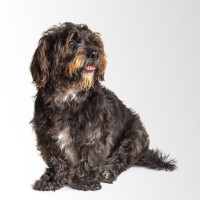
| The Scotinese is a designer hybrid dog that was created by a cross between the Scottish Terrier, often called the Scottie, and the Pekingese. It has the combined characteristics of its two parent breeds to create an adorable bundle of fluffy fur that makes an ideal lapdog. The Scotinese is relatively small, measuring between 25.5 and 28 centimeters. They weigh between 8 and 10 kilos. Females tend to be slightly smaller than males. They have a long, thick coat that can be black, tan, brown, white or tricolored. The Scotinese is a companion dog. It thrives as an apartment dog, but also enjoys daily walks with plenty of playful interaction. |
History of the Scotinese |
| The Scotinese is a relatively new breed, so its health history is unknown. As the Scotinese is a cross between a Pekinese and a Scottish Terrier, there's a good chance it will face the same or similar health problems as its parents. The Scotinese is often not a pure 50/50 mix of Scottish Terrier and Pekingese. They are frequently bred over several generations. However, its lineage remains a mix of Scottish Terrier and Pekinese. It is from the union of these two related breeds that the best qualities of the Scotinese are born. |
A little of the Scottish Terrier |
||
| The Scottish Terrier is an intelligent, courageous and independent little dog bred to hunt vermin in the Scottish Highlands. The exact origins of the breed are unknown, but this lively Terrier is deeply linked to Scottish history. The exact origins of the breed are unknown, but this spirited Terrier is deeply linked to Scottish history. It is thought that farmers bred these dogs to be small, stocky and strong, so that they could dig into vermin burrows and emerge easily. Despite its small size, the Scottie has the attitude of a much larger dog. The intrepid behavior and agile abilities of this small dog have made it an excellent hunter of badgers and foxes. | ||
 |
||
| Standard of the Scottish Terrier |
A little of the Pekingese |
| The Pekingese parent breed originated in China, the earliest known record of a Pekingese-like canine having been found as early as the 8th century. The history of the Pekingese breed is even more interesting, as it is rooted in an ancient legend. Legend has it that a lion fell in love with a marmoset - a species of monkey - and asked a god to shrink him so that they could be together, while wishing to retain his big lion's heart and courageous character. The god granted his request and is said to have created the dogs known as “lion-dogs”. So much for the legend, and here are the real facts: the origins of this little breed have been traced back to the Tang dynasty in China, in the 8th century. The Pekingese seems to have been cherished and appreciated as a companion only, with no real working activity. Considered sacred by the Chinese, they allowed only royalty to own this breed, making it illegal to own one - stealing a Pekingese, named after Beijing, the capital of China at the time, was a death sentence. Imperial families pampered these cuddly lovebirds and kept the bloodlines pure, favoring a breed that has changed little over the centuries. The Pekingese remains a regal, feisty and independent dog breed that was recognized by the American Kennel Club in 1906. |
 |
| Standard of the Pekingese |
Appearance of the Scotinese |
| The Scotinese is a small dog with a long body and short legs. Its sturdy little form and small size are an ideal combination of its two parents. This knee-sized dog has a small, muscular and robust build. The Scotinese's coat is soft and does not shed excessively. It grows quickly and requires daily brushing and occasional trimming. In most cases, the Scotinese combines the ideal characteristics of the Scottie and the Pekingese to create its own unique and adorable appearance. Because the Scotinese is a blend of two dogs, each with a very distinct face, the Scotinese's face often differs from dog to dog. Some Scotinese have a slightly flat nose and facial features reminiscent of the Pekingese, while others have a more pronounced muzzle that more closely resembles the profile of the Scottish Terrier. Ears can be straight, like those of the Scottish Terrier, or long and furry, like those of the Pekingese. The Scotinese's tail can be quite hairy, curling over the back, or straight, depending on the dominant parental genes. |
Temperament of the Scotinese |
| The Scotinese's temperament is a balance of its two parents. It has a playful, self-confident, independent and spirited nature reminiscent of the Scottish Terrier. However, like the Pekingese, the Scotinese also has a confident, regal personality and high self-esteem. This little dog loves to be lavished with his master's attention. Scottish Terriers are fiercely loyal and have an excellent memory. He rarely forgets a person he meets, even if years have passed between the two encounters. Loyalty and exceptional memory are both conferred on the Scotinese. This gentle little dog generally adores family members, but shows a healthy distrust of strangers. Scotinese are considered exceptional watchdogs, and will not hesitate to alert their owners if a stranger is nearby. |
Needs and activities of the Scotinese |
| The Scottish Terrier needs only moderate exercise. The Pekingese needs very little exercise and is generally content to be an apartment dog. The Scotinese is the ideal combination of Scottish Terrier and Pekingese when it comes to physical activity, and is well suited to life in an apartment. This lively little dog enjoys a daily walk, but if you don't feel like taking him for a walk, he'll also be happy to play a simple game of ball in the living room, then spend the rest of the day relaxing on your lap. The Scotinese is very close to its master, but it also has an independent streak that comes from its Scottish Terrier ancestry. |
Maintenance of the Scotinese |
| The Scotinese combines the virtually shed-free coat of the Scottish Terrier with the loose, excessively shedding coat of the Pekinese to create a coat that sheds only moderately, depending on the season. The Scotinese's coat needs daily brushing and trimming to keep it neat and tidy. Otherwise, it runs the risk of matting. The coat will also benefit from a professional trim every two months. The Scotinese only needs occasional baths, but you should check its ears every month to avoid wax build-up. Nails should be trimmed every month. You can also brush his teeth regularly to avoid plaque build-up that could lead to gum disease in the dog's older years. |



 English (United Kingdom)

Comments