 |
Working Kelpie |
|
He is not recognized by the F.C.I. |
Origin |
Australia | |
Translation |
Francis Vandersteen |
A brief presentation of the Working Kelpie |
| Most people think that the Working Kelpie and the Australian Kelpie are exactly the same breed, and while technically they're right, there is one main difference between the two. The Working Kelpie has remained true to its roots and is capable of performing all the tasks for which it was bred. The Australian Kelpie has moved away from the ability to do the job it was bred to do, and is more oriented towards conformation and uniformity. Working Kelpies may differ in appearance from one dog to another, but they are intelligent, agile and capable of working as herders. Working Kelpies can be registered with the Working Kelpie Council of Australia, or they can be registered with the Fédération Cynologique Internationale as Working Kelpies. The Australian Kelpie can only be registered with the FCI as an Australian Kelpie. |
History of the Working Kelpie |
| The history of the Kelpie is not well documented and many researchers have tried to find its origins, but have only come up with theories, not actual facts. The Working Kelpie is thought to have developed from three pairs of Working Collies that were imported by early landowners in Australia. It is not known whether these Collies were Border Collies or Scottish Collies. However, given that the breed is affected by the Collie Eye Anomaly or CEA, it is assumed that these Working Collies were Scottish Collies. It is known and well documented that one of the founding females of the Kelpie breed was a black and tan Working Collie owned by George Robertson of Worrock Station. This female was then given or sold to J.D. Jack Gleeson, who named her Kelpie. Jack Gleeson trained Kelpie to work sheep. Gleeson then received an all-black dog named Moss who came from dogs imported from Scotland. Kelpie and Moss were bred together and their offspring are considered to be the starting point for the development of the Working Kelpie breed. It is thought that the offspring of this mating were then bred to breeding dogs of various origins and also to Dingos. The resulting offspring were then bred to dogs similar to the Kelpie and Moss to establish type. However, handlers weren't too concerned with the dog's appearance, as long as it was capable of doing the job it was supposed to do. The Working Kelpie came in many different colors, but black and black-and-white Kelpies were commonly known as Barbs. Even today, many people in Australia still call them Barbs. The modern Working Kelpie dates back to the 1870s and, although research into the breed is still ongoing, it is clear from its appearance and genetic make-up that it developed from the Collie, Cattle Dog and Dingo. The United Kennel Club recognizes the Australian Kelpie and the Working Kelpie as a single breed. However, the American Kennel Club has decided to accept the Australian Kelpie and the Working Kelpie into its Foundation Stock Service as two separate breeds. |
Appearance of the Working Kelpie |
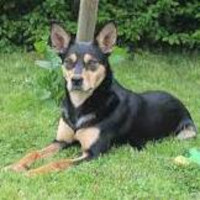
| The overall appearance of the Working Kelpie can be very different, as breeders focus more on function than appearance. Working Kelpies are medium-sized, well-muscled dogs that can work for long periods without tiring. His eyes are set wide apart, oval-shaped and medium-sized. His expression should be enthusiastic and alert. His eyes can be dark brown, blue or amber, although dark brown is the most desirable. His nose should be black, but it can be brown or single-colored depending on the color of his coat. It has a short, straight topcoat that is weather-resistant. His coat may be slightly longer on the underside of his tail, around his neck and on the back of his thighs. In general, it has a dense undercoat that is softer. Working Kelpies can have any of the colors or markings historically associated with the breed. This essentially means that almost any coloring is acceptable, with the exception of solid white or brindle. |
Temperament of the Working Kelpie |
| The Working Kelpie is always alert and eager to work. It's a high-energy dog that needs plenty of exercise to stay happy. Most Working Kelpies thrive on a ranch or farm where their skills are put to good use. They are not recommended for apartment living or for families that are not active. He needs a job to do, otherwise he'll develop bad behaviors that drive his family crazy. He's easy to train and wants to please you. The Working Kelpie would excel in dog sports such as agility, obedience, dock diving, herding trials or even Frisbee throwing. Dog sports are also a great way to bond with him and help him expend some of his energy. Expect to spend a lot of time with your Working Kelpie if he's not being used to work sheep or cattle. He'll also need early socialization to make sure he's capable of fitting into a family home. Training is also important and should be started at an early age. The Working Kelpie needs a solid fence to ensure his safety when he's not working. |
Needs and activities of the Working Kelpie |
| First of all, it's essential to provide your Working Kelpie with plenty of outdoor playtime and exercise. This is a very energetic breed of dog that needs more than an hour of intensive exercise a day. You'll also want to add agility exercises to your daily exercise routines, otherwise your Working Kelpie is likely to get bored and take out his frustration through bad, even destructive, behavior. If you have a private outdoor space in which to let your Working Kelpie romp, remember that he's a very athletic dog and will need a large fence that's impossible to climb. |
Maintenance of the Working Kelpie |
| Some Working Kelpies have a double coat that sheds seasonally. If it sheds a lot, it should be brushed daily. Otherwise, brush about once a week to limit shedding and remove dead hairs. This will keep his coat healthy and shiny. Use a long-bristle brush for grooming, and a long-bristle brush can also be used for heavy shedding. He doesn't have a strong odor, unless he's been working with livestock. In general, he only needs a bath a few times a year. If you notice a strong odor, use a dry shampoo between baths to freshen his coat. The hair between his pads should be trimmed to prevent dirt or debris from accumulating between his toes and causing lameness. Most Working Kelpies naturally wear out their nails when working with cattle, but it's a good idea to check every two weeks that his nails aren't too long. |



 English (United Kingdom)

Comments