
 |
Dooley Mastiff |
|
He is not recognized by the F.C.I. |
Origin |
U.S.A. | |
Translation |
Francis Vandersteen |
General appearance |
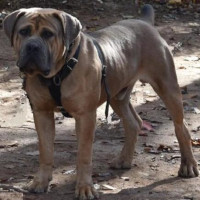
| A breed that was created 22 years ago, the Dooley Mastiff is a breed of great character, intelligence, loyalty and kindness to family. While being a vigilant guardian, the Dooley Mastiff assesses a situation and acts accordingly. |
Behaviour / temperament |
| The Dooley Mastiff's expression gives a clear impression of confidence, uncompromising character, strength and ability. Devoted to family. |
Head |
||
Cranial region |
||
Head |
Broad and flat between the ears. | |
Skull |
Characteristic wrinkles and furrows between the eyes. | |
Stop |
Well-defined stop. | |
Facial region |
||
Nose |
Distance from nose to stop may be slightly shorter than from stop to occiput. The planes from nose to stop are parallel to the planes from stop to occiput. The nose is broad and well pigmented, in keeping with the color of the dog's coat. Nostrils are wide and open. |
|
Muzzle |
The muzzle is broad, strong, well developed and deep, without weakness or narrowness. | |
Lips |
Thick and long, but not excessive or pendulous. The upper lip should not overlap the lower lip by more than 2 centimeters, and the lower lip should not be loose or fleshy. | |
Jaws and teeth |
The jaw is strong and tapers slightly from front to back. A scissor bite is preferable. A regular or slightly inferior bite should not be penalized. | |
Eyes |
Triangular or almond-shaped due to the fold of the head. Eye color in shades of amber, brown or blue to match coat color. | |
Ears |
Set high on the head. | |
Neck |
| Strong, well muscled and not too short, giving a balanced appearance to the head, widening from the base of the skull and fitting well to the shoulders. Baleen neither excessive nor pendulous. |
Body |
||
Topline |
Straight. | |
Back |
Broad and strong. The highest part of the shoulder blade barely exceeds the strong, horizontal upper line of the back. | |
Croup |
Broad and strong, with well-defined musculature. Viewed from the side, slightly sloping. | |
Chest |
Well sprung and well filled. | |
Tail |
| At rest, carried low with a slight curve; when alert, carried level with the back with a slight curve at the tip. |
Limbs |
Forequarters |
||
Generality |
The forelegs are thick-boned, with heavy, well-defined muscles. The forelegs are vertical, without curvature, seen from the front and from the side. | |
Elbows |
Turned neither in nor out, but parallel to the body. | |
Pastern |
Short, thick and strong, proportionate to the length of the forelegs. | |
Forefeet |
Well cushioned, but the toes are not articulated or compact and point slightly outward. | |
Hindquarters |
||
Generality |
Viewed from behind, the hind legs are strong, thick and muscular, but in proportion to the rest of the dog. | |
Upper thigh |
Powerful, broad and deep, well shaped and very muscular, seen from behind or from the side. | |
Lower thigh |
Well developed, with prominent, well-sunken muscles. | |
Stifle |
Strong and firm with correct angulation, as seen in the shoulders. | |
Hock |
Turning neither in nor out. | |
Hind feet |
Slightly smaller than the forefeet, well padded and pointing straight forward. | |
Gait and movement |
| Rolling but ground covering and powerful. The general appearance is a determined, powerful, ground-covering gait. |
Coat |
||
Colour |
Black, fawn, various shades from light to dark, blue, brown, fawn blue. Coat patterns solid, brindle, slatted. | |
Size and weight |
||
Height at withers |
Female: 51 to 66 centimetres. Some females can be as tall as males. Larger ones are preferred, but smaller ones are acceptable as long as mass and proportion are present. Male: 66 to 76 centimeters. Height and substance with large bones are preferred, but in good proportion. Overall balance with every part of the dog in proportion is preferable. |
|
Weight |
Female: up to 68 kilos, male: up to 77 kilos. | |
Faults |
| • Any departure from the foregoing points should be considered a fault and the seriousness with which the fault should be regarded should be in exact proportion to its degree and its effect upon the health and welfare of the dog and its ability to perform its traditional work. • Faults listed should be in degree of seriousness. |
Serious faults |
 Twisted tail. Crow tail. Very short, docked tail. Cheerful moving tail. Exaggerated jaw below or above head level. Gait uncharacteristic of molosser breeds. Excessively wrinkled (deep folds) and overly made-up dogs. Hanging lips. Excessive lips. Hanging ears. Uneven nose planes. Absence of characteristic wrinkle and furrow between the eyes or excessive wrinkle. Overshot or undershot over 63 millimeters. Cow hocks or sickle hocks. Bidonville or caracole gait. Sideways or spiky gait. Twisted tail. Crow tail. Very short, docked tail. Cheerful moving tail. Exaggerated jaw below or above head level. Gait uncharacteristic of molosser breeds. Excessively wrinkled (deep folds) and overly made-up dogs. Hanging lips. Excessive lips. Hanging ears. Uneven nose planes. Absence of characteristic wrinkle and furrow between the eyes or excessive wrinkle. Overshot or undershot over 63 millimeters. Cow hocks or sickle hocks. Bidonville or caracole gait. Sideways or spiky gait. |
Disqualifying faults |
| Lack of mass. |
NB : |
| • Any dog clearly showing physical or behavioural abnormalities shall be disqualified. • The above mentioned faults when occurring to a highly marked degree or frequently are disqualifying. • Male animals should have two apparently normal testicles fully descended into the scrotum. • Only functionally and clinically healthy dogs, with breed typical conformation should be used for breeding. |



 English (United Kingdom)

Comments