 |
American Molossus |
|
He is not recognized by the F.C.I. |
Origin |
U.S.A. | |
Translation |
Francis Vandersteen |
Brief historical summary |
| 5000 B.C. in a time very different from our own. A time when only the strong survived. Men were primitive by instinct, nomadic by nature, and often barbaric by choice. In those dark times, women and children prayed for protection while the men who loved them were away hunting or at war, but their prayers often fell on deaf ears. They wanted a defender. They needed comfort and peace of mind. They needed Molossus. The Molossus of ancient Mesopotamia was a magnificent animal. With a brindle-black coat as dark as night and a massive build, it had a ferocious appearance. These dogs made men tremble at the sight of them. With a deep sense of loyalty, these giants would defend themselves against any man or beast that threatened their masters' safety. Mesopotamia, Babylon, Greece and Rome fell, leaving the descendants of these impressive animals scattered across the earth. The fascinating stories of their feats of strength and courage are now nothing more than legends and myths. The need for such a courageous beast is just as great today as it was then. Thanks to many years of hard work, dedication and research, the guardian of guardians exists and is available once again. That guardian is the American Molossus. The American Molossus is today's most authentic version of the Molossus of antiquity. We present you with a real step back in time. A true relic of the past. The best protector and companion a man could hope for, the American Molossus. |
General appearance |
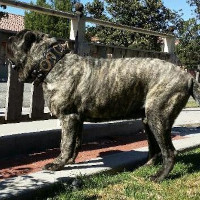
| The American Molossus is a resurrection of the ancient Mesopotamian/Sumerian guard dog. A heavy-boned, massive, muscular, intimidating dog, bred for close guarding of possessions and masters, property and owner(s). It is characterized by its extreme, intimidating stature, square head, loose skin on its head and all over its body, abundant, hanging wrinkles and folds on the head, hanging lips and dewlap. The American Molossus is characterized by its intimidating, barbaric appearance, incredible head, size and imposing stance. Because of its massive structure, its characteristic movement is rolling and powerful, not flashy and prancing. This dog is not athletic, but built for terror by appearance. |
Important proportions |
| Strong-boned, massive in substance, rectangular in proportions. Body length is 10% to 15% greater than height. The length of the dog, measured from the point of the shoulder to the point of the buttock, is 10% to 15% greater than the height of the body. The point of the buttock is 10% to 15% higher than the height of the dog, measured from the highest point of the shoulder to the ground. |
Behaviour / temperament |
| Its expression is preoccupied at rest, intimidating when awake. The American Molossus is stable and loyal to its master, not aggressive or likely to bite without reason. As protectors of their property, owners and pets, they are always vigilant and resent the intrusion of strangers into their territory. His attitude is calm but wary. In the show ring, he is majestic and powerful, but not too showy. He's not very energetic, but moves quickly with a jerk when provoked. |
Head |
||
Cranial region |
||
Head |
Large in relation to the body and very square. The top of the head should be square, with prominent wrinkles and hanging lips that merge into an ample dewlap. | |
Skull |
The lines of skull and muzzle should be parallel and broadly flat between the ears, slightly arched at the front, and covered with wrinkled skin. The width of the skull between the cheekbones is approximately equal to its length from the occipital stop. The forehead is highly developed. The frontal furrow is marked. The occiput is barely visible. | |
Stop |
Very defined, forming a right angle at the junction of the muzzle and frontal bones, and sloping backwards at a greater angle where the frontal bones meet the frontal furrow of the forehead. | |
Facial region |
||
Foreface |
The face is made up of wrinkles and major folds. The most important folds are on the top of the head above the eyebrows, those extending from the outer edge of the eyelids to the dewlap, and from below the lower eyelids to the outer edge of the lips. | |
Nose |
The nose is a continuation of the upper line of the muzzle and must not extend beyond or back from the front of the muzzle. The nose is large, with open nostrils, the same color as the coat. | |
Muzzle |
One third the length of the head, broad and short. Viewed from the front, the muzzle is very deep and its outer edges are parallel, giving it a "square" appearance. The upper plane of the muzzle, from the stop to the tip of the nose, is straight, but striated due to the heavy folds of skin that cover it. | |
Lips |
Heavy, thick and long, the upper lips meet under the nostrils to form an inverted "V". The upper lips form the lower and outer edges of the muzzle, and the lowest part of these boundaries is formed by the corners of the mouth. The corners are turned outwards to reveal the fleas, and are aligned with the outer corners of the eyes. | |
Eyes |
Deep-set and almost hidden under drooping upper eyelids. Lower eyelids droop to reveal beak. | |
Ears |
Set well above the cheekbones. They may or may not be cropped, but are generally cropped and preferred. The standard cut is complete, with the exception of a very small triangle for appearance and health reasons only. | |
Neck |
| Powerful, very muscular and of medium length. The neck gradually increases in circumference as it approaches the shoulder. |
Body |
||
Topline |
In profile, the topline should be straight, level and firm, without swaying or curling. A slight dip behind the high point of the croup is acceptable. | |
Back |
Broad, strong, muscular and powerful. Seen from the rear, it should taper from the broad shoulders down towards the rear. | |
Loin |
Broad, well muscled and harmoniously linked to the back. | |
Croup |
Broad, strong, muscular and slightly sloping. The top of the croup rises slightly and is level with the highest point of the shoulder. | |
Chest |
Broad, deep and well muscled. The ribcage is broad and barrel-shaped, extending at least to the elbow or below. | |
Ribs |
Long, well sprung ribs. | |
Underline and belly |
The underside of the abdomen is almost horizontal. There is little or no upward folding. | |
Tail |
| Set slightly lower than the topline, broad and thick at the root, tapering progressively towards the tip. It is shortened by one-third. At rest, the tail hangs straight or in a slight "S" shape. In action, it is raised horizontally or a little higher than the back. |
Limbs |
Forequarters |
||
Generality |
Thick, strongly built, straight, heavily boned, well muscled, showing strength and in balance with hindquarters. Same length as the arms. Well apart. | |
Shoulders |
Long, muscular and powerful. | |
Upper arm |
Strongly muscled and powerful. In length, they represent almost a third of the dog's height. | |
Elbows |
Covered with abundant, loose skin, they are parallel to or just above the rib cage, neither attached nor detached. | |
Pastern |
Thick and flattened from front to back, moderately sloping towards the front of the leg. | |
Forefeet |
Very large, round with strong, arched toes. Nails strong, curved and preferably dark in color. Forefeet turned slightly outwards are acceptable, as are splayed feet, but this is not a preference. Front dewclaws not removed. | |
Hindquarters |
||
Generality |
Broad, well muscled and strong, in harmony with forequarters. | |
Upper thigh |
Thighs well developed, about the same length as the forearms, broad and muscular. | |
Lower thigh |
Heavy, thick bones, well muscled. Slightly shorter than the thigh bones. | |
Stifle |
Moderate angle, strong. | |
Metatarsus |
Heavy, thick bones. Viewed from the side, they are perpendicular to the ground. Seen from behind, they are parallel to each other. | |
Hock |
Powerful and long. | |
Hind feet |
Identical to the front feet, but slightly smaller. | |
Gait and movement |
| The movement of the American Molossus is not flashy, but heavy and powerful, like that of a bear. Normal gaits are walk, trot and canter. Strides are long and rolling, powerful, characterized by a long thrust of the hindquarters and extension of the forequarters. The rolling movement and swaying of the body at all gaits are characteristic. Gaits in the ring should not be penalized. A slight shuffling movement of the front feet is normal. The head is carried level with or slightly above the back. The movement should not be choppy or racy. |
Coat |
||
Hair |
The coat is of medium length, coarse, dense and of uniform length and softness over the entire body. Moderately short. | |
Colour |
Colors are black, black brindle with some white permitted, but not preferred. Areas of white may exist under the chin, on the neck, chest, belly, penis sheath and a little on the fingers and toes. All areas should be very moderate or non-existent. White in any other area is a fault. | |
Size and weight |
||
Height at withers |
Males: 76 to 89 centimeters, females: 68.5 to 81 centimeters. | |
Weight |
Average weight of adult males: 90.5 kilos, adult females: 68 kilos, but a higher weight is usual and preferable as long as correct proportions and function are maintained. | |
Faults |
| • Any departure from the foregoing points should be considered a fault and the seriousness with which the fault should be regarded should be in exact proportion to its degree and its effect upon the health and welfare of the dog and its ability to perform its traditional work. • Faults listed should be in degree of seriousness. |
Serious faults |
 The upper lines of the skull and muzzle are not parallel. Absence of stop or folding to the point of not being able to see. Incomplete pigmentation of the nose. Upper plane of muzzle curved upwards or downwards. Tail carried straight or curved over the back. Twisted tail. The upper lines of the skull and muzzle are not parallel. Absence of stop or folding to the point of not being able to see. Incomplete pigmentation of the nose. Upper plane of muzzle curved upwards or downwards. Tail carried straight or curved over the back. Twisted tail. |
Disqualifying faults |
| Lack of mass. |
Faults of non-confirmation |
| Absence of wrinkles and folds. |
NB : |
| • Any dog clearly showing physical or behavioural abnormalities shall be disqualified. • The above mentioned faults when occurring to a highly marked degree or frequently are disqualifying. • Male animals should have two apparently normal testicles fully descended into the scrotum. • Only functionally and clinically healthy dogs, with breed typical conformation should be used for breeding. |



 English (United Kingdom)

Comments