
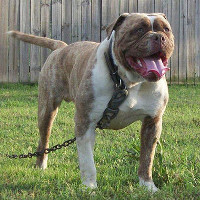
 |
Alapaha Blue Blood Bulldog |
|
He is not recognized by the F.C.I. |
Origin |
U.S.A. | |
Translation |
Francis Vandersteen | |
This breed is also known as |
Otto Bulldog
|
A brief presentation of the Alapaha Blue Blood Bulldog |
| The main purpose of the Alapaha Blue Blood Bulldog was to catch, hold and drive cattle and pigs. Today, the dog is mainly used for protection and as a companion, although the Alapaha Blue Blood Bulldog is not recommended for families with young children or first-time dog owners. He must have a human leader who will be firm and consistent with him, or he will assume the leadership position in the relationship. The Alapaha Blue Blood Bulldog has a very high prey drive and should never be allowed off-leash, except in a secure fenced area at least 1.80 meters high where no other dogs are present. |
History of the Alapaha Blue Blood Bulldog |
| The origins of the Alapaha Blue Blood Bulldog are somewhat confused, but many believe they have been part of the southern United States for around 200 years. There was no official documentation for the breed until 1979. The Alapaha Blue Blood Bulldog is thought to have descended from different types of Bulldogs that were more athletic and larger than the Bulldogs we know today. The Alapaha Blue Blood Bulldog is thought to be closely related to the now extinct Mountain Bulldog, the Old Country Big Bulldog and the Old Southern White. These dogs first appeared in the United States in the early 18th century. The Alapaha Blue Blood Bulldog was widely used in the development of several different breeds, including the American Pit Bull Terrier, the Catahoula Leopard Dog and the Black Mouth Cur. Once known as the Otto, Silver Dollar, Cowdog and Catahoula Bulldog, the Alapaha Blue Blood Bulldog began to decline in numbers in the southern United States. In 1979, a group of Southern dog lovers decided to preserve these dogs because they were on the verge of extinction. This group of people officially gave these dogs the name Alapaha Blue Blood Bulldog and formed the Alapaha Blue Blood Bulldog Association. The official breed standard was also adopted in 1979. Today, the Alapaha Blue Blood Bulldog can be found throughout the United States, and can even be found abroad in South Africa, the Philippines, China and New Zealand. As the popularity of these dogs has grown, the Alapaha Blue Blood Bulldog Association has implemented strict breed standards to preserve the integrity of the breed. |
Appearance of the Alapaha Blue Blood Bulldog |
| The Alapaha Blue Blood Bulldog has a short, glossy coat that is stiff to the touch. Preferred color patterns should be at least 50% white with colored patches. A dog that is mainly colored with white areas is also acceptable. Accepted colors are fawn, brindle, black, red or gray. Plain white is not desirable unless he has the appropriate pigmentation of skin, eye rims, lips and nose. These athletic, medium-sized dogs should move with determination and power. It should never look too bulky or carry too much fat. He should look stocky, not long-legged or long-bodied. Alapaha Blue Blood Bulldog males should be more boned and have a larger head than females. The first impression of an Alapaha Blue Blood Bulldog is that of being bold, impressive and fearless. It should never be hostile or overly aggressive towards humans or other animals. |
Temperament of the Alapaha Blue Blood Bulldog |
| The Alapaha Blue Blood Bulldog is not recommended for the first-time dog owner, or for families with young children or small pets. It may be too much for an inexperienced dog owner. He owns his property and will be territorial. He is also very demanding of attention. The Alapaha Blue Blood Bulldog is naturally wary of strangers. The Alapaha Blue Blood Bulldog should start training at the age of at least eight weeks. He needs daily training and exercise. When walking him, never allow him to walk in front of you. If he is allowed to do so, he will think he can take over as alpha or leader in the house. A strong leader is necessary for an Alapaha Blue Blood Bulldog to thrive and become a well-rounded companion. He should never be left alone in his yard, even if you have a secure fence over 1.8 meters high. The Alapaha Blue Blood Bulldog gets bored very easily. When bored, he can become extremely destructive. Provide plenty of human interaction and appropriate toys to occupy his time. |
Needs and activities of the Alapaha Blue Blood Bulldog |
| One very important thing for the potential owner of an Alapaha Blue Blood Bulldog is that this is a pack dog with a strong urge to be dominant, to be the leader of the pack. This urge will never go away, so the human owner must be strong, firm and decisive, established from day one as the leader of the pack and willing and able to maintain the role of pack leader permanently. Like any pack dog worthy of the name, an Alapaha will always be looking for ways to take over, and it's important that the human pack leader doesn't let this happen. A person who doesn't have the time, energy and patience to do so should not consider bringing an Alapaha into the household. Because the Alalapaha has a strong prey drive and a high need for dominance, it is essentially a pack dog and, like all dogs, wants to be the leader of the pack, it needs early and firm socialization and continuous reinforcement of its obedience training. He will respond very well to discipline and training, but will become a problem if he doesn't understand. Although not naturally aggressive, he has his roots in fighting dogs, and this needs to be controlled. |
Maintenance of the Alapaha Blue Blood Bulldog |
| Although the Alapaha Blue Blood Bulldog has a short, tight coat, it will always shed moderately. Shedding can be minimized by brushing at least once a week with a natural bristle brush to remove dead hairs and skin cells. By brushing him weekly, you redistribute the oils on his skin and keep his skin and coat healthy. Alapaha Blue Blood Bulldogs don't often need baths, unless he's being used to work with livestock. Working with an Alapaha Blue Blood Bulldog will require more bathing than those who are simply family companions. The Alapaha Blue Blood Bulldog, like all other Bulldogs, will drool, especially when overly excited. It's best to keep a drool rag handy to wipe up any drool he leaves behind. Ears should be cleaned once a week, and nails should generally be trimmed every 2 weeks. Teeth should also be cleaned regularly. |



 English (United Kingdom)

Comments