 |
Rajapalayam |
|
He is not recognized by the F.C.I. |
Origin |
India | |
Translation |
Francis Vandersteen | |
This breed is also known as |
Poligar |
A brief presentation of the Rajapalayam |
| The Rajapalayam, also known as the Poligar dog, is an Indian greyhound. It was the companion of royalty and aristocracy in southern India, particularly in the eponymous town of Rajapalayam in the Virudhunagar district of Tamil Nadu. Pure Rajapalayam is more or less extinct, with only a few found in isolated pockets around southern Tamil Nadu. The breed may disappear altogether if efforts are not initiated soon to revive it. A dog breeding unit was established in Saidapet, Chennai, during 1980-81. This unit breeds mainly indigenous breeds such as the Rajapalayam, Combai, Kanni and Chippiparai. To raise awareness and encourage dog lovers to breed indigenous breeds, the Tamil Nadu government's breeding department takes part in dog shows. Localities have established a cooperative, and interested families receive bitches and the expertise needed for large-scale breeding. The Indian Post Office has issued postage stamps on the Rajapalayam, as well as the Mudhol Hound, Rampur Hound and Himalayan Sheepdog. The Kennel Club of India has taken up the cause of the Rajapalayam. With the club's cooperation, the "Save the Rajapalayam" project was launched. The project has greatly influenced the breed's population and is active under the KCI (Kennel Club of India). |
History of the Rajapalayam |
| Rajapalayam dogs were mainly bred and used by the Nayakar dynasty of Tamil Nadu, and some researchers have speculated that the Rajapalayam may have been one of the dogs used in breeding the modern Dalmatian. The Rajapalayam dog was used during the Carnatic Wars and the Polygar War to attack British cavalry in battle, as Rajapalayams were very fast, strong and aggressive in attacking opponents. It is also believed that 4 Rajapalayams saved the life of their master fighting a tiger and bravely killed it, many years ago near a forest in the Virudhunagar district of Tamil Nadu. They are widely used to guard rice fields, houses and farms. Over the past two decades, the Indian army has begun to use them as guard dogs to support the army on the borders of Kashmir. |
Appearance of the Rajapalayam |
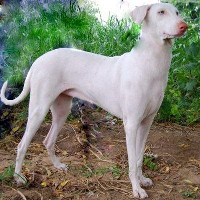
| This is a large dog, generally measuring around 65-75 centimeters at the withers. It is a dog that should therefore be kept in optimal working conditions. It tends to be more bony than most sighthounds, but shares the same depth of chest and basic body structure. Its facial structure is considerably different from that of a Caravan Hound, as it is primarily intended for hunting wild boar. The tail has a slight curve. The most popular color is milky white, with a pink nose and golden eye. In the past, colored puppies were generally eliminated from litters as owners preferred pure white dogs. The coat is short and fine. An extremely handsome and graceful dog, the Rajapalayam has a gait similar to the trot of a thoroughbred horse. As with many all-white dogs, there is a high incidence of deafness in this breed. Puppies born with whitish or blue eyes are deaf. Many Rajapalayam dogs suffer from mange, but this is not usually a serious problem. Although the breed dates back several centuries, the breed's creators unwittingly fashioned an albino dog, characterized by a pink nose and lack of pigmentation. |
Temperament of the Rajapalayam |
| The Rajapalayam was mainly used for hunting wild boar and as a fearsome guard dog. They are hunting dogs by nature, but it has been proven that, with a little training, they can also be a guard dog. It all depends on the trainer. They need wide open spaces and are very affectionate and devoted to their owner, even if they are not always demonstrative. They generally don't like to be touched or handled by strangers and are known to be one-person dogs. Rajapalayams are largely aggressive and hostile towards strangers, and will attack intruders. Puppy socialization is important. They generally don't get on well with other animals such as cats, due to their strong hunting instinct. They are highly intelligent and alert. |
Needs and activities of the Rajapalayam |
| The Rajapalayam can adapt to any living environment, be it an apartment or a house. However, one thing you need to remember when keeping them in apartments is that they'll need plenty of regular exercise. The best thing about the breed is that it was bred in India to be able to adapt to all weather conditions. At the same time, remember that they won't be happy staying at home and will need regular and prolonged exercise, whether on or off leash. The Rajapalayam will not be a difficult dog to train. They are intelligent breeds, but the most important point to bear in mind is that only one person is needed to train them, i.e. the training program should be started and finished by the same person. The dog will not react well if the original trainer is changed. It's very important to start training your Rajapalayam as soon as he arrives home, as it's never too early to train him. |
Maintenance of the Rajapalayam |
| The Rajapalayam has a short coat, but don't let the length fool you - it sheds a lot. You can brush them once or twice a week. They love to be massaged, so they'll never complain if you rub them with a soft brush or glove. In addition to this, you'll need to follow the usual grooming regime with your pet, such as brushing its teeth. This should be done at least once a week, which will help remove any tartar build-up and ensure fresh breath. at all times. It will also help prevent various gum diseases in your pet. Toenails will also require regular trimming to avoid any problems, as dog nails have veins and if they are chipped, it can be very painful for your pet. You should always start your pet on this grooming regime at an early age, as this will ensure that he won't be afraid to touch his leg or ears later on. Rajapalayams are generally a healthy breed, but you should bear in mind that, if you bring a puppy home, almost all breeds have a chance of developing genetic disorders and they can also contract one of the most common diseases. So it's not a word of law, these are just some of the unfortunate cases you can sometimes encounter with your Rajapalayams. The most common problem associated with many white-haired dogs is deafness. It's very important to know that coat and eye color are determined by a pigment-producing melanocyte, if this is absent from the genes. Hearing cells are also derived from the same stem cells as pigment-producing cells. Consequently, if an animal has no pigment in its body, this usually leads to deafness. On top of this, many skin problems are associated with this all-white breed. One of the most common is scabies and dermatitis. This may be due to the region in which these dogs are bred. Hot, humid areas are ideal breeding grounds for a variety of bacteria and insects. |



 English (United Kingdom)

Comments