 |
Cursinu |
|
He is not recognized by the F.C.I. |
Origin |
Corsica, France | |
Translation |
Francis Vandersteen | |
This breed is also known as |
Chien corse
|
Brief historical summary |
| Writings and illustrations attest to the existence of the Corsican dog since at least the 16th century. Until the early 20th century, Corsicans entrusted them with guarding their herds. But depending on the times and people's needs, he has had multiple functions, including hunting. The Corsican dog's versatility and insularity contributed to its development on the island until around 1950. After a decline due to competition from continental breeds, a new craze has been sweeping the local breed since the 1980s, especially as a hunting dog. The Association de Sauvegarde du Chien Corse was created in 1989. The Société Centrale Canine recognized the breed in 2003. |
General appearance |
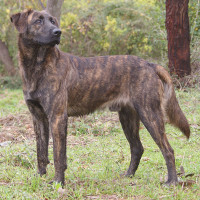
| A hardy, robust country dog. They are medium-length, eumetrical dogs. It is characterized by a short neck. In essence, the Corsican Dog is the versatile dog of yesteryear. It was originally a shepherd's dog and can still be used as such. Another common use is to search for and catch free-ranging animals such as pigs and cows. The decline in agro-pastoral activities has favored its use by hunters (wild boar, foxes, hares). |
Important proportions |
| The height of the chest is about half the height at the withers. Length from point of shoulder to point of buttock tends to be equal to height at withers. The length of the muzzle is approximately half the length of the head (47% on average). |
Behaviour / temperament |
| The Cursinu is docile, loyal and very attached to its master. It is a very proud dog. It is wary of strangers. Cursinus are intelligent, calm and well-balanced dogs, able to adapt to a wide range of situations. Quiet at home, they are lively and energetic in action. Extensive breeding meant that he didn't guide the whole herd, but brought back stray or recalcitrant animals. He hunts to windward, often to catch game; his chase is relatively short, one to two hours, accompanied by short, sharp barks. Users appreciate its spontaneous return to the release site. |
Head |
||
Cranial region |
||
Head |
The head belongs to the lupoid model defined by P. Megnin. | |
Skull |
The skull is roughly flat, with an average width at the zygomatic arches of around 10 cm in females and 11 cm in males. The lines of the skull and muzzle diverge towards the front. The profile of the muzzle is straight or slightly convex. The superciliary arches are slight to obliterated. |
|
Stop |
Slightly accentuated at an open angle of 150 to 160 degrees. | |
Facial region |
||
Nose |
Broad, black, open nostrils. | |
Muzzle |
Truncated pyramid shape, straight upper profile. Relatively thin muzzle. | |
Lips |
Thin, taut, close-fitting, well pigmented. The upper lip does not overlap the lower. | |
Cheeks |
Dry, muscular. | |
Eyes |
Oval, hazel to dark brown. Slightly oblique. | |
Ears |
Set mostly above the eye line, but sometimes level with it. They may be drooping or semi-drooping (broken into a V or folded pink). Triangular, of medium length, they can reach the inner corner of the eye when pulled forward. | |
Neck |
| Short, giving the impression of a "head tucked into shoulders". It is muscular and truncated. The skin is taut: there is no dewlap. |
Body |
||
Body |
Powerful, without excessive heaviness, straight topline. Harmonious underline. The belly is tucked up but not lifted. Short flanks. | |
Withers |
Broad and prominent. Slight neck attachment. | |
Back |
Straight profile and powerful musculature. | |
Loin |
Short. | |
Croup |
Slightly sloping, short and muscular. | |
Chest |
Broad and high. It does not descend below the point of the elbow: the understernal void is approximately equal to half the height at the withers. Ribs moderately rounded. | |
Tail |
| The whip is whole. It is long (tip below the hock) or of medium length (tip at hock level). It is always thick and well furnished with hair. At rest, it may be drooping or curled. In action, it curls over the back or croup, sometimes over the hip. The curl may be partial or total, extending to a tight ring, which is a sought-after shape. |
Limbs |
Forequarters |
||
Generality |
Regular legs and powerful muscles. | |
Shoulders |
Oblique and muscular. | |
Elbows |
Level with the lower part of the chest. | |
Forearm |
Vertical when viewed from the side and front. | |
Carpal |
Strong. | |
Pastern |
Moderately oblique. | |
Hindquarters |
||
Generality |
Regular legs, powerful muscles. Seen from behind, the hindquarters are vertical. | |
Upper thigh |
Moderately sloping, well muscled. | |
Lower thigh |
Long, moderately muscular. | |
Stifle |
Clean and in line with the body. | |
Metatarsus |
Seen in profile, almost vertical. | |
Hock |
Dry. The angle of the hock is suitably open. | |
Gait and movement |
| Regular and supple at walk and trot. The Cursinu's gallop is short, jerky and bouncy, perfectly suited to rugged terrain such as scrubland. |
Skin |
| Thick, adhering perfectly to the body. |
Coat |
||
Hair |
Well furnished, short to medium-length: some dogs have bangs. | |
Colour |
The color is most often brindle fawn; all shades of fawn exist. Charcoal fawn or sable and black with fawn or sable markings are also permitted, as is the presence of a mask. Limited variegation is permitted, with white patches on the chest and extremities of the legs. | |
Size and weight |
||
Height at withers |
For females, from 46 to 55 cm, including tolerance. For males, 46 to 58 cm, including tolerance. | |
Faults |
| • Any departure from the foregoing points should be considered a fault and the seriousness with which the fault should be regarded should be in exact proportion to its degree and its effect upon the health and welfare of the dog and its ability to perform its traditional work. • Faults listed should be in degree of seriousness. |
Disqualifying faults |
Apart from genetic faults, the following are considered eliminatory : Aggressive and timid dogs. Molossoid head. Short coat. Absence of tail. Aggressive and timid dogs. Molossoid head. Short coat. Absence of tail. |
NB : |
| • Any dog clearly showing physical or behavioural abnormalities shall be disqualified. • The above mentioned faults when occurring to a highly marked degree or frequently are disqualifying. • Male animals should have two apparently normal testicles fully descended into the scrotum. • Only functionally and clinically healthy dogs, with breed typical conformation should be used for breeding. |



 English (United Kingdom)

Comments