
 |
Greek Sheepdog |
|
He is not recognized by the F.C.I. |
Origin |
Greece | |
Translation |
Francis Vandersteen | |
This breed is also known as |
Hellenikos Poimenikos
|
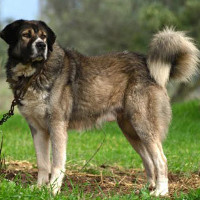
| The region known as the Foothills, located in Greece, is heavily populated by sheep. Centuries ago, migrants from Turkey probably brought their sheepdogs across the land, and the similarities between the Greek sheepdog and the Turkish Akbash dog suggest that such a derivation is likely. Years of breeding with local and semi-local stock produced the breed. The Greek Shepherd Dog is a medium-sized to large dog with a solid body and great physical strength, capable of escorting flocks and fighting enemies while maintaining physical superiority. Its head is massive. The skull is normally curved, with obvious hyperbrain arches, and is almost as wide as it is long. The muzzle and cheeks are broad and deep. It has scissors or a flat bite and is covered with fat and slightly loose lips. The skin is thick and covered with dense fur. Cropping of ears is not permitted, and dogs with cropped ears cannot be shown. The brown eyes are medium-sized, egg-shaped, set symmetrically in parallel lines from the oblong axon of the skull, with sufficient distance between them. On the oblique side of the head, their position is a little below the level of the muzzle, as if there were an imaginary line extended towards the skull. Darker shades are preferred. The eyelids should be tight without revealing their mucous membrane. This dog has a serious, penetrating, calm look about him. The chest should be broad and deep up to the elbows. The thorax is made up of arched ribs of medium curvature, set back sufficiently to leave room for the heart and lungs. The tail is thick at the base. Some have long tails, while others are short or tailless. The double coat is dense and abundant. Coat colors include black, gray-brown and white. The breed was never bred for color, but rather for a heavy skeleton, good muscle and a dense, semi-long to long coat. This herding dog is not a breed for the average pet owner. Proud and hard-working, they are natural guardians of sheep and goats, but never herd or lead them. Working in pairs, the dogs prefer to move to the sides of the flock, guarding against wolves and other predators. Greek Shepherd Dogs are independent working dogs, courageous, decisive and loyal, with a strong sense of duty and protective instincts towards animals and their environment. Naturally distrustful, loyal only to the chief shepherd, the Greek Shepherd can be characterized as the shepherd dog of the Great Mountain of Greece. The Greek Shepherd Dog is a herding dog used to guard livestock. This breed had to be strong, able to persecute in combat with the enemy and adaptable to difficult conditions. It does not tolerate violent behavior. It is extremely dominant and requires an owner with very strong leadership, one who understands its herding ways. When placed in a pack situation, this breed will seek to be a top dog through intense fighting. Suspicious but taciturn in the presence of strangers, it doesn't make friends easily. He may appear calm, but he's ready to protect at any cost at any time. When protecting his herd, he moves along the border, selecting places from which he can see a wide area. He is aggressive towards wild animals and able to repel them with his deep bark. If his deep bark doesn't drive them away, he'll chase the intruder and attack. Early socialization is essential if the dog is to be a trustworthy companion. He can be trained and tends to judge a situation before taking any action. This breed is best trained by an experienced handler who understands how to earn the dog's respect. The goal of training this dog is to achieve pack leader status. It's a natural instinct for a dog to have a command in his pack. When we humans live with dogs, we become their pack. The whole pack cooperates under one leader. Lines are clearly drawn and rules are defined. Because a dog communicates his displeasure by growling and finally biting, all other humans MUST be higher in the pecking order than the dog. Humans must be the ones making the decisions, not the dogs. This is the only way your relationship with your dog can be a complete success. This breed should not be driven to aggression. The Greek Shepherd Dog walks with a slow trot. When walking, the dog keeps its head low. This breed tends to mature slowly. Females have many puppies and are good mothers. They are usually in good health. This breed needs surface area. It is a robust dog with a good physique and a powerful muscular body. This breed is able to move around all day in difficult weather conditions, in inaccessible areas with minimal food and in the face of wild beasts that threaten herds by following and fighting them. Highly energetic and needs a variety of activities to keep him busy. Boredom will lead to destructive tendencies and excessive barking. When not actively working as a herdsman, they should be walked every day, where they are heeled beside or behind the person holding the lead, never in front, as instinct tells a dog that the leader is in the lead. and that leader must be the human. Regular brushing of the long double coat will keep it in good condition, but extra care is needed when the dog lets go of its dense undercoat. The outer layer won't felt unless there's a burr, foxtail or other external object sticking to the coat. This can be a problem for outdoor working dogs. Bathe or wash with shampoo only if necessary. Trim nails if necessary. This breed is a heavy seasonal excretor. Height at withers : Males 65 - 75 cm, females 60 - 68 cm. Weight : Males 38 - 50 kg, females 32 - 42 kg. |



 English (United Kingdom)

Comments