 |
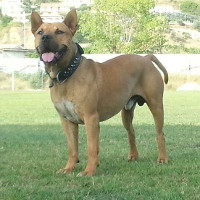
Italian Pardog |
|
He is not recognized by the F.C.I. |
Origin |
Italy | |
Translation |
Francis Vandersteen | |
This breed is also known as |
Pardogge Italiano |
| Pardog was born of the commitment and tenacity of a group of men whose common intention was to create a new breed of dog capable of coping with the Australian Dingo (wild dog), an ancient dog used for haunting, which returned to its natural state around 7-8 thousand years ago. The project and selection of this new breed came from the minds of two men: Luigi Langella, Neapolitan, with his innate interest and passion for dogs, and Frank V. Mannhaut, Australian, also a dog enthusiast and sheep breeder. He needed to deal with the numerous raids on his sheep, whose wool is invaluable, by the Australian Dingo. Consequently, the Pardog Project was born of necessity and carried out in 1985, a year in which all the steps to create a new breed of dog were analyzed and programmed, and which should have contained the excellence of a few breeds with the unambiguous aim of creating a dog capable of coping with the Australian Dingo. This ambitious project required the employment of two specialized workgroups, one in Italy and the other in Australia, which, with the help of state-of-the-art machinery, for 15 years launched the current breed of dog called "Pardog", a breed that can be considered excellent with regard to the Dingo problem. The dog breeds selected and used to breed the "Pardog" are listed below, and each of them has contributed with the particular characteristics of its own species : - The Neapolitan Mastiff, in particular the archaic type, 17% genetically used, contributed with its physical power, its deep, guttural growl (excellent deterrent against Dingo attacks), its determination (demonstrated against wild boar and bull attacks). but not least, its marked aptitude for guarding defined by the most cautious and silent, concrete and without alarmism. - The German Shepherd, 15% genetically used, considered a highly intelligent breed, very inclined to self-defense and the defense of men and sheep. - The Stafford Bull Terrier, 14% genetically used, has contributed with its courage and combativeness, and represents a very well-balanced dog, and under its muscular and bony aspect with a much better ratio than all other dog breeds. - The Bull Terrier, 16% genetically used, contributed his dynamism, sprint and speed, called the gladiator of dog breeds, his task being to instill his fighting spirit in Pardog. - The Dogo Argentino, 18% genetically used, contributed with its indifference to pain and the indomitable, combative personality that makes it incomparable and inimitable in big game coursing. - The Australian Dingo, 20% genetically used, a majority percentage that contributed with its decisive attack instinct, and thanks to its hardiness, it contributed to the new dog with a constitution capable of coping with alternating periods of heat and drought and cold and rain. The journey to arrive at Pardog was long and tiring, full of obstacles but also very satisfying, especially when from the mix of breeds some truly impeccable specimens emerged and were selected, in short a true champion, thus increasing, at best, each step evolution and improving more and more the genetic stock of the Pardog breed. |



 English (United Kingdom)

Comments