 |
Barbado da Terceira |
|
He is not recognized by the F.C.I. |
Origin |
Terceira Island, Azores, Portugal | |
Translation |
Francis Vandersteen | |
This breed is also known as |
Barbado
|
Usage |
| A driving dog par excellence, very agile and lively, herds and picks up cattle with great ease, also used in the handling of wild cattle. It is also very effectively used as a guard dog. Because of its pleasant character and ease of training, it also makes a good companion dog. |
Brief historical summary |
| With the beginning of colonization in the Azores islands, it was necessary to control and herd several species of introduced cattle. Several types of dog, including some used on the mainland to handle livestock, should already have arrived in the Azores. The Barbado probably evolved from dogs used to collect wild cattle brought by settlers since the 15th century. It should be borne in mind that over the next few centuries, many people traveling with their dogs to the islands will have decisively influenced today's Barbado. |
General appearance |
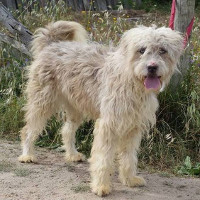
| Rustic, solid, well-muscled body, covered with long, abundant, wavy hair. |
Important proportions |
| Sublong (subdolicomorphic), body length slightly greater than height at withers. Skull length is slightly longer than muzzle length. |
Behaviour / temperament |
| Loyal companion to its owner, intelligent, easy to train, cheerful, docile and willing. |
Head |
||
Cranial region |
||
Head |
Strong, proportionate to the body. Upper longitudinal craniofacial axes parallel. Skull length slightly greater than muzzle length. | |
Skull |
Medium-sized, slightly curved. The frontal furrow begins approximately at the posterior third of the muzzle and continues to the middle of the skull. Supraciliary arches barely visible. Pronounced occipital protuberance. | |
Stop |
Barely defined. | |
Facial region |
||
Nose |
Large, cubic, straight. Well pigmented, black, brown admissible in yellows and whites. | |
Muzzle |
Strong, cylindrical and straight at the nasal bridge. Broad, with parallel sides. | |
Lips |
Firm, thick and well pigmented. No visible corners. | |
Jaws and teeth |
Jaws well developed. Canines strong, solid and well developed. Scissor bite or level bite. | |
Cheeks |
Lean, tight skin. | |
Eyes |
Medium-sized, semi-frontal, horizontal, oval-shaped, expressive and intelligent. Honey to dark brown. Well-pigmented eyelids. | |
Ears |
Set medium to high, triangular, medium size. Hanging, folded and hairy. They are very mobile and when attentive, they rise at the base and fold back. | |
Neck |
| Medium-sized, strong and well-muscled. Well set in the shoulders, carrying the head with dignity. |
Body |
||
Topline |
Straight and level. | |
Withers |
Broad, giving good connection between neck and topline. | |
Back |
Broad, supple and well muscled. | |
Loin |
Short and well placed in the croup. | |
Croup |
Strong and slightly sloping. | |
Chest |
Broad and deep, reaching to the elbows. | |
Ribs |
Well sprung, with good thoracic capacity. | |
Underline and belly |
Raised, with belly slightly tucked in. | |
Tail |
| Medium to low set. Cut at the third vertebra or medium-sized whole, without reaching the hock. At rest, it is immobile and curved at the lower tip. Lop-headed dogs are permissible. |
Limbs |
Forequarters |
||
Generality |
Vertical, broad-boned, well muscled and straight. | |
Shoulders |
Well developed and sloping. Scapula-humerus angle open. | |
Upper arm |
Strong, with elbows close to the body. | |
Forearm |
Vertical. | |
Carpal |
Strong. | |
Pastern |
Slightly sloping. | |
Forefeet |
Large and oval with well arched toes and thick, hard pads. Strong nails. | |
Hindquarters |
||
Generality |
Strong and well muscled. Well angulated, ensuring good propulsion. | |
Upper thigh |
Well developed and muscular. | |
Lower thigh |
Long and well developed. | |
Stifle |
Closed. | |
Metatarsus |
Strong, almost vertical, short. | |
Hock |
Strong. | |
Hind feet |
Tight, arched, slightly pronounced toes, sometimes with dewclaws. | |
Gait and movement |
| Agile movement with good propulsion, allowing sudden changes of direction and transition between gaits. Light walk and fast trot, good reach and suspension. The canter is energetic and fast. |
Skin |
| Thin, pigmented, taut. |
Coat |
||
Characteristics |
Long, dense, slightly wavy, neither straight nor curly, with abundant undercoat over the entire body. Working grooming is permissible, the coat can be evenly shortened and must be used in conformation dog shows. | |
Hair |
Strong, slightly thick but not hard. Dense on the whole head, muzzle and eyes, covering them. Abundant in the jaws, forming the beards that give the breed its name. Dense hair on limbs, including between the toes. Abundant on the tail to the tip. | |
Colour |
Yellow-gray, gray, black, fawn and wolf in pale, common and dark shades. May have white patches on hands and/or feet, pectorals, throat, neck (forming a collar), chest, belly and tip of tail. | |
Size and weight |
||
Height at withers |
Males : 52 to 58 cm, females : 48 to 54 cm. | |
Weight |
Males : 25 to 30 kg, females : 21 to 26 kg. | |
Faults |
| • Any departure from the foregoing points should be considered a fault and the seriousness with which the fault should be regarded should be in exact proportion to its degree and its effect upon the health and welfare of the dog and its ability to perform its traditional work. • Faults listed should be in degree of seriousness. |
Serious faults |
 Marbled nose. Narrow, pointed muzzle. Soft coat without undercoat. White patches outside the limits set by the standard. Excessive height (over 60 cm) or too low (under 48 cm). Movements without reach or propulsion. Marbled nose. Narrow, pointed muzzle. Soft coat without undercoat. White patches outside the limits set by the standard. Excessive height (over 60 cm) or too low (under 48 cm). Movements without reach or propulsion. |
Disqualifying faults |
| Shyness or aggressiveness. Jaws pulled or protruding. Partially or completely blue eyes. Brown or blackbird coat. |
NB : |
| • Any dog clearly showing physical or behavioural abnormalities shall be disqualified. • The above mentioned faults when occurring to a highly marked degree or frequently are disqualifying. • Male animals should have two apparently normal testicles fully descended into the scrotum. • Only functionally and clinically healthy dogs, with breed typical conformation should be used for breeding. |



 English (United Kingdom)

Comments