 |
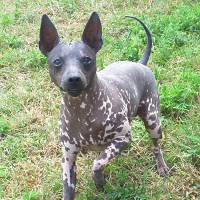
American Hairless Terrier |
|
He is not recognized by the F.C.I. |
Origin |
U.S.A. | |
Translation |
Francis Vandersteen |
Brief historical summary |
| The American Hairless Terrier traces its origins back to a crossbred terrier called the Feist, which was imported from Europe to North America in the 18th century. In the late 1800s, the Rat Terrier dog breed was developed by crossing the Feist with lines of Beagle, Italian Greyhound and Miniature Pinscher. The precise breed of American Hairless Terrier began in 1972 with the birth of a naked puppy, named Josephine, in a litter of Rat Terriers in Louisiana, U.S.A. Owners Edwin and Willie Scott had liked the puppy's looks and character, and when the bitch was old enough to breed, they gave her a litter in the hope that she would pass on her bare-coat gene to her puppies. In the end, they succeeded. A litter born in 1981 became the foundation of the breed. It was recognized on January 1, 2004 by the United Kennel Club, which considers the AHT a separate terrier breed. |
General appearance |
| Very muscular, active. |
Important proportions |
| The preferred ratio of body length (buttock tip prosternum) to height (withers to ground) is 10:09. |
Behaviour / temperament |
| This energetic, alert dog's curiosity and intelligence make it very easy to train. Their ancestors were bred to hunt. The absence of hair makes the naked variety unsuitable for hunting, but both varieties have retained a strong hunting instinct and the dogs are fearless, tenacious hunters with boundless energy. They are exceptional companions, cohabiting easily with children, other dogs and even cats. They love human company and enthusiastically share any activity with their owners. Naked dogs need protection from the sun in summer and from the cold in winter. |
Head |
||
Cranial region |
||
Head |
The head is broad, slightly domed, wedge-shaped and proportionate to the size of the body. | |
Skull |
Viewed from the side, the skull and muzzle are of equal length, joined by a moderate stop. The skull is broad and slightly domed. It tapers slightly towards the snout. | |
Facial region |
||
Nose |
The nose is black or single-colored. | |
Muzzle |
The muzzle is well filled out under the eyes, well chiseled, with light rings from stop to nose. | |
Lips |
Lips are dry and tight, with no whisker pads. | |
Jaws and teeth |
The jaws are powerful and set well back, enabling the dog to open its mouth wide enough to catch rats and other rodents. The teeth must be complete, of good size, evenly spaced and white. A scissor arrangement is preferred, but a variation in level is acceptable. | |
Eyes |
Lemon-shaped, large, open and expressive. All colors are accepted in keeping with the coat. Eyes may be of any color in the hairy variety. | |
Ears |
The ears are V-shaped, set outside the edges of the skull. Straight ears are preferred, but button ears are acceptable. Dogs under one year of age are not penalized for ear variations. | |
Neck |
| The neck is clean, of medium length, well muscled and slightly arched. The attachment is harmonious and well placed, behind the shoulders. |
Body |
||
Body |
The body is slightly longer (measured from prosternum to point of buttocks) than high (measured from withers to ground), and the length of the foreleg (measured from point of elbow to ground) should be about half the height of the dog. | |
Topline |
If the dog is standing or moving, the topline is solid and level. The loin is moderately short, slightly arched, and muscular, moderately tucked up. | |
Croup |
The croup is slightly sloping. | |
Chest |
The ribcage extends just below the elbow. Viewed from the front, the chest between the front legs is well filled and moderately broad. | |
Ribs |
The ribs extend well back and are well sprung from the spine, forming a broad back, then curving downward and inward to form a deep body. | |
Side |
Viewed from the side, the chest extends in a shallow oval shape in front of the front legs. | |
Tail |
| The tail is attached at the end of the croup. The natural tail is thick at the base, tapering to the tip. When the dog is attentive, the tail is carried in an upward curve. When relaxed, the tail can be carried directly behind the dog. Hairy dogs may have their tail docked. If so, the cut should be between the second tail joint and the third. |
Limbs |
Forequarters |
||
Generality |
The legs are equal in length to the shoulder blade and at right angles to the body. Viewed from any angle, the limbs are straight, strong and robust. | |
Shoulders |
The shoulders are muscular but not excessively so. The shoulder blades are well sloped, the shoulders fairly close together at the withers. | |
Hindquarters |
||
Generality |
The hind legs are muscular, the length of the lower and upper thighs being more or less equal. The angulation of the hindquarters is in balance with the angulation of the front. | |
Stifle |
The stifles are well folded. | |
Metatarsus |
When the dog is standing, the metatarsals are perpendicular to the ground and, seen from behind, parallel to each other. | |
Hock |
The hocks are well let down. | |
Feet |
| The feet are compact and slightly oval. The two middle toes are slightly longer than the other toes. Toes can be well separated but not flat or sunken. Rear dewclaws should be absent. |
Coat |
||
Characteristics |
There is a hairy variety and a naked variety. | |
Size and weight |
||
Height at withers |
Height varies from 25 to 46 cm (Note: the height standard was updated on 26/07/06). | |
Faults |
| • Any departure from the foregoing points should be considered a fault and the seriousness with which the fault should be regarded should be in exact proportion to its degree and its effect upon the health and welfare of the dog and its ability to perform its traditional work. • Faults listed should be in degree of seriousness. |
General faults |
 Stop too abrupt. Whistling muzzle. Missing teeth. Overshot or undershot mouth. Ears straight with sides curved inward like petals. Flat feet. Feet set wide apart. Rear pasterns present. Stop too abrupt. Whistling muzzle. Missing teeth. Overshot or undershot mouth. Ears straight with sides curved inward like petals. Flat feet. Feet set wide apart. Rear pasterns present. |
Serious faults |
| Apple-shaped head. (hairless variety) : a down of more than 1mm on a dog over six months old. |
Disqualifying faults |
| Aggressive or timid dog. Hanging ears. |
NB : |
| • Any dog clearly showing physical or behavioural abnormalities shall be disqualified. • The above mentioned faults when occurring to a highly marked degree or frequently are disqualifying. • Male animals should have two apparently normal testicles fully descended into the scrotum. • Only functionally and clinically healthy dogs, with breed typical conformation should be used for breeding. |



 English (United Kingdom)

Comments